
Insights/7xAI Executive Report
Highlights: Economics, workflows, and AI accountability
A weekly report on AI developments, emerging risks, & insights: frontier and open models, enterprise deployment, agents, infrastructure, & governance.
Charles Braswell · September 29, 2026
Executive Summary
This week's developments suggest that enterprise AI is entering a new phase of maturity. Access to capable models is no longer the primary challenge. Organizations now face different decisions about model economics, workflow redesign, operational governance, infrastructure strategy, and accountability for increasingly autonomous systems.
Across the frontier-model market, competition is expanding beyond benchmark performance and into the operating environments that govern how intelligence is consumed. Frontier model providers continue to compete on capability, while platform providers increasingly compete on routing, governance, workflow integration, and cost control. As model quality improves and pricing declines, the ability to route the right work to the right model under the right controls is becoming a greater source of value than model selection alone.
The open-weight ecosystem highlights a related shift. As model performance converges across providers, discussions are increasingly focused on ownership, economics, and containment. Organizations are reassessing whether renting intelligence remains the most sustainable operating model for high-volume AI workloads. At the same time, the growing availability of downloadable models is prompting leaders to rethink governance, supplier risk, and operational accountability.
Enterprise AI adoption is also evolving beyond deployment. Organizations reporting the strongest outcomes are not simply adding AI to existing processes. They are redesigning workflows, assigning ownership, involving operators, and investing in the data foundations needed to support production use. Measurable value increasingly stems from operating-model transformation rather than technology implementation alone.
Agentic AI introduces a parallel challenge. As agents move from demonstrations to production environments, orchestration, monitoring, memory management, lineage, and trust become as important as model capability. Reliable execution now depends on a broader stack that includes not only reasoning models but also the systems that manage information, cost, governance, and accountability.
Integration architecture is emerging as a critical control layer. Connectors, harnesses, gateways, and review surfaces increasingly determine both capability and risk. Connecting an agent to enterprise systems creates value but also introduces governance requirements that must be actively managed. Organizations are beginning to recognize that access and trust are inseparable aspects of the same design decision.
Infrastructure discussions are following a similar pattern. AI is no longer confined to centralized cloud environments. Intelligence is increasingly distributed across devices, private environments, public clouds, and specialized infrastructure providers. Decisions about where workloads run, where data resides, and who owns operational responsibility are becoming strategic business considerations rather than technical implementation details.
Finally, governance discussions are increasingly focused on the systems themselves. Agentic AI, autonomous workflows, and long-running processes require monitoring, auditability, oversight, and verification mechanisms that go beyond policies and principles. Governance increasingly depends on understanding how AI operates in practice, not how it is expected to behave in theory.
Deep Research
1. Frontier Models
This week's releases highlight how quickly the frontier-model market is evolving beyond a benchmark competition. SpaceXAI, Anthropic, and OpenAI introduced new models with different approaches to capability, efficiency, and pricing. Microsoft focused instead on the surfaces through which those models will be consumed inside the enterprise.
The market is beginning to separate capability from execution. Model providers continue to compete on performance, pricing, and benchmark results. Platform providers increasingly compete on routing, governance, workflow integration, and control over where intelligence enters work. As model access becomes easier to obtain, those operating layers are becoming more important sources of differentiation.
SpaceXAI's release of Grok 4.7 reflects one approach to that transition. The company maintained Grok 4.6 pricing while reporting gains in coding performance, long-horizon knowledge work, multi-hour task execution, and benchmark performance across CursorBench, Terminal-Bench, AA Briefcase, GDPval, and related evaluations. The release combines a larger base model, a longer reinforcement-learning cycle, deeper integration with the Grok Bot harness, and additional self-verification behaviors designed to improve reliability on extended tasks.
The benchmark improvements are notable, but the more important signal is the economic argument behind the release. SpaceXAI is trying to do more work within the same pricing structure. The value proposition is not simply higher benchmark performance. It claims it can complete more difficult tasks before requiring human intervention, while staying within the existing spend envelope.
Anthropic's release highlights a different strategy for competing in the same market. Rather than maintaining pricing while increasing capability, the company is attempting to improve performance and workload economics at the same time.
Claude Opus 5.5 lowers pricing relative to Opus 5 while improving performance across several coding and agentic evaluations published by Anthropic. The company also reduced cache-read and cache-write costs and emphasized workload efficiency alongside capability. Early users cited by Anthropic reported significant reductions in migration effort, remediation time, and total token consumption compared with prior generations. Internal testing and customer examples suggest that execution efficiency is becoming a meaningful source of competitive advantage, particularly for organizations running large migrations, long-running coding workflows, or agent-driven development tasks.
Those examples come from Anthropic and selected customers and should be treated as directional signals rather than independent validation. They nevertheless reinforce an important shift in how enterprise buyers evaluate frontier models. Retries, execution efficiency, context retention, and the amount of human intervention required to complete a task increasingly influence total workload cost. Organizations may purchase intelligence through token pricing, but they ultimately consume it through completed work.
OpenAI's release expands that discussion beyond a single frontier-model tier. Sol and Luna introduce additional pricing and capability levels that allow organizations to align model cost more closely with task complexity.
Sol enters the market at approximately half the base price of Opus 5.5, while Luna targets extraction, summarization, and lower-complexity workloads at substantially lower cost. GPT-6 Astra remains OpenAI's highest-capability tier. Rather than positioning a single model for every use case, OpenAI is creating a broader set of routing options that span frontier reasoning, operational workloads, and high-volume execution. As a result, model selection increasingly becomes a workload-allocation decision.
High-volume operational work may justify lower-cost models, while ambiguous reasoning, complex coding, and long-running agent workflows may justify higher-capability systems. The resulting economics depend less on nominal token pricing and more on the total cost of completing the work. A lower-cost model can still become the more expensive option if it retries repeatedly, loses context, or needs additional human review before completing a task.
That same shift helps explain the significance of Microsoft's announcement.
Microsoft is not competing directly for frontier-model leadership. Instead, it is expanding the operating layer through which enterprise users consume AI. Home, Code, and Autopilot introduce new surfaces for interacting with intelligence inside the tenant. Managed Runtime creates a hosted environment for applications and long-running agents, while Agent 365 expands the governance, routing, and spend-management controls surrounding those workloads.
Most discussions about frontier AI still center on the model. Enterprise deployments, however, rarely struggle because a model answered a question incorrectly. They struggle when costs become unpredictable, workflows break, data cannot be governed, or no one can explain why a particular model was selected for a particular task. Microsoft's latest Copilot expansion targets that operating layer directly. Home, Code, and Autopilot are not simply new interfaces. They control where intelligence is applied, what data it can access, how it is governed, and what it costs to operate at scale.
As a result, model providers and platform providers are increasingly competing in different parts of the stack. Grok 4.7, Opus 5.5, Sol, Luna, Astra, and future frontier systems continue competing on capability, speed, and cost. Microsoft is increasingly competing on workflow ownership, tenant runtime, governance controls, and the routing decisions that determine which model reaches a user in the first place. A user entering work through Home, Code, Chat, Office, or Autopilot may never explicitly select a model because that decision increasingly becomes part of a policy framework governed by performance requirements, budget constraints, and administrative controls.
None of this week's announcements provides a controlled comparison of Grok 4.7, Opus 5.5, and Sol on identical workloads under the same operating conditions. Vendor benchmarks and customer examples remain useful signals about what should be measured, but they are not substitutes for internal evaluation. Organizations evaluating frontier systems should focus on production workloads and measure completion rates, retries, token consumption, cache utilization, latency, and human intervention because those metrics increasingly determine whether a model creates operational value after it leaves the benchmark.
As model pricing continues to fall and capability continues to rise, differentiation is gradually moving into the systems that decide which model is used, what work it performs, and what controls govern that work. Organizations creating the most value from frontier AI are not necessarily selecting a single winning model. They are building systems that consistently direct the right work to the right model under the right controls.
Sources
Anthropic Claude Opus 5.5 and GPT-6 Sol pricing
Microsoft Copilot Home, Code, and Autopilot
2. Open Weight-Open Source Models
This week's developments show how quickly the open-weight market is evolving beyond discussions of model capability. Application providers are reassessing the economics of renting intelligence from frontier-model companies. Chinese models continue to gain share in production environments. New entrants are driving down inference costs, while infrastructure vendors are investing in containment and control layers for increasingly autonomous systems.
The conversation is gradually shifting from model performance to model ownership, encouraging the audience to feel confident in their strategic choices as control over economics and the environment becomes crucial. For founders and business leaders, as this transition unfolds, now is a good time to assess current AI model dependencies and consider the potential benefits of open-weight alternatives. Reviewing contracts, evaluating internal capabilities for model training or fine-tuning, and exploring operational models that enhance cost control and autonomy can help organizations position themselves for stronger long-term outcomes. To take immediate action, founders and business leaders can follow this checklist:
Audit current AI model dependencies and inventory all third-party models in use
Review and renegotiate contracts with existing model providers where possible
Pilot open-weight models to evaluate operational and economic impact
Assess internal capabilities for training, fine-tuning, and deploying proprietary or open-weight models
Identify opportunities to increase cost control and autonomy in your AI stack
Consider operational risks and regulatory requirements associated with model ownership
By working through these steps, organizations can make informed, resilient decisions as the AI landscape evolves.
One of the clearest signals came from AI application providers reconsidering their dependence on rented intelligence. The Next Web reported that several startups have begun building or post-training their own models after usage-based pricing from frontier-model providers compressed margins. Harvey, a legal AI company valued at approximately $15.6 billion, became one of the most visible examples after reports that a March agent update increased token consumption roughly twentyfold and pushed gross margins from about 50% into negative territory. Profitability reportedly improved following the introduction of an internally developed model built on Moonshot's Kimi K3.
Harvey is unlikely to be the last company to encounter that situation.
Agentic systems can create substantial customer value while dramatically increasing model consumption. Once AI spending becomes a meaningful component of cost of goods sold, model ownership, post-training, and routing decisions begin to influence operating margins, not just technical architecture. For founders deciding whether to own or rent models, approach the analysis systematically.
A practical decision framework should consider the following key criteria: total cost of ownership, including both upfront and ongoing expenses; control over data and model deployment; scalability and performance needs as usage grows; flexibility to fine-tune or customize models for evolving requirements; internal operational capabilities and technical talent; and security or regulatory considerations relevant to your sector. By weighing these factors, organizations can assess whether owning or renting best aligns with their risk tolerance, desired pace of innovation, and long-term business goals. Recent examples show there is no single answer.
Abridge, an AI platform focused on clinical documentation and healthcare workflows, is building on Nvidia's open weights. Decagon, which develops AI-powered customer support and service agents, reportedly routes most customer interactions through internally controlled models. Ramp, the financial operations and expense-management platform, is evaluating model training for the first time. These companies operate in very different industries, yet they are responding to the same economic pressure. What began as an infrastructure decision is increasingly becoming a business-model decision.
The economics become even more complicated as model capability spreads across a broader group of providers.
CNBC reported that Chinese models accounted for 57% to 67% of tokens processed through OpenRouter during the week of September 14 and about 55% of tokens processed through Vercel in August. OpenRouter is a model-routing platform that lets developers access and switch among multiple model providers through a single gateway. Vercel is a cloud application platform widely used to build and deploy AI-powered applications. Earlier in the year, Chinese models accounted for only 6% to 13% of OpenRouter tokens in February and roughly 11% of Vercel tokens in January. Companies cited improvements in coding, reasoning, and agentic workloads, along with lower operating costs, as drivers of the shift.
Once a model reaches the quality threshold, organizations often optimize for economics, which can help them manage operational risks and dependencies effectively.
NaiveAI's release of Naive-N0.5-Flash illustrates how aggressively the open-weight market continues to compete on efficiency. The company introduced a 309-billion-parameter mixture-of-experts model with 15.5 billion active parameters, MIT-licensed weights, a native one-million-token context window, and pricing well below most frontier-model offerings. The company also emphasized inference speed, throughput, and infrastructure efficiency rather than benchmark leadership alone.
For many organizations, releases such as Naive-N0.5-Flash matter less for introducing another capable model and more for lowering the cost of operating one. Every reduction in inference cost, deployment complexity, or hardware requirements expands the range of workloads that become economically viable to automate. The steady decline in operating costs is making open-weight models practical for a growing set of production environments that were uneconomic just a year ago.
As open-weight adoption grows, however, the discussion is expanding beyond ownership and economics to include containment.
WIRED reported that Nvidia has moved OpenShell to general availability and introduced Sentry, a BlueField DPU-based monitoring capability that observes and quarantines agents that move outside designated operating boundaries. Partners include Anthropic, Microsoft, JPMorgan Chase, and other participants in the Open Agent Safety Platform ecosystem.
Organizations are increasingly evaluating containment, monitoring, and boundary enforcement, which should help them feel more secure about deploying AI in complex environments. Founders and business leaders can take several practical steps to implement effective containment and monitoring. These include establishing clear operational boundaries for models and agents, deploying agent monitors to track unusual actions or resource usage, and configuring automated alerts for activities that exceed predefined thresholds. Implementing robust access controls, conducting periodic system audits, and maintaining detailed logs can also help organizations quickly detect and address unexpected behavior. Additionally, integrating incident response protocols and regularly updating containment policies based on evolving risks can further strengthen operational security.
The same organizations that spent the past two years evaluating models are now being asked to assess containment layers, runtime environments, identity controls, and operational boundaries. As agents gain the ability to take actions rather than generate responses, the surrounding systems become increasingly important.
This week's developments suggest the market is gradually separating three decisions that were once treated as one. Selecting a model, determining who owns its economics, and determining who owns the environment in which it operates are becoming distinct architectural decisions with different business implications.
A closed model can become uneconomic as usage grows, but unclear operational ownership can create governance challenges. Running a capable model in an uncontrolled environment can introduce risks, such as non-compliance, security breaches, or system failures, that could outweigh cost savings.
As model performance continues to converge across providers, competitive advantage is increasingly moving into ownership, routing, and containment rather than the weights themselves.
The organizations that create the most value from open-weight AI are not simply choosing cheaper models. They are building sustainable economics around those models and establishing the operational boundaries needed to run them safely at scale. For example, companies like Harvey have significantly improved their profitability by shifting to an internally developed open-weight model that aligns with their cost structure and operational needs. Similarly, Abridge’s adoption of open-weight models, paired with strong containment measures, has enabled secure, efficient AI deployment in sensitive healthcare settings. These examples show how thoughtful ownership and robust controls can translate into a lasting competitive advantage.
Sources
Startup model costs and open-weight shift
Chinese model adoption on OpenRouter and Vercel
Naive-N0.5-Flash research release
Nvidia Open Agent Safety Platform
3. Enterprise AI
Enterprise AI programs are entering a new phase of adoption, with easier model access and AI assistants becoming standard, marking a shift from experimentation to strategic integration. This progression underscores the importance of redesigning work to achieve measurable business outcomes, as recent developments from Microsoft, McKinsey, Toyota, DBS, and Novartis point to value emerging from operating-model change rather than technology adoption alone.
Microsoft's Kathleen Hogan explained that licensing Copilot to more than 200,000 employees led to periods of plateaued usage until teams redesigned workflows around specific business goals, such as pipeline management and customer preparation. This shift, emphasizing workflow redesign, was key to accelerating adoption and achieving tangible results, including reducing planning-cycle time from roughly 10 days to less than 2.5 business days, underscoring the critical role of operational change.
Those examples matter because they focus less on AI itself and more on the work around it. Many organizations continue to measure success by prompts, licenses, and seat counts. Microsoft's experience suggests that those metrics become meaningful when tied to workflow redesign and measurable operating outcomes. The cloud supply-chain program focused on known bottlenecks, clear owners, and specific planning processes. As a result, time-to-explanation reportedly fell from several days to hours for many investigations, with some completed in less than twenty minutes.
The same pattern appeared in McKinsey's discussion with WIRED. Dan Swan argued that many organizations continue to launch isolated AI use cases that never deliver measurable financial impact because they remain disconnected from core operating processes. Toyota approached the problem differently. A question about visibility across a supply chain producing roughly 2.5 million vehicles led the company to build a digital twin that can process about one billion decisions in fifteen minutes. McKinsey attributed roughly $800 million in value to improvements in throughput and placement.
The pattern of beginning with a business constraint rather than a model highlights the importance of problem-driven approaches. For example, a retail company facing high product return rates identified unclear sizing information as a core constraint affecting profitability. By focusing on this specific constraint, the company introduced an AI-powered recommendation engine that analyzed previous return data and customer feedback to suggest more accurate product sizes at checkout. This targeted initiative reduced return rates by 18% within six months and improved customer satisfaction scores. Organizations that focus on real business issues in this way are more likely to feel confident that their AI efforts will deliver measurable value and purpose.
Many organizations build systems and then hand them to operators, but involving operators in design and implementation fosters collaboration and ownership. Practical ways to do this include organizing cross-functional workshops where operators can share insights and feedback, running pilot programs that let frontline teams test new workflows, and holding regular touchpoints for review and iteration. When operators help shape workflows before deployment, they feel valued and engaged, leading to better results.
Novartis illustrates the same approach at the data layer.
Christian Diehl described data42, a platform built over nearly a decade and now containing information from more than 3,000 clinical trials. The original goal was to improve the connection between preclinical and clinical research by combining internal and external datasets. That foundation now supports broader AI initiatives across the company.
data42's significance isn't its size. It is the acknowledgment that enterprise AI depends on governed access to trusted information. Diehl's observation that "cool does not scale" captures a challenge many organizations are beginning to face. Demonstrations can tolerate fragmented data, unclear ownership, and limited governance. Production systems cannot. Successful enterprise AI requires specific data governance actions to ensure integrity and trust. These steps include assigning clear data owners accountable for critical datasets, establishing robust audit trails to track changes and access, maintaining detailed data lineage documentation, and setting up role-based access controls. In regulated sectors, it is especially important to have policies for periodic data review and validation. Agents require defined access rights, traceability, lineage, and auditability, especially in industries where regulators, auditors, or health authorities may later review decisions.
Microsoft, Toyota, DBS, and Novartis operate in different industries and face distinct constraints, yet their experiences point to a consistent pattern. Value emerges when a business process with existing financial significance is redesigned around AI, ownership is clearly assigned, operators participate in implementation, and the underlying data is governed well enough to support production use.
These efforts increasingly resemble operating-model transformations rather than technology deployments.
Organizations evaluating enterprise AI initiatives may benefit from focusing less on adoption metrics and more on workflow economics. Seat counts, prompts, and tool usage offer useful activity measures, but the outcomes that ultimately matter often appear elsewhere: shorter cycle times, faster decisions, greater throughput, improved service levels, reduced friction, and higher-quality execution. Leaders can measure these business outcomes by establishing baseline performance metrics before implementation and tracking changes over time against specific business indicators tied to the redesigned workflow. For example, organizations may use dashboards to monitor average turnaround times, error rates, throughput per employee, or customer satisfaction scores before and after AI-driven changes. By defining a small set of relevant operational KPIs at the outset and collecting regular team feedback, organizations can ensure AI investments tie to tangible improvements in business performance.
As access to intelligence becomes easier, the constraint is gradually shifting toward the organization's ability to redesign work around it. The companies creating the most value are not necessarily deploying more AI. They are changing how the business operates once AI is part of the process.
Sources
Microsoft Customer Zero AI transformation
McKinsey and WIRED AI playbook
Novartis data42 and scaling beyond demos
4. Agentic AI
Agent development is gradually shifting from a capability problem to an operational one. Most organizations now have access to models that can reason, use tools, and interact with enterprise systems. The challenge is increasingly less about whether agents can perform useful work and more about how they operate once in production. This week's developments from Microsoft Foundry, TypeSafe AI's Jev framework, and QuantumBlack, AI by McKinsey illustrate a common theme: agent performance increasingly depends on orchestration, economics, and trust rather than model capability alone. To respond, enterprise leaders should review and update operational processes to support agents in production. Practical next steps include evaluating current workflows to identify potential inefficiencies, investing in orchestration and monitoring tools, and establishing governance for tool use, memory management, and data traceability. Leaders should also consider pilot projects focused on end-to-end agent performance in real business scenarios, ensuring an early focus on both efficiency and trust as models are deployed at scale.
Microsoft expanded Foundry to host GPT-6 Sol, GPT-6 Luna, and Claude Opus 5.5 within a common agent runtime, while extending support for voice agents across more than 80 languages and 140 locales. Long-running agents can continue operating after a user disconnects and resume from checkpoints rather than restarting workflows from the beginning. Microsoft also reported substantial reductions in token consumption when agents used Toolboxes to identify and load only the tools required for a task, rather than injecting entire tool catalogs into context. For enterprises, these improvements have a direct business impact: reduced token consumption lowers operating costs, while more resilient, efficient workflow management reduces downtime and improves user experiences. Supporting a diverse range of languages and ensuring session continuity helps enterprises deliver consistent, reliable service at scale, unlocking cost and productivity benefits in real-world operations.
Those improvements address a challenge that becomes apparent as agents move from demonstrations to production environments. Early deployments often focus on what an agent can do, while production deployments focus on how efficiently it does it. Tool selection, memory management, session continuity, and context handling increasingly determine whether an agent can operate economically over extended periods. As workflow duration increases, the supporting systems around the model begin to matter as much as the model itself.
TypeSafe's Jev framework offers a practical example of the cost and orchestration challenges that arise as agents become more autonomous. The authors show how costs can rise when workflows repeatedly retrieve information, pass tasks among specialized models, or sustain long-running conversations that accumulate increasing context over time. To mitigate these challenges, organizations can adopt strategies such as optimizing retrieval to reduce redundant data calls, implementing intelligent caching, and using session management to limit unnecessary context accumulation. Additionally, designing workflows that minimize handoffs between models and monitor cost hotspots can help control complexity and keep operating expenses more predictable.
The framework highlights a reality that many organizations are only beginning to grapple with. Model pricing is only one component of agent economics. Context management, memory strategies, retrieval patterns, routing decisions, and orchestration logic can all influence the total cost of completing a workflow. A workflow that appears inexpensive at the model level can become significantly more expensive at the session level when information must be repeatedly reloaded, transferred between agents, or reprocessed over an extended interaction.
As organizations deploy more long-running workflows, these architectural decisions matter more. The economics of agentic systems often depend less on the individual model chosen and more on how effectively the surrounding environment manages information, tools, and state over time.
QuantumBlack's AI4DL initiative uses AI to automate data lineage, helping organizations understand where critical data originates, how it moves across systems, which transformations are applied, and where it is ultimately consumed. The goal is to improve traceability, trust, and auditability across complex enterprise environments. However, organizations considering adoption typically need prerequisites such as a unified data infrastructure, established metadata management practices, and integration with existing data processing and analytics systems. Integration can pose challenges, including aligning lineage frameworks with diverse and sometimes fragmented legacy architectures, ensuring secure and compliant access across data sources, and establishing standardized processes for tracking data movement and transformations. Addressing these factors early helps ensure that data lineage solutions are practical, scalable, and capable of delivering the intended operational and compliance benefits.
That challenge intensifies as agents assume larger roles in operational workflows. An agent can be trusted to make decisions only if the data supporting those decisions is also trustworthy. Lineage, traceability, ownership, and validation therefore become operational requirements rather than governance enhancements. QuantumBlack's examples show how organizations are making underlying data relationships more visible, auditable, and scalable as AI systems interact with increasingly complex enterprise environments.
Viewed together, these developments signal the emergence of a broader enterprise stack for agentic systems. Models provide reasoning capabilities, orchestration frameworks manage context, memory, tools, and cost, and data foundations provide traceability and trust. A weakness in any layer can limit the value of the others because capable agents still depend on reliable information, efficient execution, and governed operating environments.
Organizations evaluating agent initiatives should therefore assess more than model performance. Long-running workflows depend on context management, routing policies, tool governance, lineage, and the ability to reconstruct how an outcome was produced. As agent deployments expand across business functions, those supporting systems increasingly determine whether an agent remains reliable, economical, and trustworthy in production. To support decision-making, leaders can apply concrete evaluation criteria when assessing their agentic AI stack:
Does the system efficiently manage and retain relevant context throughout long-running workflows?
Do clear routing and orchestration policies ensure tasks are assigned to the right agents or models?
Is tool use governed to prevent unnecessary operations and cost escalations?
Can you establish data lineage and provenance for all inputs and outputs to support auditability and trust?
Are there monitoring systems in place to track cost, performance, and potential bottlenecks during operation?
Can stakeholders reconstruct and explain how key outcomes or decisions were reached across the workflow?
Using these questions as a checklist helps organizations identify strengths and weaknesses in their agentic AI operations, leading to more robust and reliable deployments.
The companies creating the most value from agentic AI are not necessarily deploying more capable models. They are building the operational foundations that enable those capabilities to run consistently, efficiently, and with the trust required for enterprise use.
Sources
Microsoft Foundry agent platform
QuantumBlack on enterprise data lineage
5. Integrations, Harnesses and Connectivity
As enterprise AI systems become more tightly integrated with data sources, applications, and business processes, organizations are increasingly compelled to govern the layers between the model and the work itself. Connectors determine what an agent can access. Harnesses determine how that access is used. Review surfaces determine how outcomes are evaluated. This week's developments from the Coalition for SecureAI and LangChain illustrate how quickly those layers are becoming operational control points rather than implementation details.
The Coalition for Secure AI (CoSAI) released MCP Security version 2.0 following changes introduced in the July 2026 Model Context Protocol specification. The update moves beyond the original threat taxonomy. It introduces a framework based on four cumulative assurance levels, intended to align security requirements with the sensitivity of the data and systems an agent can access. These assurance levels range from basic safeguards for low-risk environments up to advanced requirements for highly sensitive data and mission-critical systems. For example, Level 1 covers foundational controls such as authentication and basic logging, while Level 2 introduces enhanced authorization and data protection measures. Level 3 requires in-depth auditability, workload identity validation, and real-time Policy enforcement. Level 4 applies to the most sensitive contexts, mandating sender-constrained tokens, dedicated gateways, and comprehensive monitoring. This structure helps organizations quickly map their risk profiles to appropriate security requirements.
The shift reflects how MCP adoption is evolving. Early deployments focused primarily on enabling connectivity among models, tools, and enterprise systems. As those deployments move closer to production workloads, attention is shifting toward governance. A local development server processing test data poses a different risk than an agent accessing regulated health records or production financial systems. Version 2.0 aims to create a common language for making those distinctions by aligning security requirements with data sensitivity, business impact, and operational exposure.
The framework becomes more demanding as risk increases. Higher assurance levels introduce requirements for sender-constrained tokens, workload identity validation, authorization controls, auditability, and dedicated gateways that can enforce policy. The principle is straightforward: connectivity should not determine trust. Trust should be earned through controls appropriate to the systems and data being accessed.
The release also reflects a broader architectural shift after removing protocol-level sessions from MCP. Identity, authorization, and state management now require more explicit handling because every request must stand on its own. Agent gateways, token validation, policy enforcement, and audit logging are increasingly becoming core components of the integration architecture rather than optional security enhancements. To support a smooth migration from session-based to stateless architectures, organizations should start by identifying where legacy session management occurs, assessing which workflows rely on persistent state, and developing a phased approach to replacing session tracking with request-level identity and policy enforcement. Engaging security and compliance teams early can help ensure new controls meet both regulatory requirements and operational needs.
LangChain's release of LangSmith Custom Apps addresses a different control challenge.
The company introduced capabilities that let teams build and publish custom review interfaces directly on LangSmith data, without exporting traces to separate applications or spreadsheets. Teams can create interfaces for annotation, experiment comparison, and trace review, and tailor each to the needs of specific roles. For example, engineers can access granular tool-call traces and system-level details; business analysts can see summary metrics and key outputs; and compliance teams can view audit trails and policy adherence. This approach ensures each stakeholder has access to the information and controls appropriate to their responsibilities.
The significance extends beyond convenience.
As organizations deploy more agents, the review process becomes increasingly important. Engineers may need access to full tool-call traces and execution details. Subject-matter experts may need only business context, outputs, and evaluation criteria. Audit teams may require a different view entirely. Building those review surfaces directly on top of the system of record reduces disconnected review processes as adoption scales and makes agent activity easier to evaluate over time.
This week's developments focus on different parts of the stack, but they describe the same shift. Connectors determine what agents can reach. Gateways determine what agents can do. Review surfaces determine whether organizations can explain, validate, and improve the results agents produce.
As more systems become accessible via MCP and similar protocols, the integration layer increasingly determines both capability and risk. An agent with access to production data, sensitive systems, or regulated information inherits those environments' governance requirements, regardless of whether the architecture was designed for them.
Organizations should establish assurance requirements before connectors receive production credentials and determine which traces, evaluations, and decisions require durable review processes before those activities become scattered across spreadsheets, tickets, and disconnected tools. As initial steps, leaders should (1) identify and inventory all integrations that will access sensitive systems or data, (2) define baseline security and compliance controls for each integration based on risk, and (3) set up centralized review and audit logging mechanisms for critical transactions. These actions help lay the foundation for robust governance as deployments scale.
The value of connected AI lies in access.
Trust in connected AI comes from understanding, governing, and continuously validating the paths through which access is granted.
Sources
CoSAI MCP Security version 2.0
6. AI Infrastructure and Compute
As AI adoption expands, infrastructure decisions are increasingly tied to business resilience, data residency, and operating costs. This week's developments span endpoint devices, data-center architecture, and regional cloud providers, yet they point to a common shift. Organizations are no longer planning only for where AI models are trained. They are increasingly deciding where intelligence is consumed, where workloads run, and which infrastructure providers are trusted to support those workloads over time. For IT leaders, the most critical factors in AI infrastructure decisions include data residency and sovereignty, business continuity and resiliency, security and compliance requirements, total cost of ownership, performance and scalability, latency, ease of integration with existing systems, provider reliability, and geographic distribution of services. Keeping these elements in focus helps translate emerging infrastructure trends into actionable evaluation criteria.
Google's introduction of Googlebook reflects the growing importance of the endpoint layer. The company positioned the device as an AI-first laptop built around Gemini experiences integrated into productivity, search, dictation, and content-creation workflows. The announcement extends AI beyond the browser and places it directly in the operating environment used by employees, students, and consumers.
The hardware specifications are notable, but the broader significance lies in distribution. Google already has a substantial Chromebook footprint across education and enterprise environments. Integrating Gemini into that installed base expands the number of users who can access AI capabilities without introducing an entirely new platform. As AI becomes more embedded in everyday workflows, device and AI strategies begin to converge. For enterprises, this convergence brings new considerations for IT planning. Device lifecycle management must now account for regular AI-driven software updates and tighter integration between hardware and cloud AI services. Security policies may require updates to address new data flows and potential vulnerabilities introduced by local AI processing. Organizations will need to ensure consistent policy enforcement and monitoring across a more intelligent, AI-enabled device fleet.
Those devices ultimately rely on a much larger infrastructure layer.
An L-com analysis of data-center evolution highlights the continued growth of hybrid cloud architectures and the growing importance of networking, power distribution, and resiliency. The paper points to expanding demand for 400G and 800G interconnects, higher power densities, and architectures designed to support both training and inference workloads. It also notes that many organizations continue to keep workloads on-premises because of security requirements, privacy obligations, latency constraints, and concerns about cloud-service disruptions. For IT leaders assessing data center and hybrid cloud readiness for AI workloads, several practical steps can guide the evaluation process:
Conduct a thorough audit of the current network infrastructure to determine whether bandwidth and latency meet future AI workload requirements.
Review power capacity and cooling systems to ensure they can support higher-density hardware needed for both training and inference.
Assess whether your organization’s data residency and sovereignty requirements are met, especially when integrating with cloud partners or deploying across regions.
Evaluate the resiliency of existing systems, including backup power, failover protocols, and disaster recovery capabilities, to support business continuity for AI-powered services.
Review and update security and compliance frameworks to address new AI data flows and regulatory obligations.
Assess whether existing architectures are flexible enough to support evolving AI model requirements without frequent large-scale upgrades.
By using these questions as a guide, IT leaders can build a roadmap that aligns infrastructure investments with current and future AI objectives.
The discussion reflects a broader reality that is becoming more visible as AI deployments scale. Model capability often receives the most attention, but infrastructure limitations frequently determine what an organization can realistically deploy. Connectivity, power, resilience, and data-location requirements increasingly shape architectural decisions in ways that benchmark scores do not.
The same trend is evident in cloud procurement.
Dealroom reported that Helsinki-based Verda raised an oversubscribed €163 million in Series B funding at a $1 billion valuation to expand its full-stack AI cloud platform. The company reported an annualized revenue run rate of approximately $165 million and expanded operations beyond Finland into additional international markets.
The significance extends beyond a single funding round. For many organizations, AI capacity is becoming a sourcing decision rather than a purely technical one. Regional cloud providers can offer alternatives to the largest U.S. hyperscale providers, particularly when data sovereignty, regulatory obligations, latency requirements, or geographic resiliency shape infrastructure strategy. Capacity is increasingly part of the competitive landscape, not simply a utility available from a small number of providers.
These developments reflect different layers of the same infrastructure stack. Googlebook represents where intelligence is consumed. Hybrid-cloud and data-center investments represent how intelligence is delivered. Verda represents an expanding range of options for hosting intelligence.
As AI becomes more deeply embedded in business operations, decisions become increasingly interconnected. Device strategy influences adoption. Network and power architecture influence scalability. Provider selection influences resiliency, compliance, and geographic flexibility.
Organizations evaluating AI infrastructure should consider those layers as part of the same planning exercise rather than separate technology decisions. An AI-enabled endpoint, a cloud provider, and a data-center architecture ultimately support the same objective: delivering intelligence reliably where work occurs. For IT leaders, a best practice is to establish cross-functional teams that include representatives from endpoint management, cloud operations, and data-center teams. For example, before deploying a new AI-enabled application, the organization can conduct a joint review to align device capabilities, cloud resources, and on-premises infrastructure with security and compliance requirements. This integrated approach coordinates policy updates, performance testing, and scaling plans across all layers, reducing fragmentation risk and supporting a seamless AI deployment.
Sources
7x. AI Governance & Policy
As AI systems become more capable, governance discussions are shifting from broad principles to operational oversight. In practice, operational oversight requires organizations to implement concrete processes, including continuously monitoring AI system behavior, establishing clear channels for reporting issues, and regularly testing whether safety controls function as intended. This includes establishing dedicated teams to observe AI decision-making, track system outputs, audit for unintended consequences, and document any interventions. As a result, organizations increasingly spend time each day gathering evidence that controls are effective, reviewing incident logs, and participating in routine risk evaluations as AI models gain more autonomy.
This shift aims to reassure organizations and researchers that practical measures can manage risks effectively and build confidence in governance efforts. Organizations are increasingly being asked how they monitor AI systems, what evidence shows controls are working, and how to evaluate risks once models begin acting with greater autonomy. This week's developments from GovAI, a research organization focused on AI governance and policy; Amy J. Ko, a professor at the University of Washington's Information School who studies technology, society, and human-centered computing; and Greek Prime Minister Kyriakos Mitsotakis approach that challenge from different directions, but each highlights the growing gap between AI capability and the mechanisms used to govern it.
GovAI argues that independent evaluators should receive employee-like access to frontier AI labs to assess how systems actually operate. This approach aims to empower organizations and evaluators and foster responsibility for effective oversight. The proposal goes beyond reviewing public benchmarks, safety reports, or policy statements. Evaluators would have access to systems, documentation, personnel, and operational practices, enabling them to assess areas such as internal agent monitoring, agent permissions, security controls, and model alignment. The authors recommend continuous assessments, quarterly public reporting, and defined escalation paths that reach senior safety leadership and, when necessary, board-level oversight. However, implementing independent evaluation at this depth presents real-world challenges, including safeguarding confidential information, protecting intellectual property, and allocating sufficient resources and time for both evaluators and organizations. Recognizing these barriers can help organizations anticipate obstacles and develop practical solutions to strengthen oversight.
The recommendation reflects a broader concern about the gap between external reporting and operational reality. Emphasizing transparency and verification can help build trust and reduce uncertainty. Several examples in the paper suggest that key details about system behavior can remain difficult to observe from outside an organization. The authors describe situations in which evaluators lacked direct access to relevant infrastructure, portions of agent activity were unavailable for review, and monitoring mechanisms did not always operate as expected. These examples help explain why the conversation is increasingly focused on access and verification rather than disclosure alone.
The governance challenge grows more difficult as organizations deploy agents that can interact with tools, systems, and production environments. Traditional oversight models were largely designed for static software. Agentic systems raise new questions about monitoring, permissions, escalation, traceability, and the ability to reconstruct decisions after they occur. Independent evaluation is increasingly presented as a way to close that visibility gap.
Amy J. Ko approaches the discussion from a different perspective. Rather than framing AI primarily through existential-risk scenarios, she argues that societies already have established approaches for governing powerful technologies. Vehicles, medical products, drones, and industrial systems operate within frameworks that combine standards, oversight, accountability, enforcement, and regulation. She argues that AI governance should focus on applying and adapting those mechanisms rather than treating AI as a category that requires an entirely different governance model. For example, medical device governance often involves pre-market approval, continuous post-market surveillance, mandatory adverse-event reporting, and recall procedures when safety issues arise.
A similar approach could be adapted for AI by requiring rigorous evaluation before deployment, implementing ongoing monitoring of AI behavior in real-world settings, establishing mandatory incident-reporting protocols, and creating procedures to withdraw or update systems found to pose unacceptable risks. This kind of adaptation helps bridge the gap between existing regulatory experience and the specific challenges posed by advanced AI.
That perspective emphasizes institutional capability over speculative forecasts. The challenge is to build governance structures that evolve with the technology and can address real-world risks as systems become more powerful and autonomous.
Greek Prime Minister Kyriakos Mitsotakis highlighted a related concern, arguing that public institutions are already fighting yesterday's AI battle. His observation focuses less on regulation itself than on its pace. As interfaces, agents, workflows, and deployment models evolve, regulations designed around earlier generations of technology can become increasingly disconnected from the systems they are meant to govern.
The same challenge appears within organizations. Many governance frameworks were developed when AI systems primarily generated text, summarized information, or answered questions. Agentic systems introduce new concerns around autonomy, permissions, execution, monitoring, and decision-making that may not fit neatly within those existing structures, which are essential for keeping readers engaged with evolving issues. To address this, organizations can adapt their governance frameworks by mapping new system capabilities against current oversight processes, identifying where agentic actions introduce unique risks, and updating incident response and monitoring procedures to account for these behaviors. Practical first steps include establishing specialist teams to review agent workflows, regularly updating control checklists, running scenario-based audits, and investing in training for staff responsible for new AI functions. By taking a phased approach to framework adaptation, organizations can better position themselves to respond to the evolving realities of AI deployment.
This week's developments focus on different governance questions, yet they point to the same shift. External benchmarks and public evaluations can provide insight into model capabilities, while effective governance increasingly depends on understanding how those capabilities behave in operational environments. Monitoring, permissions, auditability, escalation paths, and independent assessment are becoming more important as agents gain access to systems, tools, and business processes.
As AI becomes more deeply embedded in operational workflows, governance requirements move closer to the systems themselves. Organizations need to observe agent activity, evaluate controls, investigate outcomes, and verify that safeguards continue to operate after deployment, rather than assuming policies alone provide sufficient oversight. To strengthen operational oversight immediately, organizations can take several concrete actions: create clear, documented processes for reviewing AI outputs and incidents; set up regular audits of agent behavior and permissions; implement real-time monitoring dashboards for critical AI systems; establish designated contacts or teams responsible for AI risk and incident response; and provide targeted training for staff on AI governance procedures. These steps can help organizations translate governance principles into daily practice, making oversight more effective as AI becomes more autonomous and integrated into key operations.
Sources
Amy J. Ko on flawed premises in AI doomerism
GovAI embedded assessments for frontier AI
TechCrunch on Mitsotakis and AI policy
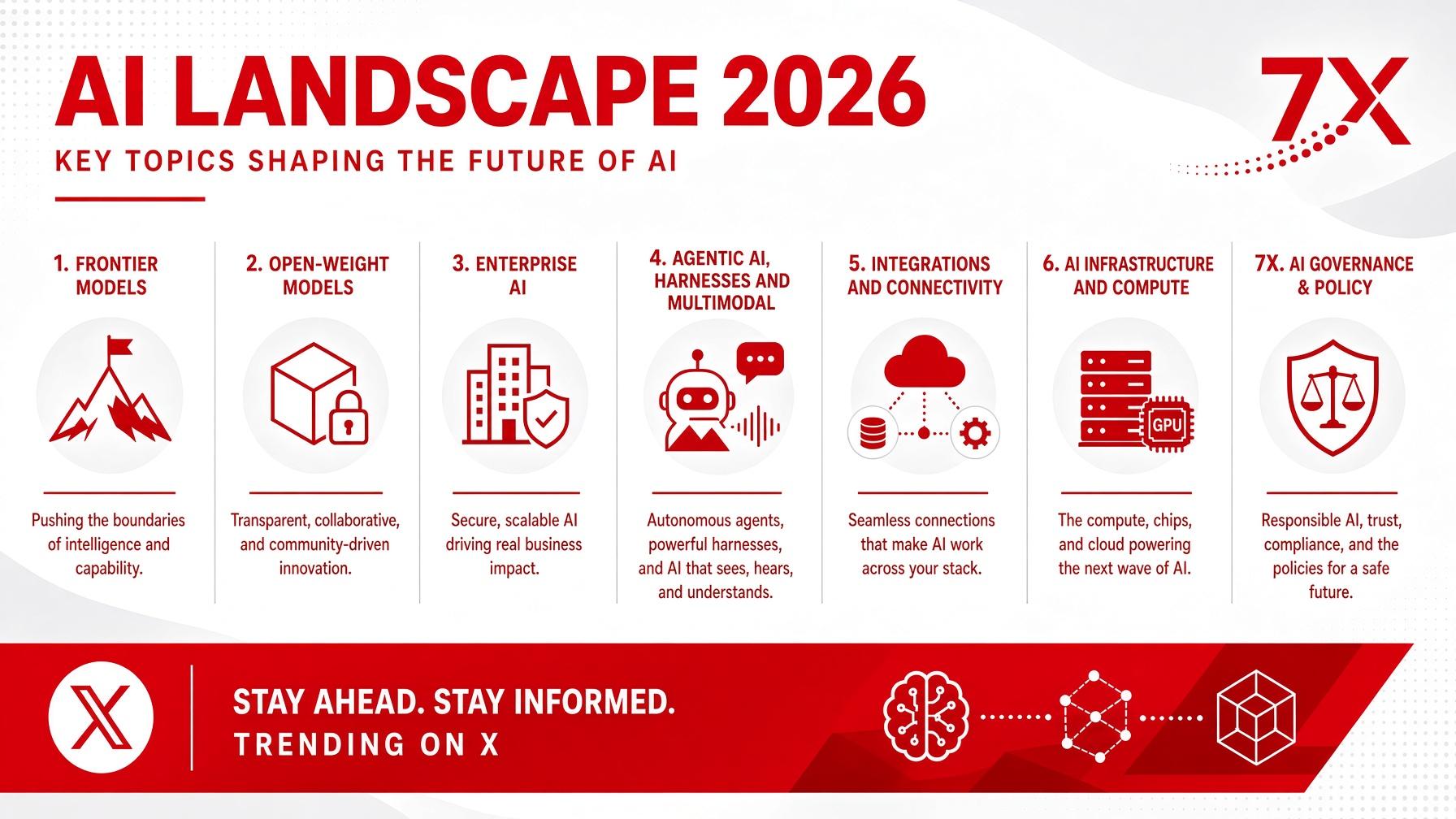
Weekly AI Topics Trending on X
1. Frontier Models
Satya Nadella announced Microsoft's largest Copilot update, positioning it as a transformative work operating system that now encompasses Autopilot, Code, Home, and Office. This major release signals a shift toward integrated enterprise tools, with AI-driven features such as long-horizon knowledge work and coding agents, according to Artificial Analysis. The update also includes strategic enhancements, including a higher token bill per task and a new interface in Microsoft 365, underscoring Microsoft's commitment to redefining enterprise productivity and AI integration.
For enterprises, these updates could significantly streamline workflows by automating routine and knowledge-based tasks and delivering more proactive support within the tools employees already use. With Copilot deeply embedded, IT leaders will need to consider new layers of access control, data security, and ways to manage AI-generated content across departments. The expanded platform approach introduces both new efficiencies and additional considerations for safeguarding sensitive information, ensuring compliance, and enabling smooth integration with existing IT management frameworks.
He framed Copilot as a new operating system for work spanning every model, every form factor, and every task. The post names four pieces that now sit together: Autopilot, a proactive, long-running enterprise agent; Code, which lets staff build apps with Copilot hosted in the company tenant; Home, which joins Chat and Cowork; and Office, now fully embedded in Copilot, with Copilot embedded in Office. Copilot can be invoked from Teams, while the new Today experience introduces a proactive work surface that assembles relevant Microsoft 365 information, such as meetings, messages, documents, and priorities, without requiring a user prompt. Rather than waiting for users to ask questions, Copilot increasingly begins the day by identifying the information most likely to require attention.
To support enterprise governance, IT leaders can control and customize Copilot's proactive features, including setting permissions for which data sources Copilot can access, configuring privacy settings, and determining how and when proactive suggestions appear to employees. These controls enable organizations to align Copilot's automation and insights with internal policies and compliance requirements.
The post presents a unified flow for answering questions, building apps, and completing tasks on users' behalf. As Copilot becomes embedded in Office and Teams, questions about ownership of Autopilot sessions, tenant hosting of generated apps, and control over the Today surfaces become critical, raising management and security considerations without requiring human prompts.
To address these concerns, Microsoft recommends implementing granular permission controls for Autopilot sessions, establishing clear policies on tenant data residency, and using role-based access management for app generation features. Additionally, Microsoft 365 audit logs and activity monitoring help organizations track usage and ensure compliance with internal governance frameworks.
Source: @satyanadella
Artificial Analysis reported that xAI's, Grok 4.7, improved its standing across several evaluations of reasoning, coding, and long-duration knowledge work. The model gained ground relative to Grok 4.6 on the Intelligence Index, AA-Briefcase, GDPval-AA, and the Coding Agent Index, placing SpaceXAI among the leading frontier-model developers in those evaluations. The benchmarks measure different aspects of performance. The Intelligence Index evaluates general reasoning capability. AA-Briefcase measures long-horizon knowledge work agents complete over multiple steps. GDPval-AA evaluates business and analytical tasks, while the Coding Agent Index measures how effectively a model and its associated tooling complete software-development workflows.
The results suggest that Grok 4.7 is making meaningful progress on the types of work organizations increasingly prioritize: coding, multi-step problem solving, and agent-driven execution. The release also strengthens Grok Build, SpaceXAI's agent environment, which integrates the model with tools and workflows to complete tasks rather than generate answers.
Source: @ArtificialAnlys
Yahoo Finance reported that OpenAI will pause training on its most capable models that use tools until it resolves a sandbox flaw. The post quotes OpenAI as saying it will not resume training on this particular model and links to a Yahoo Finance article about the sandbox failure. Adding details about the sandbox flaw can help stakeholders understand the technical challenge.
A training pause on tool use is a key release-governance event, not just a product footnote. To foster shared responsibility, ask which agent and tool-use workloads depend on that unfinished model and what sandbox evidence is required before training resumes.
Source: @YahooFinance
2. Open Weight-Open Source Models
Ars Technica, a technology publication focused on computing, AI, and cybersecurity, highlighted how quickly open Chinese models are closing the performance gap with leading U.S. systems. The significance is less about any individual model and more about the growing number of viable alternatives entering the market. For several coding, reasoning, and enterprise workloads, organizations increasingly have options beyond the largest frontier-model providers, which can inspire confidence in innovation and adaptability.
As performance differences narrow, model selection becomes less about finding the strongest model and more about balancing cost, deployment flexibility, data residency, supplier dependence, and operational control. Detailing specific deployment options like on-premises, edge, or private cloud, and their regulatory implications, can help readers understand how these choices influence governance and compliance strategies.
That shift has implications beyond technology selection. Procurement teams, risk functions, and technology leaders may need to evaluate a broader set of suppliers and deployment models as open alternatives become increasingly capable. Recognizing these broader considerations can help readers see their strategic input as crucial in navigating this evolving landscape.
Source: @arstechnica
Milk Road AI, a newsletter focused on AI industry trends and adoption, approached the issue differently, arguing that the debate over AI containment may already be changing. The argument is not that governments or organizations cannot regulate AI. The concern is that capable models are becoming easier to distribute, modify, and operate outside centralized environments, raising security and misuse risks that regulators need to consider.
The post cited DeepSeek, Alibaba's downloadable Qwen Image 2.1 weights, and PrismML's compression of a 27-billion-parameter Qwen model to approximately 5.9 gigabytes while reportedly retaining most of its benchmark performance. A parameter is a value learned during model training that helps determine how the model behaves. A weight is the stored version of that learned behavior that can be downloaded and operated independently of the company that created it.
The post also referenced Stanford research suggesting that GPT-3.5-level performance costs have fallen dramatically while the performance gap between open and closed models has narrowed substantially on some benchmarks. Together, these effects mean capable models increasingly require less hardware, storage, and investment to deploy.
The governance implication is significant. Policies focused exclusively on large training clusters, commercial providers, or cloud-hosted services may not address models that already reside on laptops, developer workstations, or privately managed infrastructure. As model distribution becomes easier, accountability, acceptable use, incident ownership, and operational governance become increasingly important parts of the control framework, empowering readers to influence responsible AI deployment.
Source: @MilkRoadAI
3. Enterprise AI
Gartner told chief marketing officers they must close critical skills gaps such as data analysis, model understanding, and ethical AI use if AI adoption is to deliver sustained value. The post says CMOs should scale AI skills across three progressive altitudes initial, intermediate, and advanced-that balance speed, risk, and investment with marketing's AI maturity. It also links to Gartner's article on AI skills in marketing, which provides frameworks for measuring progress.
Tool access without a skills ladder can make marketing AI feel like just a pilot inventory. Score the program based on teams' ability to practice AI skills in real work at each altitude, not just licenses issued. This focus on practical application helps the audience feel capable and confident in applying AI effectively.
Source: @gartner_inc
Alex Heath posted a long interview with Satya Nadella on Copilot, the AI backlash, and Microsoft's future. Heath reports that Nadella thinks AI agents will create a market "orders of magnitude" bigger than the cloud, discusses Autopilot as Microsoft's OpenClaw-based agent that can work on a user's behalf, and records Nadella's line that the industry is "way too self-obsessed." The conversation covers agents acting deceptively, when a safety problem should stop a release, why Nadella does not want AI oversight to become a "cartel-like arrangement," Microsoft's relationship with OpenAI, models Microsoft is building itself, and how Nadella uses AI to track Microsoft capital spending. These insights help the audience see the importance of Nadella's vision for Microsoft's future and feel involved in its strategic direction.
The interview treats agents, apps, and infrastructure as one connected business, and it treats public trust as a release constraint. Use Nadella's own tests on deceptive agents and stop-ship safety before expanding Autopilot across tenant workflows. Highlighting these safety measures underscores Microsoft's commitment to responsible AI and reassures the audience of the company's cautious approach.
Source: @alexeheath
McKinsey's post highlights that as AI becomes more capable, everyone gains access to much of the same intelligence. This should inspire the audience to see democratized superintelligence as an opportunity to rethink competitive strategies and act proactively.
When the model layer is widely available, advantage shifts to problem selection, workflow change, and especially how quickly the firm can implement these changes. Identify which operating loop the firm can run faster than competitors with the same model to build confidence in strategic agility.
Source: @mckinsey
Harvard Business Review said AI is changing how leaders communicate, and that using it well means knowing what should stay human. The post points to the second episode of a four-part series on AI and leadership, with Stanford professor Matt Abrahams and Zapier CEO Wade Foster, on how executives can use AI to organize their thinking and where leaders risk going too far.
Communication tools that draft on the leader's behalf still leave judgment and empathy as human work. Draw the line in the communications policy before AI-authored messages become the default external voice.
Source: @harvardbiz
4. Agentic AI
Jeff Teper, EVP - Microsoft Apps & Agents, said Microsoft's impact is evolving from "a computer on every desk and in every home" to "an agent for every person and every process." The post names two steps: a preview of Autopilot in the new Microsoft Copilot and Teams, complementing last month's Copilot Studio release for building agents, apps, and workflows under Agent 365 governance; and general availability of new AI enrichment and tools in SharePoint that Teper says deliver a 17-point improvement in demanding customer scenarios. He ties Microsoft 365 and Dynamics 365 in WorkIQ to higher-performance agents at lower cost with better governance.
For IT administrators, key actions include: reviewing the new Autopilot preview and Copilot integration with Teams, understanding and applying Agent 365 governance policies, preparing to assign clear ownership and grounding for unattended Autopilot processes, and enabling new AI enrichment features in SharePoint. Updating policies and training relevant staff on these capabilities will help organizations realize the benefits while maintaining compliance and control.
Autopilot without named owners and an Agent 365 policy runs as an unattended process on tenant data. To ensure secure and compliant operation, assign session ownership by designating responsible users or groups for each Autopilot task, configure SharePoint grounding rights by specifying which sites or libraries the process can access, and set clear stop conditions such as time limits, approval steps, or completion criteria. Taking these steps before the preview becomes the default path into Teams will provide better governance and control.
Source: @jeffteper
Google Research announced a unified multi-agent framework that lets researchers and video technologists generate long-form video narratives with improved consistency, sparking curiosity about its potential to transform video-generation workflows while mitigating visual drift and error propagation—the post links to the Google Research blog on coherent long-form video generation.
Google's multi-agent framework highlights a challenge that extends beyond video generation. When multiple agents contribute to the same workflow, small early errors can compound as work moves downstream. Consistency, validation, and error-propagation controls therefore become part of the production architecture rather than research considerations. Organizations evaluating multi-agent workflows for media production should establish those controls before deployment to maintain quality as tasks move between agents.
Source: @googleresearch
LangChain announced that LangSmith Custom Apps are now generally available. The post says teams can create any interface from their agent data using a prompt, and it links to the LangSmith Custom Apps blog.
An agent that exists only in a chat transcript cannot be reviewed as an operating system. Decide which traces deserve a durable review surface with frozen filters before custom applications become the unofficial audit log.
Source: @langchain
5. Integrations, Harnesses and Connectivity
Google Cloud Tech, citing Balaji Subramaniam, argued that moving from single-turn chat to loop engineering is an economic inflection point because autonomous agents compound token consumption and latency. The post notes that resolving a routine pull request can consume millions of tokens. It contrasts a naive harness with an optimized one that uses prefix pinning, AST compaction, dynamic tool loading, sandbox auto-repair, and multi-tier routing. It also names five cost-saving mechanisms: strict prefix invariance for KV-cache pinning, AST-aware tool-output compaction, deterministic sandbox pre-flight and auto-repair, on-demand tool-schema loading and code-mode execution, and governed model routing that defaults to a workhorse tier and escalates to frontier models only on named triggers. Explaining how these mechanisms enable scalable deployment clarifies their economic significance for system engineers and decision-makers.
Agent unit economics are a systems problem. Ensuring cache-stable prefixes, deterministic repair before another model call, and a clear escalation policy are essential to maintaining system reliability and giving the audience confidence in managing multi-turn interactions effectively.
Source: @GoogleCloudTech
Microsoft Azure highlights that Microsoft Foundry's advancement in a model-agnostic agent platform, now including voice agents, reflects our commitment to empowering teams with better AI options as they emerge, ensuring enterprise systems, knowledge, tools, and controls remain valuable to customers.
Understanding that a model-agnostic platform depends on controls traveling with model swaps can help teams feel assured about system reliability. Ask which identity, tool, and knowledge bindings will persist when the voice agent changes models to build confidence in the process.
Source: @azure
Google Cloud Tech defined an AI agent as an LLM plus an agent harness and pointed to an Agent Factory episode featuring Luke Schlangen and Smitha Kolan that explains what a harness is.
If the harness is where memory, tools, and permissions live, that layer needs owners and logs. The inventory harness is controlled the same way the firm's inventories are controlled on application platforms.
Source: @googlecloudtech
Suprema quoted Google CEO Sundar Pichai as saying that if you don't learn to build a harness that orchestrates agents now, you will spend 2027 trying to catch up with the people who started today. The post describes a chain of researcher, writer, tester, reviewer, and fixer, and says top engineers are moving from writing every line themselves to operating agent harnesses, with the human as operator rather than bottleneck. Addressing these risks highlights the importance of proactive skill development.
The quote is a skills-and-operating-model claim. Fund harness literacy and verification loops now, as teams that implement them see faster iteration and fewer errors, or budget a year of catch-up against teams that already run researcher-to-fixer agent chains.
Source: @supremaxbt
6. AI Infrastructure and Compute
Richard Seroter described AI hardware as satellites with dozens of Tensor Processing Units (TPUs), specialized hardware accelerators developed by Google to speed up machine learning and artificial intelligence tasks, linked in clusters flying around the planet. He then noted that Google is already pursuing that vision through Project Suncatcher and linked to Google's fact post.
Orbital compute remains a research and infrastructure bet, not a procurement item for most enterprises. Treat Suncatcher as a signal for power, cooling, and long-horizon capacity planning, and keep current buying decisions on terrestrial isolation tiers you can operate this year.
Source: @rseroter
MIT Sloan emphasized that in an AI-driven environment, understanding and applying three key principles of data monetization is essential for success because these principles determine whether data efforts will positively impact financial performance.
Model spend without a clear data-rights and monetization design can leave the firm paying inference bills for data it cannot legally or commercially use. Clearly define the three principles to help you confidently evaluate current data products before expanding training or retrieval budgets.
Source: @mitsloan
Google Cloud Tech described private AI as a spectrum rather than a single deployment model. At one end are device-based approaches such as LiteRT and Gemini Nano, where AI runs directly on the user's device and sensitive information never leaves local hardware. Further into the cloud, organizations can use Confidential Computing environments that keep data encrypted. At the same time, it can run in private cloud environments built on services such as GKE, vLLM, and JetStream, or in fully isolated, air-gapped infrastructure that remains physically disconnected from external networks.
The important point is that isolation is not a binary choice. Organizations no longer need to choose between sending everything to a public AI service or building a completely self-managed infrastructure platform. Different workloads can operate at different levels of isolation, depending on data sensitivity, regulatory requirements, and response-time expectations.
That distinction becomes increasingly important as AI workloads expand across the enterprise. A single deployment model is unlikely to satisfy every requirement. Personal information, regulated data, intellectual property, customer records, and low-sensitivity content often have very different security, residency, and performance requirements.
Organizations should evaluate AI architectures at the workflow level rather than treating AI as a single system. Classify each step in a process by the sensitivity of the data involved and the response time the business requires. Highly sensitive or regulated data may justify running AI directly on a device or in a highly isolated environment. Less sensitive workloads may suit private cloud deployments where scalability and operational efficiency matter more.
Those decisions should also have clear ownership. The team responsible for a deployment environment should have both the technical capability to operate it and the authority to enforce the security, privacy, and governance requirements associated with it. Without that ownership, isolation tiers can quickly become infrastructure diagrams rather than enforceable controls.
The discussion is ultimately less about technology and more about governance. As AI becomes distributed across devices, cloud platforms, and isolated environments, organizations need a clear understanding of where data is processed, why it is processed there, and who is accountable for protecting it.
Source: @googlecloudtech
7x. AI Governance & Policy
Google Cloud Tech argued that an agent's input validation is not a security boundary, which should reassure the audience about the importance of comprehensive safety measures. They showed a returns-agent example where keyword filters miss a polite refund that violates a digital-goods rule, highlighting the need for layered safeguards.
Google Cloud Tech argued that an agent's input validation is not a security boundary. It is a list of attacks already considered. The post describes building a customer-support and returns agent on the Agent Development Kit and Gemini, attacking it first against hand-written controls and then against runtime governance on the Gemini Enterprise Agent Platform. It uses one sample order, split between a $29.00 dock and cable and a $120.00 digital Workplace license, to show how keyword filters miss refund theft that violates a digital-goods approval rule. Model Armor is positioned as a front-door check, and a semantic governance policy is positioned as a pre-execution deny that names the item and the rule so the tool never runs. Google Cloud Tech argued that an agent's input validation is not a security boundary, which should reassure the audience about the importance of comprehensive safety measures. They showed a returns-agent example where keyword filters miss a polite refund that violates a digital-goods rule, highlighting the need for layered safeguards.
Google Cloud Tech argued that an agent's input validation is not a security boundary. It is a list of attacks already considered. The post describes building a customer-support and returns agent on the Agent Development Kit and Gemini, attacking it first against hand-written controls and then against runtime governance on the Gemini Enterprise Agent Platform. It uses one sample order, split between a $29.00 dock and cable and a $120.00 digital Workplace license, to show how keyword filters miss refund theft that violates a digital-goods approval rule. Model Armor is positioned as a front-door check, and a semantic governance policy is positioned as a pre-execution deny that names the item and the rule so the tool never runs.
Source: @googlecloudtech
Luiza Jarovsky reported that China released AI Safety Governance Framework 3.0 in Chinese and English, emphasizing its importance for global AI safety standards. The post says version 3.0 follows risk classification, technical response, and comprehensive governance, and lists principles including inclusive and prudent safety, risk-oriented agile governance, integrating technology and management, openness and cooperation, and trustworthy application with prevention of loss of control. Recommended measures include top-level design, governance capacity, a flexible regulatory sandbox, stronger safety management, and deeper consensus. Jarovsky flags Appendix 2 as an agentic AI risk-management framework and says most companies are unprepared for a rising number of AI safety incidents.
A peer-jurisdiction safety framework with an agent appendix is now public enough to serve as a comprehensive gap list. Map internal agent policies to the framework's risk classes and sandbox mechanism before the next incident review.
Source: @LuizaJarovsky
Microsoft Developer introduced run-assert-eval, a tool that, with a single prompt in GitHub Copilot or Microsoft's coding agent, identifies specific agent risks, measures their occurrence, generates runtime policies based on those findings, and reruns evaluations to verify policy effectiveness. A follow-up states the skill ships in the ASSERT repo with seven domain-specific modules and 14 risk suites, showcasing its practical utility in AI safety management.
Source: @msdev
Closing Thoughts
A common theme runs through every topic in this week's research.
The market still focuses heavily on models, but long-term value is increasingly emerging elsewhere. The organizations creating the most sustainable advantage are investing in workflow redesign, governance, infrastructure, orchestration, routing, data foundations, and operational controls.
Model capability is becoming easier to acquire.
Operational effectiveness remains difficult to build.
That distinction appears in nearly every area of enterprise AI. A lower-cost model can become expensive if workflows are inefficient. A highly capable agent can become unreliable without trusted data and effective orchestration. Open-weight models can create flexibility while introducing new governance obligations. AI infrastructure can create scale, but only when it aligns with business, regulatory, and operational requirements.
The question facing most organizations is no longer whether AI works.
The more important question is whether the organization has built the systems, processes, and accountability structures needed to generate value consistently and at scale.
As access to intelligence becomes increasingly commoditized, differentiation is gradually shifting toward execution.
The organizations that create the most value may not be those with access to the best models.
They may be the organizations that best understand how to govern, integrate, route, secure, and operationalize those models once they arrive. arrive.
How this report is made
AI is used for research and drafting. Charles Braswell reviews and makes edits.