
7 AI Predictions for 2027 by 7xAI
Charles Braswell · October 30, 2026
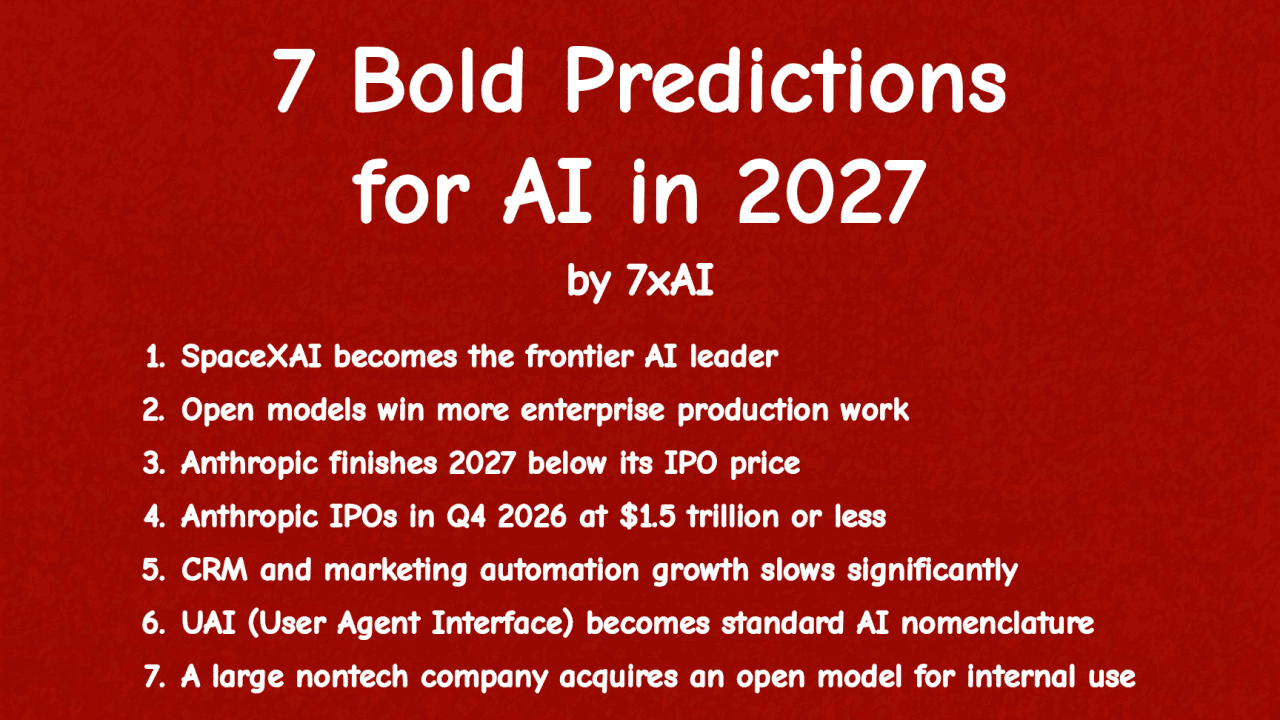
Predicting AI a year in advance has become unusually difficult because several variables that once changed slowly now shift within months. Model performance changes with each release. Prices are falling. Enterprises can redirect workloads between providers much more easily than they could a year ago. Open models keep improving, and AI-assisted software development is reshaping the economics of building applications internally. At the same time, the infrastructure required to train and operate the largest models has become one of the most capital-intensive investments in technology history.
Those changes make prediction harder, though they also make the exercise useful. The important questions for 2027 go beyond which company releases the highest-scoring model. They include who controls the model, how enterprises obtain intelligence, what happens to existing software when agents become its primary users, and where economic value accumulates as model capability becomes more widely available.
I have seven predictions for how those questions will begin to resolve. Six concern developments I expect in 2027. The exception is Anthropic’s IPO, which I expect in the fourth quarter of 2026.
Some of these predictions follow already visible trends. Others require the market to move meaningfully from where it stands today. I tried to make each specific enough that we can eventually judge it as right or wrong.
1. SpaceXAI will become the frontier AI leader

SpaceX AI is already competitive at the frontier, though the available evidence does not establish it as the overall leader today. Independent evaluations have ranked Grok behind leading models on several composite measures, while subsequent releases have shown strength in professional and agentic evaluations and weaker performance in other areas.
My prediction depends on factors broader than its current benchmark position. Frontier AI is becoming a systems competition in which model research interacts with compute, infrastructure, distribution, financing, data, inference economics, and the software surrounding the model.
SpaceXAI has developed an unusual combination of those assets. Its access to capital and infrastructure enables it to train and operate models at enormous scale. The broader organization also provides engineering talent, distribution, physical infrastructure, and a culture oriented toward quickly completing difficult technical projects.
The scale of these resources creates an opportunity, not a guarantee. Model quality still depends on training methods, data, post-training, evaluation, reliability, the surrounding agent harness, and the researchers performing the work. SpaceXAI also has substantial ground to make up in enterprise adoption, trust, runtime maturity, support, and go-to-market capability.
Those constraints matter because the frontier is increasingly measured by what a model can accomplish within a larger system. A model may perform well on a benchmark yet struggle to complete longer tasks reliably. Coding, scientific research, and professional knowledge work depend on context management, tool use, memory, verification, and error recovery. The quality of the harness around the model can become as important as the model’s ability to generate the next token.
I think SpaceXAI’s combination of infrastructure and rapid model improvements gives it a chance to close the current gap faster than many expect.
My prediction is that by the end of 2027, SpaceXAI will hold the strongest overall position in multiple credible, independent evaluations of frontier intelligence.
I expect leadership across several categories, including reasoning, coding, scientific work, agentic performance, and long-duration knowledge work. Winning a single benchmark would not satisfy the prediction.
This is one of the more aggressive predictions on the list because SpaceXAI has to close a gap while several exceptionally well-funded competitors continue to advance.
2. Open-weight and open-source model adoption will increase significantly

The distinction between open and proprietary AI is becoming more important as enterprises move from experimentation to production. Open-weight models allow an organization to own and operate a model's learned parameters, subject to the applicable license. Truly open-source systems provide broader rights to inspect, modify, use, and redistribute the underlying technology. These differences affect where a model can run, how it can be modified, and how much control the model provider retains.
The early adoption data are mixed. Open models have expanded rapidly across developer ecosystems, while measured enterprise production adoption has been considerably weaker. Previous enterprise research found the open-source share declining from 19 percent to 11 percent, a useful reminder that access to model weights does not eliminate the operational work involved in evaluations, security, infrastructure, lifecycle management, and support.
I expect that pattern to begin reversing in 2027 because the relevant comparison is increasingly workload-specific.
Consider a company performing millions of relatively predictable extraction, classification, customer service, or analytical tasks. The organization may find that an open model fine-tuned to its own work performs as well as a much larger proprietary model for that purpose. In one case study, a post-trained open model matched or beat two frontier-lab models on an enterprise extraction task at roughly one-fortieth the cost. The result applies to a specific task and shouldn't be generalized into a claim about overall model quality, but it illustrates the economics enterprises can evaluate.
The frontier market is also becoming easier to navigate. Replit reportedly needed only hours to reroute coding requests between model providers and several days to update its products. Rippling substantially shifted the mix of models handling coding work for its engineers as relative economics changed.
Together, these developments point toward a model portfolio rather than a single-model strategy. Enterprises can reserve expensive frontier models for work where their added capability matters, use smaller or open models where specialization matters more, and keep adjusting the allocation as relative price and performance shift.
My prediction is that enterprises will use open-weight and open-source models much more often in production by the end of 2027.
I expect enterprises to become better at deciding when owning more of the model stack provides an economic, operational, or strategic advantage. Proprietary systems will remain important, particularly where the frontier matters. Open models will become increasingly attractive when workload volume, specialization, privacy, deployment control, or economics justify the added operating responsibility.
3. Anthropic will finish 2027 below its IPO price

Anthropic may be the clearest example of why you must consider company quality and investment returns separately.
The company has demonstrated extraordinary growth while simultaneously requiring extraordinary amounts of capital. That combination makes sense for a company competing at the AI frontier, where training and running increasingly capable models require substantial spending on compute, infrastructure, research, and engineering.
The challenge is that public investors will be asked to value the company while the model market structure is still evolving.
The market is already becoming more price-competitive. Leading model providers can use discounts to win strategically important workloads, and enterprise customers are becoming more capable of reallocating usage among providers. A customer that can move part of its coding, research, extraction, or support workload within days has more leverage than a traditional enterprise software customer facing a multiyear migration.
Falling model prices do not make businesses unattractive. They do complicate the relationship among revenue growth, infrastructure spending, gross margin, customer retention, and long-term return on capital.
Additional pressure may come from other segments of the model market. For example, Cohere has focused its strategy on enterprise AI, including private deployment, dedicated inference, and products for industries such as financial services, telecommunications, energy, healthcare, manufacturing, and the public sector.
I think this points to an emerging category I would call Frontier Domain Models: models optimized to achieve frontier-level, and potentially frontier-superior, performance within a defined business domain rather than across every dimension of general intelligence.
The broader market already shows that domain specialization can be valuable. Stripe developed a payments foundation model trained on tens of billions of transactions. Its first deployed application increased its detection rate for card-testing attacks on large businesses by 64 percent compared with prior methods. Harvey has developed domain-specific AI for legal workflows and has extended the approach to tax and mergers and acquisitions.
For a bank, pharmaceutical company, manufacturer, or other large enterprise, this suggests a different way to think about model performance. The most valuable model may ultimately be the one that performs exceptionally well in the organization’s actual domain and workflows, even if another model continues to lead in general-purpose benchmarks.
Current benchmark coverage reinforces that possibility. One analysis of 29 AI benchmarks found that most working hours involve tasks that receive little or no meaningful coverage. Therefore, broad benchmark leadership reveals little about performance on the specific work an enterprise wants a model to perform.
If Frontier Domain Models develop into a meaningful category, Anthropic could face competition from two directions. The general frontier remains intensely competitive, as OpenAI , Google , SpaceXAI, and others pursue the strongest broadly capable models. At the same time, companies such as Cohere can pursue economically valuable enterprise domains without having to win the general intelligence race.
A domain-model provider needs to be better, less expensive, easier to deploy, or otherwise more attractive for a sufficiently valuable class of enterprise work. A bank may still use Grok for difficult general reasoning while directing millions of financial workflows to a specialized system with stronger economics, private deployment, and evaluations tailored to financial work.
That could make the model market increasingly segmented as it matures. General frontier models, Frontier Domain Models, enterprise-specific systems, and narrow-task models could all share workloads within the same organization.
This creates an unusual public-market test for Anthropic. Investors will value extraordinary growth alongside falling model prices, competition at both the general and domain levels, substantial infrastructure commitments, and customers who may move workloads more easily than traditional enterprise software customers.
I expect Anthropic to remain one of the leading AI companies in 2027. I also expect its public offering valuation to reflect enough future success that the stock struggles to meet the expectations built into the starting price.
My prediction is precise: Anthropic’s split-adjusted closing share price on the final trading day of 2027 will be below its split-adjusted IPO offer price.
A conservative offering price could easily invalidate this prediction. So could another year of exceptional growth paired with improving unit economics. The prediction ultimately hinges on the interplay among growth, valuation, competition, capital requirements, and how much time investors are willing to give the company to reconcile them.
4. Anthropic will go public in Q4 2026 (not really 2027) at a valuation of $1.5 trillion or less

The second Anthropic prediction should be much easier to resolve because I expect it to occur this year.
Anthropic’s most recent private financing established a valuation approaching $1 trillion. An IPO at $1.5 trillion (some predict $2 trillion) would still represent an enormous increase and would make Anthropic one of the world’s most valuable companies.
The question is how much additional growth public investors will price into the offering, given infrastructure obligations, competitive pricing, and customers' growing ability to substitute among leading models.
Private markets can value a company at discrete intervals, often following a financing round tied to a specific investor group. Public markets reassess valuation every trading day. Revenue growth, customer concentration, capital expenditures, compute commitments, margins, and competitive developments become part of an ongoing price-discovery process.
My prediction is that Anthropic completes its IPO during Q4 2026 at a fully diluted equity valuation of $1.5 trillion or less.
To score the prediction, I would use the fully diluted valuation implied by the final IPO offer price rather than the company’s first-day closing market capitalization. Investor enthusiasm after trading begins could produce a figure very different from the valuation at which Anthropic actually sells the offering.
The subsequent performance of the shares is a separate question, which is why I have treated the IPO valuation and the December 2027 share price as two distinct predictions. The first assesses whether public investors initially clear the offering. The second assesses whether Anthropic grows into that expectation.
5. Growth in incumbent CRM and marketing automation will slow significantly

AI agents pose an obvious challenge for enterprise software because they don't need to interact with an application the way an employee does. If an agent can research an account, update a record, prepare a campaign, summarize a customer relationship, or initiate a workflow directly, some of the economic assumptions underlying software licensed to individual human users become less certain.
I think a second development will place even more pressure on CRM and marketing automation vendors. AI is beginning to erode some of the traditional moats that protected established SaaS products from competition.
Rob Walling recently described this as both a supply and a demand problem for SaaS. On the supply side, AI makes it much easier for competitors to reach feature parity, for customers to build parts of an application themselves, for open-source alternatives to improve more quickly, and for agencies to produce customized software at prices that begin to resemble SaaS subscriptions.
On the demand side, agents can reduce the number of people who need software seats and, in some cases, eliminate the human workflow the application was originally designed to support.
One observation from Walling’s presentation gets to the heart of the problem. A customer considering an alternative to an established application doesn't need to replicate its 50 features. The customer may need only the three features it actually uses.
That changes the build-versus-buy calculation substantially.
Historically, economics strongly favored buying mature enterprise software. Rebuilding a system as broad as Salesforce , HubSpot , or Adobe would require a substantial engineering organization and ongoing development and maintenance. That comparison increasingly misses the point. Most companies have no reason to reproduce the entire product.
Consider a large company that uses only a fraction of its CRM's functionality. It may primarily need account information, pipeline management, forecasting, and several sales-organization-specific workflows. With AI-assisted software development, agents, APIs, and the company’s proprietary data, building those capabilities becomes much more feasible.
The relevant economic comparison shifts from building Salesforce versus buying Salesforce to building the functionality we actually need versus continuing to buy the larger platform.
Software development is accelerating, so a successful feature offers less protection when competitors can reproduce it more quickly. Integrations may become less defensible as agents become better at working with APIs. Data portability may improve as AI makes it easier to extract and restructure information. Even familiar user interfaces may matter less if the underlying application's primary user becomes an agent.
A company that once differentiated itself through clever code, a large feature set, dozens of integrations, and an interface familiar to employees may find that each of those advantages offers less protection than before.
The most immediate pressure will likely occur at the edges.
A company may keep Salesforce as its customer system of record while deciding it no longer needs several additional applications around it. An agent may perform work that previously required another SaaS product. An internal development team may build a specialized account-planning application rather than purchase another module. A marketing organization may generate and execute campaigns through agents rather than licensing separate tools for each step in the process.
This creates an important distinction between owning the system of record and owning the workflow. The incumbents currently have substantial advantages in the former. AI makes the latter increasingly contestable.
Incumbent platforms may also use their position to absorb functionality previously provided by smaller vendors. If a point solution depends on Salesforce, HubSpot, or another platform, the underlying platform has access to the customer relationship, integration points, and a working description of the feature. AI reduces the time required for the platform to build its own version and include it in the larger product.
Seat-based pricing introduces another vulnerability.
If eight customer-service representatives using a SaaS application are replaced by two employees supervising AI agents, the underlying business activity may remain the same or even increase. At the same time, the number of human seats falls substantially. Vendors can respond by shifting to consumption-, agent-, or outcome-based pricing, but that changes the economics of businesses built around steadily expanding per-user licenses.
Incumbents recognize these pressures and are developing their own agents and AI capabilities. That matters because their existing data, distribution, customer relationships, and systems of record give them significant advantages. The likely outcome is far more complicated than the “SaaS apocalypse” frequently predicted online.
I expect the pressure to be uneven.
Software whose primary moat is a large feature set is increasingly vulnerable. Point solutions that sit alongside larger platforms are vulnerable because the platform itself can build their functionality more quickly. Applications whose principal value is giving a human an interface to perform a task are vulnerable when an agent can perform that task directly.
Products deeply embedded as systems of record, trusted to execute important actions, protected by regulation, strengthened by network effects, or improved by proprietary learning loops should prove far more durable.
CRM and marketing automation sit at the center of this transition. The major platforms possess some of the strongest remaining SaaS moats, particularly customer data, integrations, ecosystems, and system-of-record status. At the same time, they contain enormous amounts of functionality that agents can absorb, automate, or make unnecessary at the user interface level.
My prediction is that growth in established CRM and marketing automation products will decelerate significantly in 2027 as agents reduce traditional seat-based workflows, enterprises build more purpose-specific applications in-house, and AI continues to lower the cost of replicating software functionality.
I expect the economic value of the traditional application layer to change.
For decades, enterprise software benefited from two related advantages: software was expensive to build, and employees needed applications to do their work. AI is weakening both assumptions at once. Software is becoming cheaper to build, while agents are beginning to do some of the work that the software was purchased to do.
If the cost of reproducing those features keeps falling, what exactly is the moat?
6. UAI will become standard AI nomenclature

Software interfaces have historically reflected who or what is interacting with the system. A user interface lets a person operate software. An application programming interface gives another piece of software a structured way to interact with the system.
AI agents introduce another relationship.
As agents become capable of working across applications, the person increasingly sets the objective while the agent determines how to accomplish it. The agent retrieves information, works across systems, invokes tools, makes permitted decisions, and returns to the person when it needs additional judgment or approval.
I use UAI, or User Agent Interface, to describe that layer.
A UAI is the interface through which a person directs and interacts with an agent that operates other software on the person’s behalf. The distinction becomes more useful as the primary human experience shifts away from navigating each underlying application independently.
Consider what happens when someone prepares for a customer meeting. Today, that person may open a CRM, search email, review notes, review open support issues, check recent usage, and assemble a briefing.
Through a UAI, the person asks an agent to prepare for the meeting. The agent interacts with the CRM, email, support platform, calendar, knowledge system, and other relevant applications. These applications remain important, even though the person’s primary interface is now the agent, which coordinates across them.
The underlying architectural change is already evident, even though the terminology remains unsettled. Competing descriptions include agentic experience, conversational interface, agent workspace, agentic UX, human-agent interaction, AG-UI, and A2UI. Several of these terms are already forming their own communities and technical meanings.
That makes this one of the predictions I am least confident in. Technology naming rarely follows a clean, logical progression, and the architecture could become common without the industry agreeing on UAI as its name.
Still, the term captures an important change in the relationship among a user, an agent, and the applications beneath it.
My prediction is that by the end of 2027, UAI, or User Agent Interface, will become commonly understood industry terminology for the primary interaction layer between a person and an AI agent.
For the prediction to count, I would expect to see the term used independently by multiple technology vendors, analysts, researchers, and practitioner communities. Usage confined to my own writing or a single company’s branding would not qualify.
7x. A large nontechnology enterprise will acquire an open model primarily for internal use

The final prediction extends the open-model argument.
Companies already acquire technology because they view the capability as strategically important. If AI becomes deeply embedded in pricing, customer service, risk management, product development, operations, or research and development, companies will eventually decide that a particular source of intelligence is important enough to own.
The market has moved in that direction without yet producing a clear example that satisfies this prediction. Nontechnology companies have acquired AI software and application businesses, made minority investments, licensed model technology, and entered partnerships with model providers. Those transactions stop short of a large traditional enterprise acquiring control of an open model primarily to operate it internally.
That distinction is important.
I would count an acquisition of the organization that develops the model, or a transaction that grants the buyer controlling rights to the model and its associated intellectual property. A standard commercial license would not count. Neither would a minority investment or an ordinary partnership with a model provider.
The economic argument against such an acquisition is strong. Models are improving rapidly, capable alternatives are proliferating, and ownership entails costly obligations for compute, research talent, security, evaluation, maintenance, and future development. For most organizations, continuing to purchase intelligence from outside providers will make more sense.
The emergence of Frontier Domain Models may make this prediction more plausible.
A non-technology company has relatively little reason to acquire a general-purpose model simply because it performs well today. The model could depreciate quickly as stronger general-purpose alternatives arrive. A deeply specialized model presents different economics.
A pharmaceutical company might place strategic value on a model, team, training process, and proprietary data that deliver unusually strong performance in drug discovery. A financial institution might reach the same conclusion about a model specialized in financial intelligence, risk, fraud, or regulatory work. A manufacturer could acquire intelligence tied to engineering, materials, equipment reliability, or a highly specialized production environment.
In those cases, the scarce asset extends beyond a set of model weights. It includes domain expertise, specialized talent, evaluation methods, training processes, proprietary data, and the institutional knowledge needed to continue improving the system.
That combination may be difficult to reproduce, even as models become more capable and less expensive.
An acquisition becomes rational when that intelligence is sufficiently connected to specialized talent, proprietary data, domain performance, regulatory requirements, intellectual property, or another operating capability, and dependence on an external provider creates a strategic constraint.
My prediction is that by the end of 2027, a large company outside the traditional technology sector will acquire an open-model developer, or controlling rights to an open model and its intellectual property, primarily to use and control that capability within its own operations.
The absence of a clear precedent is precisely what makes this prediction interesting.