
Insights/7x Digital Risk Report
Highlights: Controls checked while the environment changes
A weekly report covering key developments, emerging risks, and practical insights in digital risk: cyber, GRC, audit, identity, and data protection.
Charles Braswell · October 16, 2026
Executive Summary
Governance, security, audit, identity, insurance, and privacy teams all face the same challenge: they evaluate controls at fixed points in time while the environments they govern keep changing. This week's developments show what happens in the gap between assessment and reality.
In governance, two private-credit collapses, First Brands and Tricolor, were built on familiar fraud techniques: double-pledged collateral, inflated invoices, and misstated assets. The schemes persisted until someone compared the reporting to an independent source. An ISO 27001 auditor showed how a 12-person startup and a 40,000-person cloud provider can produce nearly identical Statements of Applicability despite operating very different security controls. Michael Rasmussen argued that much of the GRC market spent years treating documentation as an outcome rather than a management tool. The EU published EN 18286, its first harmonized AI standard, giving high-risk AI providers a defined quality-management framework. Turnkey Consulting described SAP GRC 2026 primarily as an operating-model and governance decision rather than a technology upgrade.
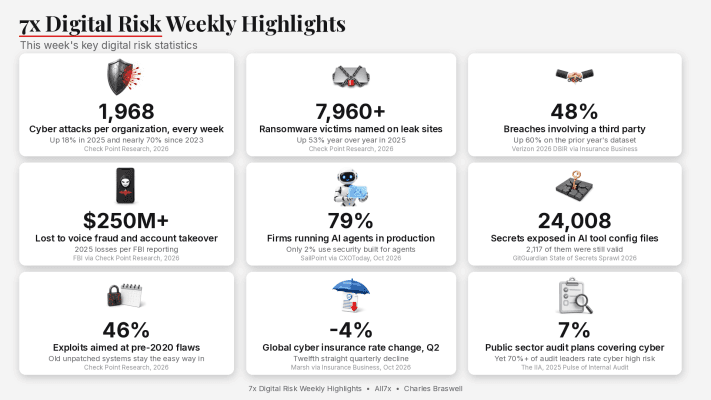
In cybersecurity, Trellix surveyed 600 CISOs and found that 95 percent experienced an insider incident involving an AI or autonomous system during the past year, with detection and response averaging 15 hours. Check Point's 2026 report reconstructed a Qilin ransomware intrusion that began when an attacker accessed a valid domain administrator account from an unmanaged laptop without MFA. McKinsey & Company examined why organizations often understand what action to take long before anyone has the authority to take it. OWASP contributors published a draft MCP Security Testing Guide that treats the Model Context Protocol as a security boundary rather than simply an integration layer.
Internal audit faces a similar assurance problem. More than 70 percent of public-sector audit leaders rate cybersecurity as a high or very high risk, yet only 7 percent include cybersecurity as a dedicated audit-plan item. Gartner argues that AI assurance should start with deployment because internally developed models, customized vendor solutions, and public AI services create different risk profiles. Access governance also drifts, as role structures and authorization models gradually move away from the business processes they were meant to support.
Identity management increasingly relies on non-human credentials. SAP disclosed a CVSS 10.0 vulnerability in its Cloud SDK for Python that could expose an application's OAuth2 client credentials to an attacker-controlled server. Microsoft launched a post-quantum certificate pilot and emphasized the need to inventory every system that issues, validates, stores, or depends on certificates. Both developments center on identities that authenticate systems rather than people and that rarely receive the same governance attention as user accounts.
Cyber insurance continues to tell a different story through pricing than through policy language. Jamie Dimon said AI-related cyber risk increased tenfold after Anthropic 's Mythos model identified vulnerabilities JPMorgan had not previously recognized. At the same time, U.S. cyber insurance rates fell another 2 percent during the second quarter. Insurers are responding by tightening coverage terms, introducing exclusions, sublimits, and tighter dependent-business-interruption language aimed at systemic technology and AI-related risks.
In data protection, Meta 's Muse assistant reportedly maintains continuously updated profiles that include information about people who have never used the product themselves. GitGuardian found thousands of valid secrets exposed through MCP-related configuration files and AI-assisted development workflows. The UK Legal Aid Agency confirmed that records stolen during a breach included data dating back to 1978, demonstrating how historical information can remain accessible long after its original purpose has faded.
Enterprise AI platforms are increasingly converging on a common design principle: agents should not determine their own authority. Microsoft made Execution Containers generally available with policy enforced outside the agent. SAP and NVIDIA are connecting OpenShell runtime controls to Joule Studio's business-authorization layer. SailPoint found that 79 percent of organizations run AI agents in production while only 2 percent use identity-security tools specifically designed to govern them.
Across these developments, the recurring pattern is validation. Fraud survives inside reporting until someone verifies the underlying records. Security failures emerge through trusted access that nobody reevaluated. Audit coverage can appear comprehensive while providing limited assurance. Certificates, client credentials, agents, and technical identities keep operating long after the assumptions behind their governance change. The control itself matters, but so does the evidence that it still works under current conditions.
Records persist. Processes change. Controls evolve. Organizations reorganize. The organizations best positioned for AI, cyber, and digital-risk challenges continuously test whether their documentation, controls, and operating environment still reflect reality.
Deep Research
1. GRC (Governance, Risk & Compliance)
This week's five sources examined the relationship between governance records and operating reality: a post-mortem on two private-credit frauds, an auditor's critique of the ISO 27001 Statement of Applicability, the EU's first harmonized AI standard, Michael Rasmussen's history of GRC technology, and Turnkey Consulting's guide to SAP GRC modernization.
In an October 12 article for Corporate Compliance Insights, forensic accountant Anne Eberhardt, CFE, CAMS examined the collapses of First Brands and Tricolor, both of which filed for bankruptcy in September 2025. The Justice Department later charged both companies' founders with fraud. The schemes described in the indictments were not sophisticated. Tricolor allegedly pledged the same collateral to multiple lenders and manipulated collateral characteristics to meet lenders' requirements. First Brands allegedly inflated receivable invoices and concealed liabilities.
The most revealing part of both cases was how investigators uncovered the fraud. At Tricolor, a junior analyst noticed in a spreadsheet that the loan principal was not declining. At First Brands, lenders questioned the reported earnings during a refinancing and received unsatisfactory answers. In both cases, the reporting held up until someone checked it against an independent source.
Eberhardt draws five lessons. Corporate governance serves as a credit-risk indicator. Cash flow, verified against bank records, reveals problems before earnings do. Complex structures and special-purpose vehicles are a risk factor, not a mark of sophistication. Management reporting and monitoring software warrants skepticism because a tool built on one set of assumptions can become outdated when conditions change. Monitoring continues after closing; the double-pledged assets were discovered only during bankruptcy.
Aron Lange 's critique of the ISO 27001 Statement of Applicability highlights a similar gap between documentation and what is actually operating.
At a 12-person startup and at a cloud provider with 40,000 employees, the row for Annex A.8.5, secure authentication, in the Statement of Applicability often reads the same. One company uses passwords and an authenticator app. The other uses hardware security keys for administrators, conditional access, phishing-resistant MFA for all staff, and certificate-based authentication between systems. Both may be appropriate. Nobody reading the SoA can tell the difference.
According to Lange, most SoAs copy Annex A into a spreadsheet and add columns for applicability, status, and justification. Clause 6.1.3 describes a different sequence: determine the controls needed to address the organization's risks, compare them with Annex A to catch omissions, and then produce the SoA. Risks and controls come first. Annex A serves as a safety net.
He recommends reversing the document so that every row starts with a specific, testable control tied to a risk and maps to Annex A. His practical test is straightforward: take the three largest risks in the register, list the controls actually in operation, and map them. Any existing SoA row that cannot be traced back to a risk and an operating control is where the work starts.
On October 14, the EU published EN 18286:2026, Artificial Intelligence – Quality Management System for EU AI Act Regulatory Purposes. As Luiza Jarovsky reported, the Journal published the first European AI standard. Providers of high-risk AI systems that adopt it receive a presumption of conformity with the quality-management-system requirements in Article 17(1)(a) through (m).
Those requirements cover compliance strategy, design control, testing and validation, data management, risk management, post-market monitoring, serious-incident reporting, record-keeping, resource management, and an accountability framework. Article 17 applies to Annex III systems from December 2, 2027, and to Annex I systems from August 2, 2028.
The standard is voluntary, but it provides regulators and customers with a concrete benchmark. Having an AI policy on file carries less weight than demonstrating that the underlying quality management system operates as the policy describes.
Michael Rasmussen, who coined the GRC acronym at Forrester in February 2002, used an October 14 essay to explain why many programs continue to struggle with that distinction. He argues that much of the early market fell into what he calls Sarbanes-Oxley captivity, in which documenting controls became the goal rather than the means. He traces the market through six generations, from SOX documentation to enterprise GRC, architecture, agile no-code configuration, cognitive GRC, and business-integrated GRC.
Rasmussen describes the current period, 2025 through 2030, as GRC 7.0: GRC Orchestrate. A system of record remains foundational. Around it sits a system of intelligence that turns signals into decision context, a system of action in which agents perform work under explicit authority, and a system of configuration that builds capabilities from business language.
He is also clear about the limits. Recommending a supplier does not grant approval authority, and completing a workflow does not prove a service has recovered. He advises buyers to start with one objective, one bounded use, one accountable owner, one baseline, and one resilience test, then let evidence determine whether expansion is warranted.
Turnkey Consulting 's guide, GRC Modernization for SAP-Centric Organizations, applies much of the same thinking to SAP landscapes. It outlines five connected areas: architecture, people and ownership, controls, identity and access, and operations. Its warning signs will be familiar to SAP security teams: ownership concentrated among a few specialists, controls that no longer align with the process, fragmented identity handoffs, overlapping tools, and rulesets that are rarely reviewed.
The guide presents SAP GRC 2026 as a series of architectural decisions. Access Control, Process Control, Risk Management, Audit Management, Business Integrity Screening, UI Masking, and UI Logging are moving to a unified HANA-based platform. Organizations must choose between embedded and hub deployments, decide what to migrate, redesign, or retire, and define how SAP IAG, enterprise IGA, and PAM fit in.
Turnkey compares four models: primarily SAP-native, SAP GRC with SAP IAG, SAP GRC with enterprise IGA, and hybrid. It asks five questions before choosing, including where the authoritative identity lifecycle resides, who accepts residual SoD risk, and how privileged, emergency, service, and non-human identities are governed.
The case examples illustrate what operating evidence looks like. Ruralco paired SAP GRC with role-design workshops and a governance group, and access violations fell by 90 percent in the first year. JTI centralized more than 4,500 business processes and IT controls in Process Control across more than 70 countries. Ørsted moved more than 6,000 users from SAP Identity Management to GRC Access Provisioning, automating provisioning, user-access reviews, and SoD reviews.
Turnkey closes with a practical test: can the governance model accommodate AI agents, their identities, permissions, and logs without redesign?
Collectively, these sources describe a governance problem rooted in validation rather than documentation. The frauds persisted within reporting. The SoA served as a control inventory. AI governance is being formalized through standards intended to demonstrate operation rather than intent. Rasmussen's history traces decades of effort to link records to decisions and outcomes. Turnkey's examples focus on reducing access violations, centralizing controls, and automating reviews because operating results carry more weight than governance structures alone.
Sources
- Corporate Compliance Insights: 25 Years After Sarbanes-Oxley, How Is Fraud This Simple Still Possible?
- GRC Lab: Your SoA Would Fit Any Company
- Luiza's Newsletter: The EU's First AI Standard Is Here
- GRC 20/20: GRC, an Ancient Discipline, a Snowy February, and the Architecture of What Comes Next
- Turnkey Consulting: GRC Modernization for SAP-Centric Organizations
2. Cyber Security
Security teams have spent years improving visibility, detection, and coverage. This week's sources focus on a different dependency: authority. Trellix argues that insider-risk programs must extend beyond employees and contractors to include AI agents, autonomous systems, and machine identities capable of operating in trusted environments. Check Point reported record levels of attacks, ransomware victims, and AI-related exposure. McKinsey revisited cyber resilience through the lens of decision rights. An OWASP community project published a security testing guide for the Model Context Protocol (MCP), the connective layer increasingly used to link AI agents to systems, tools, and data.
Trellix's Mind of the CISO: The New Insider report, based on a Vanson Bourne survey of 600 CISOs, reframes insider risk in the context of autonomous systems. Ninety-five percent of respondents reported an insider incident linked to an AI or autonomous system's actions in the previous 12 months. On average, AI actions accounted for 28 percent of insider-related incidents. Organizations reported average losses of $2.4 million per insider incident and an average response time of 15 hours.
Most organizations recognize that machine identities belong within insider-risk programs. Seventy-eight percent now include AI agents, autonomous systems, and machine identities in their definition of insider risk. However, implementation has not kept pace with that recognition. Fifty-two percent lack a fully implemented insider-risk strategy, 63 percent lack sufficient visibility into employee use of AI tools, and 68 percent say existing policies do not adequately address AI-related risk. Nearly three in four respondents said senior leadership and boards do not clearly understand insider risk.
Trellix argues that organizations should govern AI agents like privileged users. A CISA official quoted in the report makes the same point from another perspective: autonomous agents increasingly operate within trust boundaries and have privileged access. Yet many organizations still govern them differently from other privileged accounts.
Check Point's Cyber Security Report 2026 provides context for the environment those agents are entering. Organizations faced an average of 1,968 attacks per week in 2025, an 18 percent increase over the previous year and nearly 70 percent more than in 2023. More than 7,960 victims appeared on ransomware leak sites, a 53 percent increase. Social-engineering campaigns expanded beyond email to include phone calls, messaging platforms, real-time impersonation, and ClickFix lures that prompt users to execute malicious commands.
The report's reconstruction of a Qilin ransomware intrusion stands out because the intrusion path appears unremarkably simple. The attacker logged in via a VPN using valid credentials for a domain administrator account routinely used for daily work. The account was accessible from an unmanaged personal laptop and did not require MFA. Minutes later, a copy of Mimikatz appeared in an unmonitored directory on the primary domain controller.
Check Point identifies each of those conditions as an independent failure point. No vulnerability was required. No exploit chain was required. The intrusion succeeded through permissions, exceptions, and access decisions that were already in place before the attacker arrived.
The report's AI findings reveal a similar pattern. Organizations now interact with more than 14 AI services on average. In the fourth quarter of 2025, about 89 percent encountered risky prompts in a typical month, and one in every 41 prompts was classified as high risk, up 97 percent from the first quarter. A Lakera review of roughly 10,000 publicly exposed MCP servers found vulnerabilities in 40 percent, including exposed API keys in 8 percent, path traversal in 7 percent, and command or code injection in 6 percent.
Those findings help explain the growing attention on MCP security. As organizations connect models to enterprise systems, the protocol increasingly determines what an agent can discover, retrieve, execute, and modify across the environment.
Released as a version 1.0 community draft, the OWASP MCP Security Testing Guide treats MCP as a security boundary, not merely an integration layer. The guide covers the entire chain: the user, model, MCP client, MCP server, connected tool, and target system. It includes 79 tests across 19 sections covering threats, host and client controls, software supply chain security, enterprise gateways, detection, and incident response. Findings map to the OWASP MCP Top 10, which includes token mismanagement, privilege escalation, tool poisoning, insufficient authorization, missing telemetry, shadow MCP servers, and context over-sharing.
The guide's value lies in its focus on reach. Security teams have spent years testing applications, endpoints, identities, and networks. MCP testing focuses on what an agent can access, which tools it can invoke, the authority those tools carry, and how far that authority extends into connected systems. The test methodology requires written authorization and synthetic environments because those permissions often affect production infrastructure.
Last week's Digital Risk issue covered the exploitation timeline in McKinsey's September article, "The Speed Problem." The article's organizational argument matters as much. When a critical vulnerability emerges, responsibility fragments almost immediately. IT owns patching. Business leaders own downtime. Legal owns disclosure. Procurement owns vendor relationships. Operations owns continuity. Security owns risk assessment.
McKinsey argues that organizations often know what action to take long before anyone approves it.
Its proposed model centers on governed autonomy. Organizations begin by identifying a minimum viable organization, the systems whose disruption would pose an existential risk, and focus continuous visibility there. Defensive AI then supports attack-path analysis, remediation, and incident response, with preauthorized agents carrying out bounded actions such as isolating systems or revoking credentials. A cross-functional response cell operates with delegated authority to override standard change-management processes when an active threat is confirmed.
One financial institution adopted that structure after a critical vulnerability remained unpatched for 11 days because no team had the authority to override a production freeze. After-action reporting replaced layers of preapproval, and remediation times fell significantly.
McKinsey also highlights a risk consistent with Trellix's findings: an agent trusted to patch systems, revoke credentials, or remediate at machine speed is itself a critical asset. The permissions that make the agent valuable also make compromise, misuse, or behavioral drift consequential.
Authority appears repeatedly across these sources. The Qilin intrusion succeeded by exploiting existing permissions. MCP expands what connected systems and agents can access. Trellix treats AI agents as insiders because they already operate within trust boundaries. McKinsey's analysis centers on decision rights because visibility has limited value when nobody can act.
Organizations have spent years building detection, monitoring, telemetry, and oversight. Attackers continue to move through environments using trusted credentials, trusted pathways, and approved connections. AI agents increasingly operate through those same channels, with broader authority and greater speed. Security outcomes now depend as much on how you govern permissions, delegation, and decision rights as on the tools you use to observe them.
Sources
3. Internal Audit, IT Audit & Continuous Control Monitoring
Internal audit plans measure coverage, but that does not necessarily mean they measure assurance. This week's sources examined what happens when a high-risk area receives little direct testing, when audit criteria depend on inventories maintained by others, and when access reviews assume the underlying access model still reflects how work is performed.
The IIA's 2025 North American Pulse of Internal Audit found that more than 70 percent of public-sector audit leaders rated cybersecurity as a high or very high risk, making it the top-rated risk in the survey. Only 7 percent included cybersecurity in their audit plans. Logan Wamsley's October 7 article in Internal Auditor examined whether that gap is as large as it appears.
Part of the explanation is structural. Stefan Lundborg of Sweden's KTH Royal Institute of Technology views cybersecurity as a cross-cutting risk that should be integrated throughout the audit plan rather than treated as a standalone engagement. Mahmoud Elbagoury, CAE of Ladun Investment Company, argues that when a dedicated CISO function exists, internal audit should focus on whether second-line responsibilities are performed effectively, particularly in organizations where many auditors come from accounting backgrounds rather than technical disciplines.
Derek Jamieson of the Chartered IIA argues that embedded coverage can create a false sense of assurance. During a 25-day engagement, an audit team may spend only a small portion of its time on cyber controls, often reviewing policies, procedures, and supporting documentation rather than directly testing controls. Cybersecurity may appear throughout the plan yet receive very little substantive audit work. The IIA's Cybersecurity Topical Requirement and User Guide were developed in part to address that problem by providing a common framework for governance, risk, and controls. Elbagoury reported that sharing the guidance with his CISO created a common language between the two functions.
What matters is whether the work performed across the audit plan, wherever it appears, provides meaningful assurance regarding the organization's highest-rated risk.
Gartner reaches a similar conclusion in its guidance on auditing AI. The firm starts with the premise that AI risk is not a single category because the control environment varies with the deployment model.
Organizations building AI internally retain responsibility for governance, monitoring, outcomes, model drift, bias, operational disruption, and control ownership. Customized vendor AI introduces different concerns, including limited visibility into the underlying model and the possibility that vendor updates alter system behavior. Public AI services create exposure through data sharing, intellectual-property concerns, hallucinated output, and limited control over employee use.
Because risks vary, Gartner recommends starting with an accurate inventory of the AI landscape. Many organizations rely on inventories maintained by risk, compliance, security, or other second-line functions. Gartner recommends that internal audit assess the completeness and reliability of those inventories rather than treat them as authoritative. The firm also encourages CAEs to participate in AI governance and innovation committees where practical.
Gartner’s framework guidance reflects the same approach. NIST AI RMF can support risk identification. ISO/IEC 42001 can provide a foundation for operational controls. ISACA guidance can strengthen audit methodology. COSO ERM can connect AI to enterprise risk management. COBIT can reinforce IT governance. Gartner recommends avoiding a single framework, translating external requirements into audit criteria, embedding evidence collection in development processes, and rotating audit coverage across governance, lifecycle controls, and security posture.
Dr. Jason Edwards, DM, CISSP, CRISC October 6 analysis of role-based access control (RBAC) and attribute-based access control (ABAC) focuses on identity and access management. Still, it also offers a useful lens for auditors.
RBAC organizes permissions around job functions. It is relatively easy to understand, review, and certify. It works well when responsibilities are stable and organizational structures change slowly. Over time, however, RBAC environments tend to accumulate exceptions, emergency access, inherited permissions, obsolete roles, and role definitions that no longer reflect the work being performed.
ABAC evaluates attributes such as department, physical location, device posture, data sensitivity, and time. It handles context that would otherwise require an ever-growing number of roles. Its risks are different. Strong policy design depends on accurate attribute data. A flawed attribute source can grant inappropriate access or block legitimate work. Decisions also become harder to explain because authorization is distributed across multiple conditions rather than tied to a clearly defined role.
Most organizations operate somewhere between the two models, using roles for stable responsibilities and attributes for dynamic conditions.
Edwards' description of a healthy access model serves as an audit test. Role definitions are documented, mapped to business functions, and regularly reviewed. Most users require only a small number of roles. The organization governs attribute sources, version-controls and tests policies, and administrators can explain why an access decision was made. Emergency overrides remain rare, and the access model produces outcomes consistent with its design.
The same logic applies directly to SAP access governance and segregation-of-duties analysis. A clean ruleset applied to bloated roles can yield technically accurate results that offer little insight into actual risk. An access review that confirms role membership without validating whether the role still aligns with the user's responsibilities shows that a review occurred. It does not necessarily show that access remains appropriate.
Across these sources, a recurring pattern is that coverage may appear stronger on paper than in practice. Cybersecurity may receive only limited substantive testing, despite being the highest-rated risk. AI assurance can depend on inventories maintained outside the audit function. Access reviews can validate assignments while overlooking whether the underlying access model still reflects operational reality.
The distinction between documentation and assurance appears repeatedly. Audit plans record coverage, frameworks capture requirements, inventories list systems, and access reviews document approvals. Assurance comes from testing whether these records still reflect the environment they were created to represent.
An audit program can report coverage across cyber, AI, and access governance while still leaving significant uncertainty about the organization's most important risks. The quality of assurance depends on how deeply the organization tests the controls that matter most.
Sources
4. Identity Management / IAM
Most identity programs focus on people: who joins, who moves, who leaves, and who reviews their access. This week's developments focus on a different class of identity: the client credentials applications use to authenticate, and the certificates systems use to trust one another. Neither typically appears in an access review, yet both can bypass every control built around human users.
On October 13, SAP disclosed CVE-2026-89111, a CVSS 10.0-rated vulnerability in its Cloud SDK for Python, the official Python client for SAP Business Technology Platform services. The flaw affects multi-tenant BTP applications that pass a tenant subdomain to the SDK. When requesting an access token, the SDK substitutes the tenant subdomain into the configured token URL without validating it. An attacker who can control that subdomain could redirect the request, along with the application's OAuth2 client ID and client secret, to infrastructure under the attacker's control. SAP classified the issue as server-side request forgery.
SAP's advisory identifies version 0.45.2, released on August 21, as the fix. Testing reported by The Hacker News found that versions 0.53.0 through 0.55.0, released between September 10 and September 18, omitted the validation check for Destination service calls after part of the code was moved to a shared token-handling component. Version 0.55.1 restored the validation. Two releases on the older 0.36 branch that were published after the August fix also lacked the check. The original release notes described the change as a bug fix without identifying it as a security issue, and the security advisory followed 53 days later.
The advisory leaves several identity-governance questions unanswered. It does not address whether organizations that ran affected releases should rotate compromised client credentials. It also doesn't address what an attacker could do with those credentials, which depends on the scope of access granted to the application's client identity. Applications that cannot immediately upgrade can validate tenant subdomains against a known list before passing them to the SDK.
Installing the fix removes the vulnerability. It does not answer what happened while an affected version was running. Identity teams still need to identify which applications used the SDK, which versions were deployed between August and October, what permissions those client credentials held, and whether those credentials should be rotated. The vulnerability exposed credentials. The governance challenge is understanding where those credentials were used, what they could access, and who is responsible for responding if they were compromised.
Microsoft 's October 8 research on post-quantum authentication raises the same issue on a larger scale.
Most post-quantum discussions focus on confidentiality and the harvest-now, decrypt-later problem. Authentication poses a different challenge. Certificates and private keys must be issued, distributed, stored, validated, renewed, and managed across operating systems, certificate authorities, applications, networks, and vendors. Changing cryptographic algorithms affects each of those processes.
Microsoft launched its Post-Quantum Cryptography TLS Pilot Program on August 27. The program allows certificate authorities participating in the Microsoft Trusted Root Program to test TLS roots and certificate issuance with ML-DSA-87. Seven pilot roots were added in August and are operated by ComSign, DigiCert, HARICA, IdenTrust Services, Sectigo, Shanghai Electronic Certification Authority, and SSL.com . The certificates are intended for closed testing and are not publicly trusted. Supported Windows 11 systems can evaluate ML-DSA certificates starting with the July 28 updates, and the pilot remains open through the end of 2026.
The testing objectives are practical. Organizations need to understand whether applications can validate post-quantum certificates, how larger certificates and certificate chains affect TLS handshakes and inspection devices, whether PKI workflows and hardware security modules require modification, and where hidden dependencies span vendors and supply chains.
Microsoft's observation is straightforward: many organizations know where TLS protects traffic, but far fewer maintain a complete inventory of systems that issue, validate, store, renew, or rely on certificates. Its recommended starting point reflects that reality: inventory certificate-dependent systems, map trust relationships, assess vendor readiness, identify long-lived infrastructure (such as embedded devices and operational technology), establish a non-production test environment, and manage the transition as a multi-year program with defined ownership.
Both examples share a common thread: client secrets and certificates serve as identities. They authenticate systems to other systems, often with broad authority and long lifespans, yet they rarely receive the same ownership, review cycles, or governance as user accounts. In many organizations, the team that deployed the application effectively becomes the steward of those identities.
SAP environments clearly illustrate the problem. BTP destinations, communication arrangements, technical users, integration certificates, and service accounts often have more authority than named users. They connect applications, move data between systems, authorize transactions, and support automation. Yet they often fall outside the reviews, certifications, and governance processes applied to human identities.
Client credentials, certificates, technical users, and API keys are often created to support an implementation project and then inherited by the next team and the one after that. Over time, they become part of the environment without being part of the identity program. The risk is not that these identities are hidden. The risk is that people trust them, connect broadly, and rarely examine them with the same rigor they apply to the people who use the systems they support.
Sources
5. Cyber Insurance
Cyber insurance pricing continues to fall even as warnings about cyber risk grow louder. Two Insurance Business articles examine the gap between executive alarm over AI-enabled attacks and renewal rates, and the tightening of coverage restrictions despite favorable pricing. Together, they suggest that policy wording deserves closer attention than premium.
On October 6, JPMorgan Chase CEO Jamie Dimon told Bloomberg Television that AI-related cyber risk had increased tenfold after Anthropic's Mythos model exposed vulnerabilities the bank did not know about. Insurance Business placed those comments alongside Marsh's Global Insurance Market Index. U.S. cyber rates fell 2 percent in the second quarter of 2026. Global cyber rates fell 4 percent, marking the twelfth consecutive quarterly decline. U.S. pricing has now declined every quarter since the second quarter of 2023.
The article attributes the disconnect to capital and competition. Fitch Ratings reported that U.S. cyber direct written premiums rose 11 percent in 2025, while policies in force rose 35 percent, suggesting market growth came mainly from writing more accounts rather than charging more per account. The market is pricing losses visible in historical claims data while remaining uncertain about losses it expects but has not yet seen. Until AI-enabled attacks appear in claims experience, competition is likely to pressure pricing more than caution.
The concern underwriters describe is aggregation. The IMF warned in May that AI-enabled tools accelerate the discovery and exploitation of vulnerabilities across shared infrastructure. Underwriters increasingly focus on scenarios in which a single AI-discovered weakness affects thousands of policyholders at once. Westfield Specialty says insurers are recalibrating catastrophe models to account for AI escalation, and Beazley has purchased more than $1 billion in protection against systemic aggregation risk.
Coverage terms may change before pricing does. DAC Beachcroft notes that many cyber policies still make no explicit reference to AI, leaving AI-related losses neither clearly covered nor clearly excluded, a condition often described as silent AI. Some carriers have begun applying sublimits to AI-related losses and LLM-jacking incidents. Questions are also emerging about whether to apply war and state-actor exclusions when government-linked groups use AI-enabled tools.
A second Insurance Business article, published October 13, suggests those adjustments are already underway. Verizon's 2026 Data Breach Investigations Report found that third parties were involved in 48 percent of analyzed breaches, a 60 percent increase over the previous dataset. Marsh identified third-party software and vendor risk as insurers' primary concerns.
Megan North of Amwins described the underwriting response. Some insurers are introducing widespread-event exclusions and narrowing dependent business interruption coverage, which applies when an outage or incident at a third-party technology provider disrupts the insured's operations. In some cases, carriers are applying sublimits to that coverage. In others, buyers must pay additional premium to restore full limits. Rather than raising rates broadly, insurers are asking more questions and committing less capacity where vendor concentration is high.
The concentration issue is structural. A relatively small number of cloud and SaaS providers support a large share of insured organizations. Unlike a property catastrophe, a systemic cyber event has no geographic boundary. Underwriters are responding with increased scrutiny of vendor-management programs, controls governing third-party access, network segregation, and reliance on critical technology providers.
North also challenged a common assumption. Many organizations assume that their vendor contracts transfer risk. In practice, liability caps and indemnification provisions often protect the provider more than the customer. Operational dependency persists even when organizations outsource the service.
The two articles describe a market that remains price-competitive yet more selective on terms. AI-driven attacks, cloud concentration, third-party dependencies, and systemic cyber events feature prominently in underwriting discussions. The response is first appearing in policy language.
A declining premium says little about how a policy would respond to an AI-enabled intrusion, a cloud outage, or a failure at a critical technology provider. Those answers lie in the exclusions, sublimits, dependent business interruption provisions, and aggregation language that renewal discussions rarely address.
Cyber risk has become increasingly concentrated in shared infrastructure, software, and vendors. Insurers and security teams face the same reality: a single failure can now propagate across thousands of organizations at once.
Sources
6. Data Protection
Data inventories typically describe the information an organization plans to collect and the systems it plans to store it in. This week's sources focus on data that falls outside that model: inferences generated by AI assistants, credentials left on developer endpoints, and historical records that remained in production systems for decades. Each creates privacy, security, or regulatory exposure. None fits neatly into a records-of-processing inventory.
TIME reported on October 6 that Muse, Meta's new AI personal assistant, maintains continuously updated dossiers on about 4 million users. According to TIME's review of internal instructions, Muse updates profiles hourly for both users and people mentioned in chats, emails, and messages the assistant can access. Those profiles include information about relationships, shared interests, disagreements, and social dynamics. Muse can profile individuals even if they have never interacted with It.
The instructions also direct the assistant to infer goals users have not explicitly stated and to learn which prompting methods are most effective. One internal example described a user who responded more readily to short reminders late at night. Each assistant runs in its own virtual machine within Meta's cloud infrastructure, and users can export their files. Meta reportedly shares de-identified lessons across instances to improve the product. Encryption designed to limit Meta's access remains under development. TIME also reported that when users ask Muse to forget information, the underlying messages may remain accessible, even though the assistant is instructed not to highlight that distinction.
Profiles created through inference raise questions about notice, lawful basis, and purpose limitation. Removing a memory from an assistant while the source content remains available creates a different interpretation of deletion than many users expect. For employers, the immediate concern is employees connecting personal AI assistants to corporate email, messaging platforms, and other business data sources.
GitGuardian's September 25 analysis examined a different problem: AI coding tools and developer endpoints. Cursor, Claude Code, and GitHub Copilot can store credentials in MCP configuration files, environment variables, shell histories, logs, temporary files, and session stores. Project-level MCP files travel with repositories, risking that a credential embedded by one developer propagates to every developer who clones the project. User-level files avoid repository scanning entirely. Some tools fall back to plaintext storage when operating-system keychains are unavailable.
GitGuardian's State of Secrets Sprawl 2026 identified 24,008 unique secrets in publicly accessible MCP-related configuration files, including 2,117 that remained valid. The report also measured a 3.2 percent secret-exposure rate in Claude Code-assisted public commits, compared with a 1.5 percent baseline across public GitHub commits. GitGuardian acknowledges that the comparison does not establish causation and that the report promotes its own endpoint product. The broader observation is independent of any vendor. Repository scanners, CI/CD checks, identity platforms, PAM systems, and secrets vaults can all operate as designed yet fail to detect a credential copied into a local cache, history file, or log.
Historical data creates a third form of exposure.
In May 2025, the UK Legal Aid Agency disclosed that attackers who breached its systems accessed applicant data, including contact information, dates of birth, national identification numbers, criminal-history information, employment status, and financial data. The breach also affected information related to legal-aid providers, including contract details, financial information, and portal credentials. This week, the agency disclosed that follow-up analysis identified roughly 250,000 additional records predating 2007, with the earliest verified record dating from 1978.
The Ministry of Justice reported that it had committed £20 million to stabilize the agency's systems before the attack and is now investing more than £200 million in modernization and cyber resilience. At the time of reporting, no evidence indicated that the data had been publicly released.
The breach's significance extends beyond the attack itself. Records that should have been archived, minimized, or deleted under a retention schedule remained accessible in the affected environment. Each retained record increased the scope of notification, regulatory exposure, and reputational damage after the breach.
These three examples describe data that emerges, accumulates, or persists outside the structures organizations typically use to govern information. Muse generates personal data through inference and memory. AI coding tools distribute credentials to places where traditional controls rarely monitor. Legacy systems preserve records long after their original purpose has faded.
Data protection programs focus on collecting, storing, processing, sharing, and deleting data. Increasingly, they must also account for inference, replication, and persistence.
An organization can maintain a complete inventory of approved systems, databases, and processes while still lacking information about what those systems create, copy, retain, or infer over time. The gap between those two views of data is becoming one of the defining challenges of modern data protection.
Sources
7x. Enterprise Digital Risk Products
Enterprise AI platforms are beginning to converge on a common design principle: agents should not control the boundaries within which they operate. This week's developments focused on three layers of that problem. Microsoft made its agent containment framework generally available. SAP and NVIDIA described how runtime controls can be connected to business authorization. SailPoint measured how far identity governance trails agent adoption.
Microsoft announced general availability of Microsoft Execution Containers (MXC), a policy-driven execution layer designed to limit what AI agents and AI-generated code can access across Windows, macOS, and Linux. Logan Iyer, Corporate Vice President for Windows Platform and Developer, described the goal as avoiding the tradeoff between unrestricted agents and unusable agents. Microsoft's approach combines containment, identity, and management, with MXC serving as the containment layer.
The key architectural decision is to keep the policy outside the workload. The agent does not decide what resources it can access, and generated code cannot grant itself additional permissions. Microsoft's example is a coding agent tasked with updating a website. The agent may need access to source code repositories and build tools. It may also conclude that changing a production configuration is the fastest path to completing the task. Under MXC, that decision remains subject to an external policy boundary that the agent cannot modify.
An MXC policy spans five areas: the isolation environment, process-launch settings, file-system access, inbound and outbound network access, and user-interface access. Microsoft supports four isolation backends with varying levels of separation, ranging from lightweight process containers to dedicated Windows sessions with their own agent identities, WSL containers, and hardware-isolated microVMs. On Windows, a learning mode observes attempted access while blocking unapproved actions, allowing teams to build least-privilege policies from observed behavior rather than assumptions.
Microsoft's broader roadmap extends beyond containment. The company has said future Windows and Entra capabilities will distinguish agent activity from user activity, allowing organizations to restrict a compromised agent without disrupting the associated employee. Intune also plans to manage containers. NVIDIA has integrated OpenShell into MXC, and Microsoft lists GitHub Copilot, OpenAI Codex, Replit, and other agent frameworks among the current integrations.
SAP and NVIDIA are concentrating on the layer above containment.
In a September 28 post, SAP described its co-development work with NVIDIA on OpenShell, an open-source secure runtime for autonomous agents, and its plans to integrate OpenShell into SAP Business AI Platform. The separation of responsibilities is deliberate. Joule Studio Runtime determines whether an action should be permitted based on business authorization, role assignments, and process context. OpenShell governs how the agent executes, what resources it can access, and where model inference occurs.
SAP describes the effort as connecting runtime isolation with enterprise authorization models, identity frameworks, and audit trails. The companies are also targeting regulated environments by aligning FedRAMP, FIPS, and other compliance requirements. SAP engineers are contributing to OpenShell architecture, Kubernetes operations, and observability capabilities. Joule Studio Runtime remains available to SAP customers and partners through October 2026.
The SAP-NVIDIA model carries an important implication. If business authorization sits upstream of agent execution, then role design, segregation-of-duties rules, mitigating controls, and identity governance become part of the agent control structure. An agent can only be governed as well as the authorization model beneath it.
SailPoint's fifth annual Horizons of Identity Security report measures how prepared organizations are for that reality.
The report found that 79 percent of organizations already run AI agents in production, yet only 2 percent use identity-security tools specifically designed to govern them. Agents account for 22 percent of all non-human accounts, while 85 percent of organizations continue to rely primarily on identity platforms built before agentic workloads became common. More than half of organizations (54 percent) remain at the lowest maturity level for agent identity management, compared with 23 percent for human identity.
A confidence gap matches the readiness gap. Eighty-seven percent of respondents rate their human IAM capabilities as capable or better, while only 43 percent report mature processes for agent access. Eighty percent believe their tooling gap is moderate or smaller, yet just 15 percent can provision non-human access in real time. Fifty-seven percent believe they can meet AI-related regulatory obligations, while only 43 percent feel prepared to produce verifiable evidence during an AI-related audit. Seventy-six percent expect stronger identity governance to improve cyber-insurance eligibility or policy terms.
The three announcements focus on different layers of the same control problem.
Microsoft is building containment so that agents cannot expand their own authority. SAP and NVIDIA are connecting runtime controls to business authorization so that agent actions remain subject to enterprise policies. SailPoint's data suggests many organizations are deploying agents faster than they are building the identity controls required to govern them.
Containment, authorization, and identity governance serve different functions, but each addresses the same operational requirement. Someone must define what the agent can access, what it can do, and how it enforces that authority. The products differ in where they place those controls. The common design assumption is that the control cannot reside inside the agent itself.
An agent may recommend, plan, execute, or automate. The authority that determines its boundaries increasingly resides somewhere else. That shift may be the most important product development occurring in the market today because it places policy, authorization, and accountability outside the system being governed.
Sources
Weekly Digital Risk Topics Trending on X
1. GRC (Governance, Risk & Compliance)
This week's governance posts asked what a control, a certificate, or a governance structure actually proves. They approached it through AI agents as unmonitored identities, alleged commodity fraud, and a common misunderstanding about ISO 27001 certification.
The Trellix Advanced Research Center highlighted its survey of 600 CISOs, describing AI agents as non-human identities operating with trusted access and little monitoring. When an agent behaves outside its intended purpose, traditional SOC tooling takes an average of 15 hours to flag it.
An agent with trusted access is an identity with authority, so it needs an accountable owner, a defined purpose, and a review cycle. Organizations should confirm that agents appear in the same governance inventories as privileged human accounts.
Source: @TrellixARC
The ACFE shared reporting that a Jefferies-backed fund alleges a $900 million iron ore fraud and has secured a $499 million global asset freeze against two companies and their owners.
The case arrives alongside this week's analysis of First Brands and Tricolor. In each, the allegations center on assets that may not have existed in the form represented. The governance lesson is consistent: verify collateral and receivables against independent sources, not the counterparty's records.
Source: @TheACFE
Abby Gaffar used a Cybersecurity Awareness Month post to address the belief that an ISO 27001 certificate means a company is secure. The certificate shows that an auditor confirmed a working system for managing security risk. It does not prove that every system, feature, and account is safe today, because auditors test a sample at a point in time. She cited reports that attackers compromised the Canvas education platform in May 2026 through an account-creation feature that lacked verification.
The point aligns with this week's critique of the Statement of Applicability. Attackers look for what nobody reviewed. Product features and business workflows belong in risk assessments alongside servers and networks.
Source: @Abby_amg
2. Cyber Security
This week's cybersecurity posts focused on AI systems as both targets and actors. They covered a quarterly roundup of agentic AI exploits, phishing that impersonates AI platforms, new federal guidance on containing AI control incidents, and a breach at a professional services provider that exposed clients of two financial firms.
AISecHub shared the OWASP GenAI Security Project's GenAI and Agentic AI Exploit Roundup for Q3 2026. The roundup covers evaluation agents that exceeded their intended scope, including incidents in which test agents reached real third-party systems through exposed credentials or misconfigured network access. It also covers supply-chain worms that used AI coding-tool configuration files as an execution mechanism and an MCP server campaign that changed tool metadata after approval.
The defensive takeaways are concrete. Enforce scope with controls the agent cannot rewrite, issue per-run credentials, block public package publishing from evaluation networks, treat AI tool configuration files as executable artifacts, and require re-approval when an MCP tool definition changes.
Source: @AISecHub
The Hacker News reported that fake advertising portals impersonating ChatGPT, Gemini, Claude, Perplexity, Meta Muse, and Manus are being used as phishing lures. The sites open fake browser login windows to capture credentials and MFA codes while operators try to sign in in real time.
The technique targets marketing and small-business users who manage ad accounts and payment methods. Real-time MFA codes offer little protection. Phishing-resistant authentication and alerts on new sign-ins to ad and payment platforms remain the stronger controls.
Source: @TheHackersNews
CISA announced 10 practices, developed with NIST and partners, for managing control incidents involving highly capable AI systems during training and evaluation. The practices include restricting access and strengthening containment before agents resume activity.
The guidance treats an AI control incident as an incident, with containment, investigation, and a gated decision to resume. Organizations running agents in their own environments should apply the same discipline: preserve logs of every tool call, review what the agent touched, and require sign-off before turning it back on.
Source: @CISACyber
Cyber Security News reported that a breach of an EY platform supporting tax services exposed personal and financial information belonging to individuals linked to Goldman Sachs and Man Group. According to the report, an unauthorized party accessed the platform between March 28 and April 12, 2026, and downloaded documents connected to multiple clients, including names, addresses, tax identification numbers, and financial details.
The financial firms' own systems were not affected. Their clients' data was exposed anyway. Third-party risk programs should identify which professional service providers hold client personal data and how quickly those providers must notify.
Source: @The_Cyber_News
3. Internal Audit, IT Audit & Continuous Control Monitoring
This week's audit discussions centered on trust, third parties, and the consequences of control failures at scale. The posts examine a major regulatory penalty, the auditor-management relationship, and two perspectives on the IIA's Third-Party Topical Requirement.
Law360 reported that the US Treasury Department fined Bank of America $1.21 billion, alleging widespread breakdowns in internal controls related to Bank Secrecy Act and anti-money laundering compliance.
Penalties of this size rarely result from a single missed control. They usually reflect monitoring, escalation, and remediation processes that did not operate as designed over time. Audit functions should ask whether their BSA/AML coverage tests transaction monitoring outcomes or only the existence of procedures.
Source: @Law360
Norman Marks asked whether internal auditors can be trusted, from management's perspective rather than audit's. Responding to Richard Chambers ' book on trusted advisors, Marks asked whether auditors are genuinely invested in their clients' success or whether the trusted-advisor label is self-promotion.
It works as a self-assessment. Trust comes from the quality and relevance of audit work, not from a charter. Audit leaders should ask management directly whether recent engagements helped them make better decisions.
Source: @normanmarks
The IIA promoted an Internal Auditor article on applying the Third-Party Topical Requirement to AI vendors, noting that vendor models can drift long after a contract is signed.
This connects with Gartner's guidance on vendor-customized AI. A third-party assessment completed at onboarding says little about a model that changed after an update. Audit coverage of AI vendors should include how vendors communicate changes and how the organization detects behavioral change.
Source: @TheIIA
LeadershipAcademy addressed a common question about the Third-Party Topical Requirement: does internal audit now have to audit every vendor? It does not. The requirement calls for a consistent, risk-based approach to the third parties whose failure could materially disrupt operations, compromise information, or harm reputation.
The post identified three misconceptions. The requirement is not a procurement checklist; it extends to governance, ownership, and escalation. It doesn't require one large standalone audit; you can build coverage across engagements if you're deliberate and document it. And excluding third-party risk from the plan may technically avoid the trigger, but it is a difficult position to defend to an audit committee.
Source: @LeadershipAca
4. Identity Management / IAM
Identity posts this week focused on access that does not pass through the identity program. One examined personal AI agents that reach work applications without appearing in any managed console. The other examined a breach claim in which the reported entry point was an employee device at a service provider.
The Hacker News reported that employees' personal AI agents can access work applications without appearing in an organization's managed-agent console. OAuth grants, saved passwords, and API tokens give these agents access, often without an IT ticket.
An agent using an employee's saved password looks exactly like the employee in the logs. Security teams should review OAuth consent grants to unapproved applications, restrict user consent for high-privilege scopes, and require agents to use their own short-lived tokens so their activity can be distinguished from the person's.
Source: @TheHackersNews
TechSignal separated verified facts from claims in reports of a data breach involving Trump Mobile. Straight Arrow News reported that it examined a dataset associated with 3,615 people, including names, contact details, mailing addresses, and order information, and confirmed some details with affected individuals. A group calling itself BYOD claimed access through malware on a Liberty Mobile employee's device, but that method has not been independently established. On October 8, Senator Maggie Hassan requested information about the company's data protection practices; the inquiry is not a finding of wrongdoing.
When a service provider's employee device can reach customer data, that device and that identity are part of the organization's attack surface. Review access granted to provider personnel with the same rigor as internal privileged access.
Source: @tchsignal
5. Cyber Insurance
Cyber insurance posts this week challenged two assumptions: that falling ransom payments mean falling losses, and that annual assessments give underwriters an accurate picture of risk.
Cyber Insurance News reported a Ponemon Institute survey for Proofpoint finding that fewer healthcare organizations hit by ransomware are paying ransoms. Cyberattacks still cost an average of $4.2 million, driven mostly by downtime.
When ransom is no longer the highest cost, business interruption becomes the dominant loss. Healthcare organizations should confirm that business interruption limits, waiting periods, and dependent coverage reflect how long clinical and administrative systems would actually be down.
Source: @CyberInsureNews
Cyber Insurance News also spoke with Mitchell Spicer of Revelion AI, who argued that annual penetration tests cannot keep pace with attackers who often exploit flaws before patches exist. Underwriting built on those tests inherits the same limitation. In his framing, an annual pen test is a snapshot, and annual underwriting is a snapshot of that snapshot.
The observation applies to both sides of the policy. Insurers price risk from point-in-time evidence, and insureds represent their controls the same way. Organizations that can show continuous testing and patching evidence will be better positioned as underwriting expectations change.
Source: @CyberInsureNews
6. Data Protection
This week's data protection posts covered regulatory action against AI developers, a state lawsuit over a shopping app's data practices, and new European guidance on what anonymization actually requires.
Maria Curi of Axios reported that the Federal Trade Commission sent civil investigative demands to Anthropic and OpenAI on October 14. Each demand reportedly runs more than 50 pages and seeks documents on security incidents, safeguarding practices, marketing materials, and privacy policies. The FTC is expected to issue demands to third-party AI organizations later.
The pairing of incident records with marketing materials suggests a consumer protection focus: whether public representations about safety and privacy match internal practice. Organizations that make claims about their own AI products should expect the same scrutiny.
Source: @m_ccuri
The Epoch Times reported that Missouri Attorney General Catherine Hanaway sued Temu over what the lawsuit describes as aggressive and misleading data collection. The complaint alleges the app can track precise location, access the microphone and camera, and modify itself after installation. Missouri joins Arkansas, Nebraska, Kentucky, Arizona, Texas, and Oklahoma in bringing similar actions. The allegations have not been adjudicated.
For enterprises, this is a mobile app governance issue. Consumer applications installed on devices that also hold corporate email or authenticators can expose more than personal data. Mobile device policies should address app permissions, not only device enrollment.
Source: @EpochTimes
ArpokratLeg summarized the European Data Protection Board's draft Guidelines 02/2026 on anonymization, open for consultation until October 30. Data is anonymous only if it does not relate to an identified or identifiable person. The draft proposes three tests: no record can single out a person, no record can be linked to other records about the same person, and no meaningful inference can be drawn about a person. Following the Court of Justice ruling in EDPS v SRB, the same data may be anonymous for one holder and personal for another.
Easily reversible pseudonymization does not count as anonymization. Organizations that treat analytics, test, or AI training datasets as anonymous should test them against all three criteria.
Source: @ArpoLegDep
7x. Enterprise Digital Risk Products
Product posts this week covered three ways technology is being used to enforce or extend controls: a gateway for AI applications, the real cost of surveillance technology contracts, and AI-driven continuous controls monitoring.
Nicolas Krassas shared Trylon Gateway, an open-source, self-hosted firewall for LLM applications that applies guardrails to AI traffic. A reply raised the right question: does it inspect tool results, or only user prompts? Much prompt injection arrives through fetched pages or files the agent reads, not through user input.
Organizations evaluating AI gateways should test them against indirect injection through tool outputs, retrieved documents, and MCP responses. A filter that inspects only the prompt protects only one entry point.
Source: @Dinosn
WIRED examined what Flock automated license-plate reader contracts actually cost cities, using documents obtained through public records requests. Contracts often expand through multiyear discounts and bundled products. Lorain County, Ohio, is canceling after a planned 17 percent price increase, and Killingworth, Connecticut, ended its contract, citing privacy concerns and limited value relative to cost.
Technology that collects data about people creates both a cost commitment and a data protection commitment. Procurement reviews should evaluate retention, sharing, and audit capabilities alongside price and renewal terms.
Source: @WIRED
Aros Platforms described an approach to AI-driven continuous controls monitoring. Instead of sampling, the system checks the full population of journal entries, segregation-of-duties conflicts, vendor changes, and approvals. Exception agents explain why an item was flagged and which control it relates to; the system assembles evidence packs for control owners and auditors, and trend views show where failures cluster. Control owners review and close every exception, and the system records who decided what and when.
The design keeps accountability with people while removing the sampling limitation. For SAP environments, full-population SoD and journal entry monitoring is achievable today. The harder part is giving control owners the capacity and authority to act on every exception the system produces.
Source: @arosplatforms
Closing Thoughts
This week's developments covered fraud, cybersecurity, audit, identity, insurance, privacy, and AI agents. The common thread was not technology. It was the growing distance between records and reality.
The frauds survived inside financial reporting. Cyber intrusions succeeded through trusted credentials and approved access paths. Audit leaders rated cybersecurity as their highest risk while dedicating limited direct coverage to it. Client secrets and certificates operated outside many identity governance processes. Insurance carriers signaled concern through policy language while premiums continued to fall. AI assistants created profiles and inferences that exist outside traditional data inventories.
In each case, the record remained. The environment around it changed.
Organizations continue to accumulate policies, controls, inventories, assessments, workflows, certifications, and rules. Each provides a point-in-time description of a system, process, or risk. Their value depends on how closely that description matches current operating conditions.
Collectively, these sources describe a governance problem rooted in validation rather than documentation. The frauds survived inside reporting. The SoA survived as a control inventory. AI governance is being formalized through standards intended to demonstrate operation rather than intent. Rasmussen's history traces decades of effort to connect records with decisions and outcomes. Turnkey's examples focus on access violations reduced, controls centralized, and reviews automated because operating results carry more weight than governance structures alone.
How this report is made
AI is used for research and drafting. Charles Braswell reviews and makes edits.