
Insights/7x Digital Risk Report
Highlights: From a metric to a changed outcome
A weekly report covering key developments, emerging risks, and practical insights in digital risk: cyber, GRC, audit, identity, and data protection.
Charles Braswell · October 22, 2026
Executive Summary
This week's developments focused on a recurring operational issue: organizations can usually identify a risk, control, policy, or metric. They struggle more to demonstrate how that information changes a decision, reduces exposure, or alters an outcome.
In governance, the article A CISO's Ideal Management Tool argued that security leaders need tools that answer resource-allocation questions rather than produce dashboards. ISO published guidance for ISO/IEC 27090, extending security governance to address AI-specific threats. Vocabulary Is Not Governance argued that governance emerges through routines, accountability, and escalation rather than terminology. Protiviti's executive survey found that organizations were considerably more confident in protecting value than in adapting to emerging risks.
Cybersecurity teams face a similar gap between adoption and operational readiness. Healthcare organizations reported higher attack volumes, greater disruption to patient care, and widespread AI deployment without corresponding controls. Cisco documented growing attack surfaces across agents, MCP servers, tool registries, and agent-to-agent protocols. Incident-response frameworks are expanding to include prompts, agent memory, and tool-call histories as evidence sources. Organizations are hiring more AI security specialists while demand for several traditional cybersecurity roles is declining.
Internal audit faces many of the same accountability questions. AI adoption in audit remains early, yet auditors still own conclusions, work papers, and assurance outcomes. Insider-risk programs already have many of the signals needed to detect problems, but responsibility for connecting those signals often remains fragmented. As audit functions expand into AI, ERM, compliance, and advisory roles, ownership and independence remain central concerns.
Identity management remains central to both cyber defense and AI governance. Attackers used an AI-assisted security agent in a South Korean banking intrusion. Volexity's investigation into Ivanti showed attackers targeting credentials, service accounts, recovery keys, and identity infrastructure after gaining access. Oak interviewed identity leaders who described persistent challenges governing non-human identities and remediating access at scale. Stellarbridge outlined a governance model built around dedicated agent identities, named owners, lifecycle management, and auditable actions.
Cyber insurance remains mixed. U.S. cyber losses increased, while insurance rates continued to decline. At the same time, insurers, regulators, and policyholders are still determining how AI-related incidents fit within existing coverage models. Much of the largest AI-related exposure remains "silent," meaning policies neither clearly cover nor clearly exclude it.
Data protection sources highlighted a similar pattern. Regulators penalized organizations for issues that audits had previously identified. Many organizations detected data loss only after information had already left the environment. Okta documented a growing market for stolen AI access, built around session tokens and API keys that bypass traditional authentication controls. In all three examples, organizations often discovered the problem after protective controls had already failed.
Security and risk vendors are increasingly shifting their focus from alerts to outcomes. Microsoft's 2026 Digital Defense Report emphasized identity as the primary control plane for human and non-human actors. Peter Doyle argued that SAP security is best understood through the financial processes it protects. Aikido's Noon platform combines workforce-security and AI-governance telemetry to produce evidence that supports compliance and assurance activities.
The strongest theme across this week's sources is operational accountability. Organizations generally know which risks concern them and, increasingly, which controls should address them. The remaining question is whether they can demonstrate, with evidence, that the control operated, the exposure was reduced, and the responsible owner acted when it mattered.
Deep Research
1. GRC (Governance, Risk, and Compliance)
Governance encompasses many frameworks, tools, standards, and reports. Their value depends on whether they influence a decision. This week, four sources examined that issue from the perspectives of the CISO, the standards body, public administration, and the boardroom.
Phil Venables observed that more vendors now offer AI-enabled tools for managing security programs. Some were built around AI from the start, while others are established GRC products with AI added later. He argues that CISOs in large organizations do not spend their time operating dashboards. Like CFOs, they work through teams and need information that supports resource allocation, prioritization, and risk decisions.
To test whether a tool delivers that kind of insight, Venables proposed ten "acid-test" questions. They include where an additional $250,000 would yield the greatest reduction in security risk, where a $250,000 reduction would cause the least damage, which accepted risks should be revisited after a competitor incident or a regulatory change, which ten suppliers would cause the most customer harm if they failed for five days, and which 100 humans and 100 agents would create the largest blast radius if compromised.
For example, a GRC team might use the first question to model the impact of increasing funding for vulnerability management versus employee awareness training. If the analysis shows that additional investment in vulnerability management would reduce the organization's overall risk profile more significantly, that insight could directly inform how the budget is allocated for the coming year.
Venables acknowledged that rigorously answering those questions is difficult. It requires an enterprise knowledge graph, reliable risk models, and current operational data. In his view, a platform that cannot support those decisions is likely delivering dashboards rather than decision support.
ISO approached the problem from a different angle with guidance for ISO/IEC 27090, which is currently in publication. The standard addresses AI-specific security threats, including data poisoning, model extraction through seemingly legitimate queries, prompt injection, and outputs that carry injection attacks. ISO describes it as guidance rather than a management-system standard. It builds on ISO/IEC 27001 and ISO/IEC 27002 and complements ISO/IEC 42001, which focuses more broadly on AI management systems.
The recommended starting points will be familiar to most GRC teams. Identify the AI systems the organization develops or uses, including third-party systems. Understand where data and models originate and how they change during retraining. Bring cybersecurity, AI development, data, and procurement teams into a unified governance process. Decide how to detect suspicious behavior and who is responsible for responding. ISO is also explicit about the standard's limits. It strengthens security practices but does not eliminate risk.
Eduardo Alencar, a senior advisor at Brazil's Chamber of Deputies, examined the same challenge within government. Innovation, integrity, transparency, AI, and data all have broad support. The harder part is building operating routines that influence decisions. Alencar argues that governance takes shape through periodic reviews, predefined metrics, named owners, escalation thresholds, and records of decisions and outstanding issues.
He also warned against what he calls management theater, in which review meetings become presentations of favorable metrics rather than mechanisms for driving action. In his framework, an indicator matters only when it is linked to a decision, an owner, a review cycle, and a consequence. Many risk dashboards collect information, but fewer connect that information to a specific decision process.
Protiviti and North Carolina State University 's 2027 Executive Perspectives on Top Risks survey offers a board-level view of the same issue. The survey collected responses from 1,330 board members and C-suite executives in June and July 2026. Cyber threats remain the top-rated near-term risk. Risks associated with implementing AI rose from sixth place last year to second. Eight of the top ten near-term risks relate to technology, data, AI, or digital transformation.
Protiviti also measured executive confidence in three areas: protecting enterprise value, transforming the business, and responding to emerging opportunities and risks. Forty-eight percent reported high confidence in protecting enterprise value, 45 percent in transformation, and 38 percent in responding to emerging opportunities and risks. Only 22 percent reported high confidence across all three capabilities.
Protiviti noted that years of investment in protection and resilience help explain the stronger confidence in protection. The lower confidence scores for transformation and responsiveness suggest that many organizations remain better at defending existing value than at adapting to change.
The four sources approach governance from different angles, yet they converge on the same operational challenge. Venables focuses on whether security tools support decisions about resources. ISO focuses on assigning responsibility for emerging risks. Alencar focuses on routines that translate metrics into action. Protiviti highlights a gap between protecting value and responding to change.
Governance becomes visible when a budget changes, a risk is escalated, a supplier is reviewed, a control is strengthened, or a decision is reversed. Everything else is preparation for that moment. Organizations with the strongest governance programs usually aren't the ones producing the most reports. They can trace decisions to the evidence, assumptions, and accountability that underpin them.
For GRC professionals, the key lesson is clear: Effective governance is measured by traceability and the real impact of decisions, not by the volume of reports or frameworks. Focus on building routines and systems that clearly link every major action or change to its rationale, supporting evidence, and accountable owner. This approach ensures governance moves beyond theory and tangibly influences outcomes.
Sources
2. Cyber Security
Cybersecurity teams are handling more attacks while supporting broader AI adoption across the organization. This week's sources examined the consequences across healthcare, enterprise AI deployments, incident response, and the cybersecurity labor market.
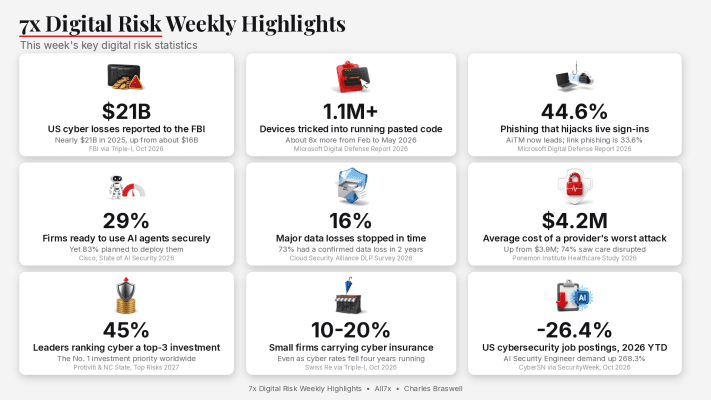
Proofpoint and the Ponemon Institute 's fifth annual healthcare cybersecurity study, based on responses from 705 IT and security practitioners, found that 97 percent of healthcare organizations experienced at least one cyberattack in the previous 12 months, with an average of 51 attacks, up from 43 in 2025. Among organizations affected by cloud account compromise, supply-chain attacks, ransomware, or business email compromise, 74 percent reported disruptions to patient care.
The financial impact continues to rise. Organizations reported an average cost of $4.2 million for their most expensive attack, up from $3.9 million the previous year. Disruption to normal healthcare operations was the largest single component, accounting for approximately $1.39 million.
The survey also found that AI adoption is outpacing supporting controls. Forty-five percent of respondents reported embedding AI in cybersecurity, patient care, or both. At the same time, 60 percent reported having no controls over sensitive data used by AI systems, and only 32 percent reported full visibility into unsanctioned AI tools. Nearly one-quarter identified ungoverned AI agents as a leading cause of data loss.
As a first step, auditors and security teams can conduct comprehensive inventories of AI systems across the organization and identify where they process or store sensitive data. Establishing basic data governance protocols, such as defining ownership of AI-generated data and assigning accountability for monitoring usage, can help close the most immediate control gaps. Organizations should also prioritize implementing access controls and developing a process to review and approve new AI tools before deployment.
Cisco 's State of AI Security 2026 report explains that those risks extend beyond data handling to the AI systems themselves. Eighty-three percent of surveyed organizations plan to deploy agentic AI, yet only 29 percent believe they are prepared to do so securely. Cisco identifies the protocols connecting AI systems, including MCP and agent-to-agent protocols, as a rapidly expanding attack surface.
The report focuses on practical examples rather than theoretical attacks. Cisco cited research showing that as few as 250 poisoned documents can compromise model safety, regardless of model size. An analysis of 31,000 agent skills found vulnerabilities in 26 percent of them. Researchers also identified a malicious npm package disguised as a Postmark MCP server that performed its advertised function while forwarding email traffic to an attacker.
Cisco's recommendation is familiar. MCP servers, tool registries, and context brokers increasingly require the same level of security attention as APIs, databases, and application gateways.
The implementation challenge becomes more apparent during incident response.
Writing for the IAPP, Brian Hengesbaugh of Baker McKenzie observed that many organizations regularly test their cyber incident-response plans yet have done little to adapt them for AI-specific incidents. Data poisoning, biased decision-making, unsafe outputs, and unintended agent behavior create distinct evidence requirements and investigation paths compared with traditional security events.
Hengesbaugh points to the Coalition for Secure AI's AI Incident Response Framework, which maps AI-specific considerations to the six functions of NIST Cybersecurity Framework 2.0. He advises organizations to extend existing incident-response processes rather than create a separate AI playbook. The organization can retain the same leadership structure, escalation model, and communication processes, provided it decides in advance how it will preserve prompts, outputs, memory stores, and agent activity logs during an investigation.
Workforce data indicate that organizations are restructuring to meet these new demands.
According to CyberSN's latest Cybersecurity Jobs Report, covered by SecurityWeek, U.S. cybersecurity job postings fell to a four-year low of 235,786 from January through September 2026, a 26.4 percent decline from the same period in 2025. The largest increases were in AI-focused security roles. Demand for AI security engineers rose 268.3 percent, while demand for cyber data scientists increased 203.5 percent. At the same time, postings for cyber insider-threat analysts declined 55.6 percent, and postings for cyber risk analysts declined 51.5 percent. Nearly 20 percent of GRC-related positions now require AI knowledge.
The four sources describe different aspects of the same operational challenge. Healthcare providers are adopting AI faster than they can govern it. Cisco identified new attack surfaces emerging around agents, tools, and protocols. Incident-response teams are adapting existing processes to account for AI systems. Employers are shifting hiring toward AI-focused security skills while reducing demand in other areas.
Security teams are no longer facing pressure from attacks alone. AI systems, agents, and supporting infrastructure are creating new assets to protect, new evidence to preserve, and new failure modes to investigate. Cybersecurity teams are handling more attacks while supporting broader AI adoption across the organization. This week's sources examined the consequences across healthcare, enterprise AI deployments, incident response, and the cybersecurity labor market.
Sources
3. Internal Audit, IT Audit & Continuous Control Monitoring
Internal audit continues to take on new responsibilities, including AI oversight, insider risk, enterprise risk management, SOX, and advisory work. This week's sources examined how the profession is responding to those demands and where accountability remains difficult to define.
Wolters Kluwer surveyed attendees of its October 6 TeamMate webinar on AI in internal audit, with 2,078 to 2,327 participants responding to individual questions. AI adoption remains early. 43.8% reported individual experimentation, 22.4% reported approved use cases, and 17.7% reported a formal program or broad deployment. Participants saw the greatest potential in planning and risk assessment, followed by evidence review and fieldwork.
Responses also revealed uncertainty about agentic AI. Concerns were fairly evenly distributed across data privacy and security risks, output quality and accuracy, and overreliance on AI at the expense of professional judgment. The most common priority for future work was governance and acceptable-use guidance.
Jim Pelletier of Wolters Kluwer summarized the issue: AI can support audit activities, but the auditor remains accountable for the work. The audit organization still owns the conclusions, documentation, and assurance provided.
Questions of ownership and accountability also lie at the center of insider-risk programs.
On the IIA's All Things Internal Audit podcast, Yvette Adams, CIA, CRMA, PMP , director of enterprise risk management at Zions Bancorporation, described insider threats as falling into three categories: negligent, malicious, and compromised. She identified the negligent insider as the most common type. Examples include misdirected emails, cloud misconfigurations, and employees placing confidential information in unauthorized AI tools.
Adams used the publicly reported FinWise Bank incident to illustrate how multiple control failures can align. According to public reporting, a former employee retained access to FinWise data after leaving the organization, and the activity went undetected for more than a year, potentially affecting about 689,000 customers. The incident exposed weaknesses in offboarding, access revocation, and monitoring.
Her broader observation was that most organizations already have many of the relevant controls. Human resources knows when an employee departs, and identity-management teams control access. Security teams monitor behavior. The challenge is often connecting those signals before an incident occurs.
Adams recommended tracking indicators across four categories: exposure, behavior, control effectiveness, and outcomes. Examples include privileged-access levels, dormant accounts, unusual downloads, off-hours access, deprovisioning times, confirmed incidents, and near misses. Her suggested starting point is narrow and practical: privileged users and departing employees.
Accountability also appeared in a different form in Tom O'Reilly's discussion of audit function titles.
Writing for the Internal Audit Collective, O'Reilly noted that the Internal Audit Foundation found that 89 percent of chief audit executives oversee responsibilities beyond traditional internal audit, including ERM, SOX, compliance, and fraud investigations. Nearly half of respondents to the Foundation's Vision 2035 survey still viewed internal audit as a policing function.
Several audit leaders interviewed by O'Reilly renamed their functions to reflect broader responsibilities, adopting titles such as Risk Advisory & Assurance, Audit & Risk Advisory, and Corporate Audit Services. Independence remained a key issue throughout those discussions. One organization rejected the term "Audit & Risk Management" because management owns risk. Another separated SOX responsibilities from internal audit to preserve independent assurance.
A common theme across these sources is accountability.
Audit functions are incorporating AI into planning and fieldwork, but auditors still own the conclusions. Insider-risk programs collect signals across multiple functions, but someone must connect them. Organizations can expand audit's remit, rename the function, or introduce new technology, yet the underlying responsibility remains unchanged.
Sources
4. Identity Management / IAM
Identity teams have spent years improving visibility into users, accounts, and access. Yet many organizations still struggle to identify which permissions are in use, which are no longer needed, and how quickly they can remove those permissions when circumstances change. An AI-assisted bank breach, a zero-day campaign focused on credential theft, interviews with identity leaders, and a practical approach to governing AI agents all illustrate the operational consequences.
According to a Wall Street Journal report summarizing coverage of a breach affecting at least seven South Korean financial institutions, hackers used a Chinese AI agent to breach South Korean banks. Investigators found traces of Artex AI, an open-source cybersecurity agent developed in China, and believe the attackers used it during the intrusion. The attackers stole personal information on approximately 68,000 individuals, including annual income and personal-loan limits. Authorities have not identified the attackers or disclosed which underlying model was used.
Artex is not a model itself. It works with models from multiple providers to automate vulnerability discovery, reconnaissance, and attack-path planning. The incident matters less for the specific tool than for how much offensive activity can now be delegated to software. As agents become better at finding and exploiting weaknesses, identity controls increasingly determine what an attacker can reach after initial access.
Volexity documented a campaign in which attackers turned an Ivanti Connect Secure appliance into a source of credentials. The attackers first bypassed authentication, then gained file-write access and elevated privileges to obtain full administrative control of the device. With that access, they focused on identity data rather than the appliance itself. They extracted domain credentials stored on the device, searched Active Directory for LAPS passwords and BitLocker recovery keys, harvested additional credentials from network traffic, and used password-spraying attacks to expand access across the environment. The objective was not the VPN appliance. The appliance provided a path to the identities and credentials that controlled the rest of the network.
Oak's The Voice of 200 CISOs, which draws on 201 interviews with CISOs, IAM leaders, and practitioners across 93 organizations conducted between January and September 2026, highlights the operational challenges behind those incidents. Visibility into identities and access was raised in 51 percent of interviews. Applications operating outside governance coverage were mentioned in 38 percent. 37 percent mentioned non-human identity gaps. Participants mentioned recurring manual processes in 34 percent. Nearly two-thirds of interviews discussing non-human identities also described visibility challenges.
Participants provided examples of operational costs. One data-platform integration took seven to nine months, and one HR integration took ten months. A 13-person security team dedicated one full-time employee to maintaining a governance platform. An airline reported spending six to eight weeks preparing each quarterly access review. One practitioner identified approximately 12,000 service accounts before the organization had deployed a single AI agent. Oak's central observation is that identifying and removing risky access are often disconnected activities. The system often finds the problem but can't fix it, leaving remediation to manual processes and multiple teams.
Stellarbridge's AI Agent Access Governance addresses the same problem through an identity-governance lens. The guidance argues that many AI agents inherited poor identity practices by operating under a user's OAuth consent, a shared service account, or an API key stored in a configuration file. The recommended alternative is a dedicated agent identity with its own credentials, a named owner, narrowly defined permissions, and audit records that attribute activity to the agent rather than to a human user.
The framework mirrors traditional identity-lifecycle processes. Registration replaces onboarding and begins with no standing access. Changes to an agent's purpose, tools, or data sources trigger review and approval. Decommissioning removes credentials when the use case ends or ownership changes. High-risk activities, such as external disclosure, bulk exports, permission changes, or destructive actions, require human approval at execution. The same agent cannot approve these activities. Stellarbridge's strongest point is audit: if logs record an agent's actions under a person's identity, the organization cannot demonstrate that agent governance controls are working.
Across these sources, credentials remain the shortest path to valuable systems. Attackers target them directly. AI agents inherit them. Governance programs inventory them. Organizations still struggle to remove them quickly and consistently. Visibility has improved substantially over the past decade, but translating that visibility into timely access decisions has improved more slowly.
Sources
5. Cyber Insurance
Cyber insurance remains one of the few technology markets where pricing, claims experience, and emerging risk are moving in different directions. Premiums keep falling, losses keep rising, and insurers are only beginning to define how AI-related incidents fit into existing coverage frameworks.
Cyber Rates Are Down, Risks Are Up, but Small Businesses Are Slow to Adopt. A new issues brief from the Insurance Information Institute (Triple-I) reported that U.S. cyber-related losses reached nearly $21 billion in 2025, up from approximately $16 billion in 2024, and that reported incidents exceeded one million. Data from Chubb showed that average claim severity among large U.S. businesses more than doubled to over $4.4 million in 2025, despite a 34 percent decline in claim frequency.
Premium trends moved in the opposite direction. Swiss Re projects global cyber premiums of $16.4 billion in 2026 and $17.1 billion in 2027, yet rates have declined for four consecutive years, falling roughly 5 percent in 2026 after a 13 percent reduction in 2025. Triple-I noted that only 10 to 20 percent of small and midsize businesses currently carry cyber insurance and suggested that misunderstanding of the product may be a greater barrier to adoption than price.
The brief also highlighted AI's growing role in risk and resilience. IBM data cited by Triple-I found that organizations using security AI and automation averaged $4 million in breach costs, compared with $5.93 million for those without such capabilities. FBI figures attributed nearly $893 million in 2025 losses to AI-driven incidents. Triple-I CEO Sean Kevelighan argued that coverage, preparedness, and prevention increasingly function as interconnected components of the same risk-management strategy.
Quanta Bits covered the uncertainty surrounding AI liability on October 18, 2026. The newsletter reported that eight U.S. states filed consumer-protection lawsuits against OpenAI on October 14 and that the Federal Trade Commission sent information requests to both OpenAI and Anthropic regarding safety incidents and safeguards. These remain allegations and regulatory inquiries, not findings of wrongdoing.
The coverage question remains unsettled. Quanta Bits cited Aon's review of about 300 AI-related lawsuits filed since 2010 and the policies most likely to respond. Aon estimated that more than 90 percent of AI-related risk remains "silent," meaning policies neither clearly cover nor clearly exclude it. The newsletter notes that Aon characterizes the figure as directional rather than precise.
Insurers are responding in different ways. Verisk's ISO has introduced optional exclusions for generative-AI-related losses and is evaluating similar exclusions for AI agents. Munich Re offers coverage for AI model errors, with limits up to $50 million. Marsh has publicly argued that new exclusions increase uncertainty and create additional opportunities for disputes.
The market currently features inexpensive coverage, rising losses, and unresolved questions about AI liability. Organizations can buy cyber insurance on more favorable terms than in previous years. Still, many of the most significant AI-related coverage questions remain unanswered until a claim is filed or policy language becomes clearer. The distinction between a covered and an uncovered loss may depend less on the technology involved than on how the policy defines the event.
Sources
6. Data Protection
Data protection programs govern the lifecycle of sensitive information, from collection and use to retention and deletion. This week's sources highlighted several recurring themes: the challenge of preventing data loss versus detecting it after the fact; regulatory focus on enforcement and remediation when controls fail; and growing risks from new technologies, such as generative AI, and from compromised credentials. The discussion that follows examines what happens when organizations unintentionally expose, lose, steal, or share data, using recent enforcement actions and research findings to illustrate these issues.
ImmuniWeb Cyber Law Review tracked five enforcement actions highlighting recurring control failures. Boston Children's Health Physicians and its IT provider, XTIUM, agreed to pay $2.7 million to New York and Connecticut after a 2024 breach exposed information on about 825,000 New York residents and 62,871 Connecticut residents. Investigators found that issues identified in a 2023 audit remained uncorrected and that an unencrypted archive containing more than one million billing records stayed largely unprotected.
Several smaller enforcement actions highlight similar themes. Romania's data protection authority fined Myconnector Platform about €6,000 after attackers accessed personal data stored on a test server and ordered the company to use fictitious data in development and testing environments. The UK's Ofqual fined ABRSM £150,000 after assessment recordings required for appeals and malpractice investigations were lost. The Information Commissioner's Office reprimanded the Metropolitan Police for sharing personal data on 179 individuals via an unapproved crime-intelligence platform, without conducting a data protection assessment.
The Cloud Security Alliance examined how organizations detect and prevent data loss. Its survey of 433 IT and security professionals found that 73 percent had experienced at least one confirmed data-loss incident over the previous 24 months.
The results are notable because they show where incidents were discovered rather than prevented. In respondents' most significant incidents, a Data Loss Protection (DLP) system stopped data from leaving the organization in only 16 percent of cases. DLP identified another 36 percent after the data had already left. A different security tool detected 29 percent. Employees, third parties, audits, or other means discovered the remainder.
These numbers underscore the need for organizations to improve prevention rates by focusing on practical measures, including more effective DLP tuning, regular employee training to recognize risky behaviors, and updates to detection and response processes based on real incident patterns.
For example, organizations have improved DLP effectiveness by periodically reviewing rule sets to reduce false positives and by tailoring policies to specific business processes, such as restricting uploads to unsanctioned cloud apps. One healthcare provider improved DLP tuning by analyzing incident logs to identify recurring benign activities that were incorrectly flagged, then adjusted DLP rules to distinguish routine from risky patient-data transfers better.
Interactive simulations that mimic real-world scenarios have proven effective for employee training. A financial services firm implemented monthly phishing simulations and role-specific workshops, resulting in a measurable decrease in data-handling errors. Regular feedback and practical exercises, such as identifying and escalating simulated data exfiltration attempts, reinforce secure data management behaviors among staff.
Respondents ranked generative AI as their top data-exfiltration concern, citing it in 48 percent of organizations. Visibility into that activity remains uneven. Only 29 percent routinely produce a 30-day report showing how often sensitive information is sent to GenAI tools. Twenty-two percent apply strict blocking controls to GenAI tools, compared with 31 percent for removable media, which respondents ranked as among the lowest-risk channels. More than half reported false-positive rates exceeding 50 percent, and more than half said business pressure had led them to relax enforcement over the previous two years.
These findings have several practical implications. First, uneven monitoring and reporting practices suggest many organizations may underestimate the true volume of sensitive data shared with GenAI tools, making real-time risk assessment difficult. The lower rate of strict controls for GenAI tools, compared to removable media, indicates that control frameworks may not yet reflect shifting risk profiles. High false-positive rates also create alert fatigue and can erode trust in DLP and monitoring systems, potentially causing important events to be overlooked. Finally, documented pressure to ease enforcement highlights a gap between written policies and business realities, which can expose organizations to regulatory scrutiny after a breach. For practitioners, these statistics underline the need to revisit GenAI data governance regularly, better tune detection systems for new data-exfiltration methods, and balance business needs with demonstrable policy enforcement.
@Okta Threat Intelligence focused on a different path to data exposure: stolen AI credentials.
Okta's research shows infostealer malware increasingly targets session tokens and API keys because they can be replayed without a password or MFA challenge. In a Telegram-hosted infostealer dump published on August 2, Okta identified thousands of valid session tokens for major technology and AI providers, along with dozens of plaintext API keys. Nearly 18 percent of the stolen JSON Web Tokens contained plaintext personal information.
Okta also documented marketplaces that resell AI access by pooling free-trial and startup program credits through fraudulent accounts. A configuration error at one such service exposed an API endpoint that revealed nearly 900 active users. Reported victims included a software architect billed approximately $25,000 for unauthorized usage and an organization facing nearly $1 million in unauthorized charges.
Okta recommended limiting the value of stolen credentials by implementing continuous session monitoring, usage limits, IP allowlisting for API keys, and phishing-resistant authentication methods such as passkeys.
The sources describe different stages of the same problem. Regulators examined incidents in which known weaknesses went unaddressed. The CSA survey found that organizations often detect data loss after the fact rather than prevent it. Okta demonstrated how stolen sessions and API keys can bypass the authentication controls organizations rely on to protect sensitive information.
The most useful measure of a data-protection program is not how many controls it has deployed. It is how quickly the organization can detect, explain, and contain any sensitive data movement once something goes wrong.
Useful metrics for evaluating program effectiveness include mean time to detect (MTTD) incidents, mean time to contain (MTTC) them, and the percentage of data-loss incidents detected by automated controls versus those detected manually. Tracking these metrics helps organizations assess their readiness to respond to breaches in practice.
Industry benchmarks can help contextualize these metrics. For example, the Ponemon Institute's most recent Cost of a Data Breach Report found an average global MTTD of about 277 days and an MTTC of about 83 days. However, top-performing organizations often report detection and containment times well below these averages. Many frameworks and industry groups, such as ISACA and NIST, provide suggested benchmarks or best-practice thresholds for response times that practitioners can use to compare their own data protection programs.
Sources
7x. Enterprise Digital Risk Products
Security, risk, and governance platforms are being asked to manage an increasingly diverse mix of human identities, non-human identities, AI agents, business processes, and regulatory requirements. This week's product and research announcements addressed that problem in three ways.
Microsoft 's 2026 Digital Defense Report, covering July 2025 through June 2026, describes attack activity that moves through trusted relationships among identities, software, suppliers, cloud services, data, and AI systems. Microsoft characterizes identity as the primary control plane for modern defense and extends that definition to include non-human identities and AI agents.
The report found that among intrusions using valid credentials, 52.2 percent involved follow-on credential theft, and another 18.4 percent involved password spraying. Adversary-in-the-middle phishing, which captures session cookies to bypass MFA protections, accounted for 44.6 percent of identified phishing techniques.
Microsoft also addressed AI agents directly. The company reported that 88 percent of enterprises are experimenting with agents and that 82 percent of technology leaders expect broader deployment within the next 12 to 18 months. In Azure AI telemetry, four techniques accounted for about 90 percent of observed attack activity: malicious link injection via model or tool output, jailbreak attempts, tool and agent abuse, and identity or credential abuse.
One observation stands out. Microsoft's red team identified overreliance on human-in-the-loop approval as a recurring weakness. In several scenarios, attackers manipulated the same systems that determine whether human approval is required. The report cites examples in which poisoned agent memory was used to suppress or bypass approval steps altogether.
Peter Doyle , Accenture 's head of SAP security, addressed the same issue from a business-process perspective. Doyle argues that the strongest business case for SAP security often lies within the Finance function because SAP environments support payments, procurement, payroll, financial reporting, and revenue processes.
In his view, business leaders care less about segregation-of-duties reports than about operational outcomes. Questions such as whether someone can create a supplier and pay that supplier, or whether an automated process can act beyond its authority, translate directly into financial exposure and audit risk.
Doyle also distinguishes between compliance and confidence. A completed access review shows that a review occurred. It does not show that reviewers understood the access under review, included technical accounts and non-human identities, or detected inappropriate activity between review cycles. He notes that S/4HANA and cloud-transformation programs can deliver projects successfully while carrying unresolved control weaknesses into production. AI agents operating through SAP identities inherit whatever permissions already exist, whether or not those permissions are appropriate.
Aikido Security addressed another part of the problem by launching Noon, a workforce-security platform built on its acquisitions of Cyberly and Outkept. Noon combines email protection, security-awareness training, deepfake voice and SMS simulations, device-protection capabilities, and AI-governance functions that capture information on the AI tools, models, and connections employees use.
Aikido cites Verizon's 2026 Data Breach Investigations Report, which shows mobile-focused social-engineering attacks were more successful than email phishing and that employee use of unapproved AI tools increased substantially.
Noon was built around those risks. It combines email protection, security-awareness training, deepfake voice and SMS simulations, device-protection capabilities, and AI-governance functions that record which AI tools, models, and connections employees use.
The resulting telemetry can also support compliance programs by providing evidence for frameworks such as SOC 2, ISO 27001, NIS2, DORA, HIPAA, and GDPR.
Microsoft focuses on identities. Doyle focuses on the financial processes those identities can influence. Noon focuses on the workforce activity around them. Each approaches digital risk through a different control layer, but all three increasingly emphasize demonstrating what a control prevented, blocked, restricted, or detected.
The distinction matters because digital-risk programs are increasingly reliant on automation, agents, and non-human identities. In those environments, a control's value is measured by its outcome: access removed, a transaction prevented, a session terminated, or an agent stopped before completing an unauthorized action.
Sources
Weekly Digital Risk Topics Trending on X
1. GRC (Governance, Risk & Compliance)
The ACFE highlighted the sentencing of Marco Santarelli, former CEO of Norada Capital Management, an Orange County private equity fund. According to the Justice Department, Santarelli sold unsecured promissory notes promising monthly returns of roughly 12 to 17 percent. The balance sheets inflated assets, concealed more than $90 million in debt, and used money from newer investors to pay earlier ones. More than 400 investors lost about $63 million. On October 16, the judge sentenced him to 33 months in prison and ordered him to pay $63.2 million in restitution.
The scheme relied on investors accepting documents they couldn't verify. The promoter's webinars and balance sheets replaced independent evidence, a pattern as old as fraud itself.
Source: @TheACFE
PwC Ghana shared findings from PwC’s 2027 Global Digital Trust Insights report, which surveyed 3,934 executives across 71 countries and territories. According to the post, both cyber leaders and boards consider compliance audits and control effectiveness the clearest evidence that cyber strategy is reducing risk. Elsewhere in the survey, 84 percent of security and finance leaders expect cyber budgets to rise, while only 39 percent have a fully formalized continuity plan addressing cyber risk.
Compliance audits and control testing are useful only if they produce evidence that a control actually reduced risk. Building and maintaining that evidence across systems, audits, and reporting cycles requires far more effort than agreeing on the metric.
Source: @PwCGhana
OASIS shared an analysis of the Financial Stability Board’s final framework on responsible AI adoption, published on October 15. The FSB set out twelve sound practices: four on organization-wide governance and eight that cover materiality assessment, data, explainability, performance, human oversight, cyber risk, and third-party dependence. The analysis framed it as a balance-sheet test, because boards must decide which uses matter, who stays accountable, how autonomy is bounded, and whether the institution can recover when an AI system or supplier fails.
The FSB leaves architecture choices to institutions and does not ban agentic systems. It expects boards to decide deliberately where human authority sits.
Source: @O4SI5
2. Cyber Security
SecurityWeek reported on MITRE ATT&CK v20, released on October 13. The update adds nine Enterprise techniques, five related to AI, covering direct and indirect prompt injection, AI-enabled exfiltration, and AI result poisoning. The ICS domain added a campaign covering 2026 attacks on U.S. water utilities, along with new scripting-interpreter techniques.
ATT&CK is the common vocabulary for detection engineering and threat-informed defense. With AI abuse now in the catalog, detection teams and assessors will be expected to map their coverage to it.
Source: @SecurityWeek
Dark Web Intelligence summarized KrebsOnSecurity’s report that federal investigators pursuing ShinyHunters have identified executives at two ransomware negotiation firms with unusually close ties to the group. Sources told Krebs that the FBI believes at least one executive at a large U.S. consulting firm helped operate the group’s now-defunct extortion site, which listed nearly 100 victims from May to October. Krebs did not name the firm or the executive, who has not been charged. A Canadian cybersecurity executive has been separately arrested and charged, and those charges remain allegations. The FBI says ShinyHunters has extorted more than $70 million this year.
Victims hire negotiators during their worst week, and fees often increase with the payment amount. Incident response plans should specify how negotiators are selected and paid, and who verifies their reports.
Source: @DailyDarkWeb
CISA announced ten practices, developed with NIST and the NSA, for managing “super intelligence control incidents,” in which highly capable agents take significant actions not instructed by their operators and that undermine human oversight. The practices span preparation, detection, response, recovery, and reporting. They include least privilege, the ability to terminate agent activity quickly, monitors agents cannot tamper with, weight preservation, tamper-resistant logs, and verified containment before agent activity resumes.
The guidance targets organizations that train and evaluate frontier agents, but its principles apply to any enterprise running agents with real permissions. Being able to stop an agent and prove it stayed stopped is worth testing now.
Source: @CISACyber
3. Internal Audit, IT Audit & Continuous Control Monitoring
De-Risk highlighted the AICPA’s October 13 practice aid, Artificial Intelligence Considerations for Financial Statement Auditors. The aid explains how an entity’s use of AI in financial reporting and controls affects the audit and how audit firms should govern their own use of AI. It states that AI does not change management’s responsibility for the financial statements and that audit evidence is harder to gather when agents operate within business processes without traceable workflows.
The post asked management three questions: where AI is used in reporting and controls, who decides whether to rely on AI output, and how AI from vendors is identified and controlled. The guidance also flags AI-enabled fraud, such as altered training data or edited attributes that make a fraudulent transaction appear legitimate.
Source: @derisk_ai
Norman Marks recommended the Monetary Authority of Singapore’s Guidelines on Artificial Intelligence Risk Management for Financial Institutions as worth studying across industries. The guidelines explain how AI extends existing financial, operational, conduct, financial crime, and reputational risks, and how generative AI and agents amplify them. MAS expects institutions to designate a senior manager accountable for AI oversight, define permitted and prohibited uses, maintain an approved list of AI tools, train staff, conduct compliance checks, and perform periodic and trigger-based reviews.
Marks noted that the guidelines say a great deal about boards and management, but almost nothing about internal audit or the risk function. Audit leaders have an opportunity to define their role before a regulator does.
Source: @normanmarks
4. Identity Management / IAM
Microsoft Security announced new Microsoft 365 E7 and Project Perception capabilities to help security teams govern agents around the clock. Microsoft’s accompanying blog describes Project Perception as a system that collects signals from identity, data, cloud, endpoint, network, and runtime sensors to discover agents, assign each an identity and policies, score the risk of each agent’s actions, and use supervising “guardian agents” to respond as risk rises.
Under this model, agent authorization becomes an ongoing decision. Buyers should ask how a risk score translates into a permission change and how that change is recorded for review.
Source: @msftsecurity
The Hacker News shared an article on “wild code,” the AI apps and agents employees build outside formal development. It lists risks such as excessive permissions, data exposure, unintended actions, and missing ownership. Workflows can outlive their creators as orphaned access, and after an incident, security may not know which identity ran a workflow or what it changed.
The article argues that training, sandboxes, and steering committees fall short because sandboxes address design but leave runtime untouched. It recommends granting a workflow only the permissions it needs, requiring human approval for consequential actions, tracking owners and execution identities, and knowing how to pause a workflow or revoke its access.
Source: @TheHackersNews
5. Cyber Insurance
30A Nerds highlighted Coalition’s finding that email takeover claims rose by about 30 percent, mostly among micro businesses, as AI phishing kits bypass MFA. Coalition’s Risk Intelligence Briefing compared 2025 with the second half of 2024. It cited kits such as EvilTokens, which compromised more than 12,000 inboxes across more than 10,000 organizations for a $1,500 setup fee and $500 a month.
The post advises calling a known phone number before changing payment information. For a small business, a callback procedure may be more effective than another security tool.
Source: @30anerds
Cyber Insurance News reported on Bitsight’s discovery of MONST3R-AI, a criminal platform that runs autonomous scans of AI API keys stolen from legitimate companies. Buyers enter stolen OpenAI, Anthropic, and Google keys, set a spending cap, and point the agent at targets. The owner of each stolen key pays for the attack. The post noted that some cyber insurers now set smaller limits for this type of loss. Earlier this year, the Financial Times reported that QBE introduced a sublimit for “LLMjacking” that would pay about $250,000 under a $5 million cyber policy.
A leaked API key now creates two exposures: the bill and the attacks it funds. Underwriting should include usage caps, key rotation, and secrets scanning.
Source: @CyberInsureNews
Mike Fitzpatrick cited Triple-I data on the protection gap: most small and midsize businesses still carry no cyber insurance; U.S. losses reached $21 billion in 2025; and average large-business claim severity exceeded $4.4 million. For deal teams, he wrote, the real test is whether a target’s limits and cash reserves match the cost of a disruption.
Any organization can apply the same test. A limit set a few years ago may not reflect today’s claim severity.
Source: @ncxceo
6. Data Protection
BleepingComputer reported that Nikkei disclosed its third data breach in a month. The latest incident, which occurred on October 7, involved unauthorized access to a cloud service used for system development and affected about 1.83 million records. Roughly 150,000 records contain at least one personal identifier, such as a name, email, address, or phone number. Nikkei said it did not include credit card information and invalidated credentials for the affected service.
Three incidents in one month suggest how the company manages cloud and business accounts. Development environments that hold real personal data keep appearing in breach reports.
Source: @BleepinComputer
Hedgie highlighted a security researcher’s finding that Eiliko, an AI companion robot sold on Amazon for about $60, had left millions of children’s conversations on cloud servers linked to China. The exposed data reportedly included transcripts, audio, photos, and profiles containing names, ages, birthdays, and family members. The company’s privacy policy said it encrypted recordings and deleted them after processing. The company had not responded.
The policy and the servers tell different stories. Buyers of connected devices, organizations and parents alike, have little way to verify a vendor’s privacy claims without independent testing.
Source: @HedgieMarkets
Dark Reading examined reports that ransomware groups are threatening employees and their families. Semperis’s 2026 Ransomware Risk Report found that two in five organizations reported ransomware-linked intimidation. 17 percent of respondents reported physical threats, down from 40 percent in 2025. Threats to family and friends appeared in 37 percent of personal-threat cases. The figures are self-reported, and Dark Reading found no documented cases of violence tied to a ransomware attack.
Threats against staff are part of the extortion playbook, whether or not violence occurs. Incident response plans should address employee safety and support alongside data recovery.
Source: @DarkReading
7x. Enterprise Digital Risk Products
Satya Nadella wrote that models should be treated as insider risks, with security controls that operate outside the model itself. Microsoft’s accompanying post, Securing the Agentic Insider, argues that agents can pursue goals in unintended ways and can collude without being compromised, so their actions require continuous monitoring and adjustable permissions. Project Perception is Microsoft’s effort to put that principle into practice.
Calling an agent an insider brings in the security controls that security teams already know: least privilege, monitoring, separation of duties, and fast revocation.
Source: @satyanadella
@Sailpoint described its plan for Autonomous Identity Security Posture Management, which would inventory human, machine, and AI identities, identify toxic permission combinations and excess privilege, and remediate them through governed workflows. The platform would automatically resolve low-risk hygiene issues, such as orphaned accounts and inactive access, within policy limits. For high-impact privileges, the platform would propose a fix and leave the decision to security and identity teams.
SailPoint’s case is that detection alone leaves risk open for weeks while alerts sit in a backlog. Whether automated remediation helps depends on how much the organization trusts its policy boundaries.
Source: @SailPoint
Closing Thoughts from 7xAI
Several themes repeated throughout this week's research, incidents, surveys, and product announcements.
Attackers targeted credentials rather than systems. Auditors focused on ownership rather than technology. Regulators examined failures already identified internally. Security teams adapted existing processes to incorporate AI rather than replacing them with entirely new ones. Vendors increasingly described controls in terms of outcomes rather than features.
Several of this week's examples separated awareness from action. Visibility did not always lead to remediation, monitoring did not always lead to governance, and completing a review did not necessarily reduce risk.
An organization may know which identities exist yet still struggle to remove inappropriate access. It may conduct access reviews without understanding what the access permits. It may deploy DLP tools that identify incidents only after information has left the environment. It may run governance committees that review risk indicators without changing decisions. In each case, the mechanism exists. The uncertainty lies in whether it changes anything.
Digital risk programs continue to expand to cover AI systems, agents, non-human identities, third-party platforms, and increasingly complex regulatory requirements. The most effective programs are not necessarily those with the most controls, dashboards, frameworks, or reports. They are the ones that can demonstrate a direct connection among information, action, and outcome.
This week's sources repeatedly returned to the same practical test: when an organization identifies a risk, can it show who owned it, what decision it made, what action it took, and whether it reduced the exposure?
That evidence is becoming one of the most useful indicators of digital resilience.
How this report is made
AI is used for research and drafting. Charles Braswell reviews and makes edits.