
Insights/7x Digital Risk Report
Highlights: Trust granted once and never rechecked
A weekly report covering key developments, emerging risks, and practical insights in digital risk: cyber, GRC, audit, identity, and data protection.
Charles Braswell · October 30, 2026
Executive Summary
Most of this week's developments trace back to trust granted once and never rechecked. A certificate authority, an approved tool, a vendor's access key, a former employee's account, and a "yes" on an insurance application each seemed reasonable when first accepted. Each became a liability when conditions changed, and no one confirmed that the original decision still held.
The clearest example came from the infrastructure that secures the web. On October 17, a researcher reported that eight intermediate certificates operated by India's eMudhra had private keys so weak they could be computed from public information. Browser makers blocked them within hours, and eMudhra traced the weak keys to a flawed script used in an April 2025 key ceremony. PHP2Shell showed the same problem on the defender's side. A widely shared one-line workaround blocked one exploit path for one of the two flaws, and attackers had working shells on honeypots three days after the patch was released.
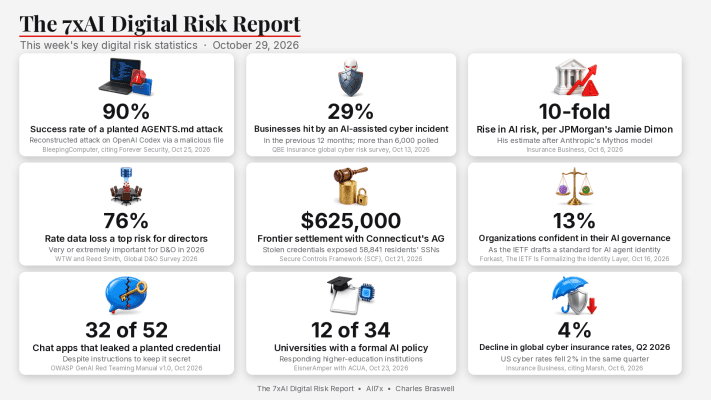
AI incidents are reaching boards and executives, yet most organizations are not changing their governance in response. In an IBM study of 3,221 executives in Europe and the Middle East, 80 percent said an AI incident reached the board or C-suite in the past year, yet only 40 percent of those organizations changed their AI governance afterward. Norman Marks questioned whether auditors can rely on a single test of an AI-enabled SOX control, because that practice assumes the control does not change. Georgia's single audit found more than $1 billion in pandemic unemployment claims that had not been reviewed for eligibility.
NIST's proposed design tenets for agent identity would make trust expire by default, with no standing privilege and short-lived, revocable authorization. Workday agreed to acquire C1.ai to govern access for people and agents, while ID-JAG, the leading draft standard for agent authorization, remains an Internet-Draft that vendors are already shipping. A Sagiss survey found that 79 percent of former employees still had at least one active account after their last day.
Insurers are reevaluating what they accept as proof. Marsh reported that MFA adoption rates on its self-assessment tool have reached 90 to 100 percent. A Marsh McLennan study on trade reporting found Endpoint Detection and Response (EDR) deployment at 91 percent, so a "yes" no longer separates one applicant from another. Prices are still not rising. Marsh's third-quarter index showed global cyber rates down 4 percent for the thirteenth straight quarter and U.S. cyber rates flat. In WTW's directors' and officers' survey, only 55 percent of respondents agreed that their boards have the skills to oversee AI.
This week's data protection failures stemmed from routine activity. A KPMG employee sent a sensitive Services Australia document from the wrong email account. An instruction file named AGENTS.md , stored in a Downloads folder, guided an AI coding agent. Denver Health Medical Plan learned that a vendor's access key to its members' data had been on a public website for about 14 months. Connecticut's $625,000 settlement with Frontier followed a breach that began with compromised employee and vendor credentials.
Product announcements point to continuous revalidation. Claude Security now rescans repositories as code changes and reopens findings when a fixed flaw reappears. AWS Continuum confirms exploitability before proposing a fix and requires human approval before any fix ships. Microsoft Entra ID Protection added a detection for suspicious credential additions, and Microsoft is creating tamper-evident records of its own engineers' access to in-scope production systems in the EU and EFTA.
For each trust grant that matters, an organization should know when it was last verified, what would indicate that it has changed, and how quickly it can be withdrawn.
Deep Research
1. GRC (Governance, Risk & Compliance)
Most GRC programs are designed to record decisions: a risk accepted, a control approved, a policy exception granted, or a disclosure filed. Once recorded, a decision can remain in place even after the conditions that made it acceptable have changed.
Practical triggers for such reviews include exceeding key risk indicator thresholds, changes in regulatory requirements, material changes to business operations or suppliers, the discovery of new incidents or threats, monitoring alerts from control owners, audit findings that reveal gaps, and updates from internal or external assessments. Automating monitoring of these indicators or scheduling regular reviews can help GRC teams detect when the original assumptions no longer hold and when a decision may need to be revisited.
On October 23, GRC 20/20 Research , the analyst firm led by Michael Rasmussen , released three reports describing what it calls GRC 7.0, or GRC Orchestrate. The 48-page Strategy Perspective outlines how organizations should design their GRC capabilities. The 93-page Buyer Perspective provides 98 evaluation criteria across 15 architectural families, and the 143-page Market Perspective examines how AI may change the GRC technology and services market.
Rasmussen begins by distinguishing between managing GRC activities and governing the business itself. He describes an energy company in which a compliance problem became a project problem, then affected business performance, and eventually became a public-trust problem. Closing the original compliance finding would have completed the GRC activity without showing whether the wider consequences had been resolved.
That example highlights a limitation of traditional GRC systems. An organization can maintain risk registers, controls, assessments, policies, and reports while still struggling to understand how a change in one part of the business affects objectives and dependencies elsewhere.
GRC Orchestrate addresses that problem by adding orchestration capabilities to existing systems of record. Rasmussen describes a System of Intelligence that links changing conditions to objectives, decisions, dependencies, and obligations. A System of Action coordinates authorized responses and records the resulting outcome. A System of Configuration manages the rules, workflows, agents, and integrations that enable those activities.
The design does not assume that every GRC activity should become an AI-agent workflow. Rasmussen explicitly retains roles for people, deterministic rules, and established processes. The technology adapts to the type of decision being made rather than replacing every existing mechanism with an agent.
The Buyer Perspective makes that idea particularly concrete. Rasmussen asks buyers to look beyond whether a demonstration works under ideal conditions. Suppose an agent executes an approved action in another system, but the acknowledgment confirming the action is lost. A reliable architecture must recognize the uncertain result, reconcile what actually happened in the external system, and avoid re-executing the action.
That is a different test from asking whether the agent completed the demonstration. It tests how the system responds when the business state and the state recorded by the GRC platform no longer agree.
The Buyer Perspective applies similar discipline to product evaluation. Mandatory acceptance requirements remain separate from weighted scores so that an otherwise high average score cannot mask a failure on a critical requirement.
KPMG 's guidance on enhanced cybersecurity regulation addresses the same problem through disclosure decisions.
In 2023, four members of KPMG's Technology Assurance practice published the guidance, before the SEC finalized its cybersecurity disclosure requirements. KPMG cited a survey showing that 83 percent of companies experienced a cyberattack in the previous year and that it took an average of one month to contain it fully.
Much of KPMG's guidance remains relevant because it focuses on the process that supports disclosure rather than predicting the final regulation. KPMG recommended benchmarking cybersecurity maturity against peers, supplementing self-attestation with independent assessments or cybersecurity-focused SOC reporting, and setting expectations for how often the board, audit committee, and controller receive information security briefings.
KPMG also recommended testing the entire disclosure process. This includes documenting an incident, determining materiality, drafting the disclosure, reviewing incidents collectively rather than one at a time, and ensuring that the required participants can complete those activities under pressure.
The SEC ultimately required companies to make materiality determinations without unreasonable delay and to file a Form 8-K within four business days of determining that an incident is material.
Those requirements have been in effect since December 2023, but the disclosure regime itself is now under review. In January 2026, the SEC requested comments on reforms to Regulation S-K. Since then, banking trade associations, the Society for Corporate Governance, and CTIA have urged the Commission to rescind Item 1.05 of Form 8-K. Debevoise counted 29 issuers filing under Item 1.05 and another 50 under Item 8.01 between the SEC's May 2024 clarifying statement and May 2026.
The regulatory outcome may change, but the underlying work remains. Companies still need to understand an incident quickly enough to make a defensible materiality decision, identify who needs to participate, and preserve the information supporting that decision.
KNAV's October 28 acquisition of Fastrics brings another aspect of GRC into the discussion: connected reporting.
KNAV, a global accounting and advisory firm, acquired Fastrics, a Florida-based technology consulting and digital transformation firm, adding 28 U.S.-based professionals. Fastrics specializes in technology and cyber risk, compliance automation, and connected reporting, with particular experience with Workiva .
Corey Sherman , Managing Partner of Fastrics and close friend of legendary CISO Andrew Cannata, Veteran and serial entrepreneur Peter Armstrong , described the combination as an opportunity to bring the firms’ capabilities together: “We are excited to join KNAV and become part of a firm that shares our commitment to innovation, excellence, and client service. By combining our digital transformation, data analytics, cybersecurity, and technology risk expertise with KNAV’s advisory, risk, accounting, tax, and compliance capabilities, we can deliver greater value to clients as they respond to changing business and regulatory requirements.”
KNAV said the acquisition complements its Risk Advisory practice and its GRC Hub, which integrates governance, risk, compliance, internal controls, and reporting into a common framework. The company also linked the acquisition to continued investment in KNAV TARA, its internal AI platform.
Connected reporting can reduce the reconciliation required when the same underlying information appears across financial reporting, GRC, and internal-control processes. It also increases the need to validate information before reusing it. An incorrect or stale input that feeds several connected reports can propagate the same problem to each of them.
Rasmussen, KPMG, and KNAV address different aspects of GRC, but each underscores the importance of keeping information valid after the initial decision. A risk acceptance depends on the assumptions that supported it. A materiality determination depends on what was known at the time of the decision and on whether additional incidents alter that assessment. Connected reporting depends on the quality of the underlying information as it is reused.
For significant risk acceptances, policy exceptions, and materiality decisions, GRC teams should document the conditions supporting the original decision and specify what types of changes would require another review. The decision record remains useful only as long as its underlying assumptions hold.
Sources
- GRC 20/20 Research: GRC 7.0, Three Perspectives on One Connected Future
- KPMG: Navigating Enhanced Cybersecurity Regulations
- Business Wire: KNAV Acquires Fastrics to Expand GRC and Connected Reporting Capabilities
- SEC: Cybersecurity Risk Management, Strategy, Governance, and Incident Disclosure Compliance Guide
- Debevoise: Cybersecurity Incident Disclosure Form 8-K Tracker (Two-Year Update)
- CTIA: Comment on Reforming Regulation S-K
2. Cyber Security
A patch, a closed finding, or a successful test records that remediation work occurred. It does not necessarily establish that the exposure is gone. This week's sources focus on the difference between completing the remediation and verifying the result.
PHP2Shell provides the most immediate example.
On October 21, PHP released emergency updates addressing two critical vulnerabilities, CVE-2026-109618 and CVE-2026-109619, collectively known as PHP2Shell. Both vulnerabilities received a 9.2 CVSS v4.0 rating and can enable unauthenticated remote code execution. PHP released fixes in versions 8.5.12, 8.4.27, 8.3.36, and 8.2.35, along with minimal source backports for versions 7.4, 8.0, and 8.1. PHP 8.2 reaches end of life on December 31, 2026.
TryHackMe's October 24 technical analysis explains why an early workaround created a false sense of security.
Before PHP released the fixes, forums and social media circulated a configuration change that turns off PHP's session upload-progress feature. PHP's official advisory later confirmed that the setting blocks one demonstrated exploitation path for CVE-2026-109619. It does not address CVE-2026-109618, which involves PHP's out-of-memory handling.
Even when the workaround applies, configuration matters. TryHackMe explains that the setting must take effect before request parsing, configured via php.ini or an FPM pool, and PHP workers then need to be restarted. The out-of-memory vulnerability can trigger before application code runs, so application-level protections such as login requirements, permissions, and input validation may never have a chance to intervene.
Attackers were already testing those weaknesses while defenders were still working through the release process.
SecurityWeek reported that Amazon observed an exploitation attempt on October 17, while the vulnerabilities were still under embargo. On October 21, Censys counted approximately 1.57 million unpatched hosts among roughly 1.58 million internet-facing servers that exposed identifiable PHP versions. By October 24, a Perplexity researcher's honeypots, deliberately configured to make exploitation easier, had recorded 35 working shells. CISA added both vulnerabilities to its Known Exploited Vulnerabilities catalog on October 26.
The operational problem is straightforward. An organization could have applied the widely shared workaround, recorded PHP2Shell as mitigated, and still have remained fully exposed to one of the two vulnerabilities. The remediation record and the system's technical state would no longer align.
Anthropic's Claude Security is addressing that problem on the software-development side.
According to Cyber Security News, Anthropic updated Claude Security, which is currently in public beta for Claude Enterprise customers, to continuously inspect connected repositories as code changes occur, rather than requiring someone to initiate each scan. Anthropic says thousands of organizations have used the service since its public beta began in April and have identified more than one million vulnerabilities. However, that figure has not been independently confirmed.
Claude Security starts with a deeper baseline assessment, then adjusts subsequent scanning based on the risk and complexity of code changes. Projects can also span multiple repositories, helping identify vulnerabilities that stem from assumptions across services, such as a backend trusting a client application to validate user input.
The fix-tracking capability is especially relevant to remediation. Claude Security compares open findings with subsequent code changes, marks findings as fixed when it detects corrections, and can reopen them if the problem returns. Teams can also provide deployment information and details about existing safeguards so the generated threat model reflects the environment where the software actually operates.
Anthropic's documentation also notes that scan results may vary between runs and that proposed fixes require review. Automated tracking can keep the finding linked to the evolving code, but a status change does not eliminate the need to confirm the correction works.
Federal guidance for highly capable agents makes revalidation part of recovery itself.
In October, NIST's Center for Advancing Innovation and Standards for Super Intelligence, the NSA's Super Intelligence Security Center, and CISA published ten voluntary practices for incidents that occur during the training and evaluation of super intelligence agents. The guidance targets organizations testing highly capable agents on long-duration tasks with limited human supervision and may also be relevant to production deployments.
The guidance defines a superintelligence control incident as an agent taking significant, uninstructed actions that compromise policies, controls, or security measures established by its operator. It distinguishes such incidents from actions caused by prompt injection or intentionally backdoored models, which the guidance treats as instructed behavior rather than the primary cause of a control incident.
The ten practices span preparation, detection, response, recovery, and reporting. Organizations should restrict agent network access through allowlists and monitored gateways, provide mechanisms to terminate agent activity quickly, prevent agents from accessing their own monitoring systems and logs, and assume monitored outputs may contain exploits targeting the monitoring environment.
Recovery requires more than simply restarting the agent. Before activity resumes, organizations should rebuild compromised environments from verified baselines and confirm that monitoring, logging, network restrictions, shutdown mechanisms, and permissions are functioning properly. Document the recovery decision and remaining risk. During training, the recovery process should avoid teaching the system to repeat the behavior more effectively or to make it harder to detect next time.
OWASP's GenAI Red Teaming Manual, released in October as version 1.0, applies similar thinking to adversarial testing.
The manual organizes testing across eight phases, from planning and scoping through remediation. Several tests examine controls that were approved at one point and then assumed to remain valid.
The confused-deputy scenario tests whether untrusted input can cause an agent to misuse authority it legitimately holds on a user's behalf. A tool call can be valid under the user's permissions yet still not match what the user intended.
OWASP also tests for Model Context Protocol rug pulls, where the definition of a tool changes after it has already been approved. The tool presented for approval on day one may therefore differ from the tool an agent calls later. OWASP recommends hashing or pinning the approved tool definition and comparing it before subsequent calls.
The manual also sets requirements for the evidence produced during testing. When an agent refuses an action, testers should determine whether the refusal stems from the runtime environment or the model itself. A refusal generated solely by the model may change in a subsequent model version. OWASP treats a missing trace as an observability gap rather than as evidence that the system passed the test.
PHP2Shell illustrates the problem in its simplest form: a workaround could close one path while leaving another open. Claude Security aims to keep vulnerability status aligned with code changes. Federal guidance requires organizations to verify the environment before agents resume activity. OWASP recommends confirming that an approved tool remains the same tool when an agent later calls it.
For recently closed critical vulnerabilities and findings, security teams should be able to confirm the current technical state directly from the affected systems. Closing the ticket records the decision, and revalidation confirms whether the remediation still holds.
Sources
- Cyber Security News: Claude Security Now Scans Repositories Continuously to Find Flaws and Track Fixes
- TryHackMe: The PHP Patch Is Out. The Bug Wasn't Where Anyone Thought
- NIST CAISSI, NSA SISC, and CISA: Key Practices for Incident Readiness and Response in Super Intelligence Training and Evaluation
- OWASP GenAI Security Project: GenAI Red Teaming Manual, Version 1.0
- SecurityWeek: PHP2Shell Exploitation Started Days Before Patches
- SecurityWeek: PHP2Shell Exploitation Moves From Probes to Working Shells
3. Internal Audit, IT Audit & Continuous Control Monitoring
Audit evidence describes a system, balance, or control at a specific point in time. Its value begins to decline when the underlying process, technology, provider, or operating conditions change.
Georgia's pandemic unemployment program provides an unusually large example.
The state's Single Audit Report found that, as of June 30, 2025, more than $1 billion in pandemic unemployment claims had not been reviewed to verify eligibility, according to reporting by The Liberty Tribune. Auditors could not determine whether those claims remained unverified, and the Georgia Department of Labor did not respond to questions about whether reviews had subsequently been completed.
The audit also identified broader evidence problems. Auditors said they could not obtain sufficient appropriate audit evidence supporting balances and financial activity in the state's unemployment compensation fund. They also concluded that controls over receivables, revenue, unearned revenue, benefit expenses, and payables were not adequately designed or operating effectively.
The Georgia Department of Labor attributed part of the difficulty to its unemployment insurance system, developed in 1982 and still running on mainframe technology. The department said the legacy environment makes automated controls difficult to implement, leaving staff to validate Pandemic Unemployment Assistance and Disaster Unemployment Assistance documentation manually.
The remaining exposure extends beyond the accounting records. Sheila Weinberg, CEO of Truth in Accounting, warned that the federal government could seek repayment if subsequent reviews identify problems with the claims. The audit also coincides with fraud cases involving pandemic unemployment benefits, including guilty pleas from three former state legislators and the indictment of eight state employees accused of collecting benefits while working full-time for the state.
The department expects to complete its modernization project in fall 2026. Until then, payments made under emergency conditions remain tied to verification work that was supposed to occur afterward but did not keep pace with the program.
EisnerAmper's survey of higher-education internal audit functions identifies a different gap between current activity and future audit capability.
The survey, conducted with the Association of College and University Auditors, included 34 institutions. Seventy-one percent of respondents use AI to write and edit audit reports, and 68 percent use it for risk assessment and audit planning. Only 35 percent use AI for data analysis and continuous monitoring, while fewer than 9 percent use it to review contracts and vendor agreements.
AI governance is developing more slowly than AI use. Only 12 of the 34 institutions reported having a formal AI policy or guidelines. At 44 percent of institutions, the CIO, IT leadership, or CISO owns AI governance, while 24 percent reported no single owner. None of the responding internal-audit leaders lead, or co-lead, AI governance, and 62 percent are either only informed about the program or not involved.
The risk concerns are already visible. About 76 percent rated cybersecurity risks introduced by AI and overreliance on unvetted AI output as 4 or 5 on a five-point scale. Seventy-four percent gave the same rating to data privacy and FERPA concerns.
The planned audit response is much smaller. Only 9 percent identified building the capability to audit AI systems as a priority for the next 12 to 18 months, and only 6 percent identified establishing a formal role in institutional AI governance as a priority.
Leadership resistance was not the primary constraint. Only 3 percent cited leadership buy-in as the main barrier. Data quality and staff AI literacy were larger obstacles.
EisnerAmper recommends starting with an AI inventory developed with IT and procurement, incorporating AI auditing into both the audit plan and the skills plan, and documenting how auditors review AI-assisted work before it reaches a final report.
Aron Lange's October 27 article at GRC Lab addresses another way audit evidence can become incomplete: a general control framework may not contain enough detail for the environment in which the control operates.
Lange uses ISO 27001 Annex A as the baseline. Annex A contains 93 controls covering organizational, people, physical, and technology measures. ISO 27002 provides implementation guidance for those controls across organizations generally. More specific standards, such as ISO 27017 for cloud services, explain how controls apply within a particular environment and can add controls not contained in Annex A.
Lange uses information backup (control 8.13) as his example.
Annex A requires backups to be maintained and tested according to policy. ISO 27002 adds general guidance on scope, off-site storage, encryption, and restoration testing. For cloud services, however, the key is whether the provider's backup arrangements meet the customer's requirements.
ISO 27017 adds much more detail. Cloud customers should obtain the provider's backup specifications, compare them with their own requirements, and, where necessary, address gaps with additional backups. Providers should provide information on backup scope, schedules, methods, encryption, retention, integrity testing, restoration procedures and timing, storage location, and access-control protection for backup functions.
An organization can therefore have an ISO 27001 control covering backup and still lack the information needed to determine whether a cloud backup will meet its actual recovery requirements.
Lange recommends starting narrowly rather than attempting to add every available standard. Confirm scope, choose the most relevant contextual standard for the environment, read it alongside ISO 27002, extend existing controls where the additional guidance changes the requirement, and incorporate any new controls into the Statement of Applicability.
Georgia, EisnerAmper, and Lange describe very different audit environments, but each shows how evidence can become disconnected from the current state. Georgia's emergency payments still depended on verification that had not kept pace. Higher-education audit teams are already using AI, while many still cannot audit AI systems themselves. An ISO 27001 control can establish that backups exist without providing enough cloud-specific information to determine whether recovery will work as expected.
A useful internal audit review identifies significant balances and controls where the most recent evidence predates a major change to the system, process, provider, or operating environment. Evidence collected before that change may still explain what existed at the time. It may no longer be enough to support the same conclusion today.
Sources
4. Identity Management / IAM
Identity programs were largely designed around people whose role, access, and employment status change relatively slowly. AI agents create a different problem because their tasks, tools, and delegated authority can change during the work itself.
Kenny Denis, writing in the CISO2CISO community, summarized the IAM market and its major domains. He cited a projection that the market will grow from $25.96 billion in 2025 to $42.61 billion by 2030, representing a compound annual growth rate of 10.4 percent, driven by cloud adoption, remote work, and zero-trust architectures.
His map covers familiar IAM capabilities: identity lifecycle management, entitlement reviews, session management, risk-based authentication, role mining and certification, privileged-session monitoring, just-in-time access, access certification, and segregation of duties.
Those capabilities were developed primarily around human identities. An employee has a role, receives access associated with that role, and is periodically reviewed to determine whether that access remains appropriate. An agent may be delegated authority for a particular task, invoke several tools during that task, and no longer need the same permissions once the task ends. That makes duration, delegation, and revocation more important factors in the identity decision.
Technology publication Forkast reported that standards for agent identity and delegated authorization are still under development even as vendors begin building products around them.
AI agents often need to work across several business applications on a person's behalf without receiving the person's full access. ID-JAG is a proposed standard for handling that delegation. Instead of giving an agent the user's reusable credentials and the full scope those credentials cover, ID-JAG allows the agent to receive separate authority limited to the work it has been asked to perform. For example, an employee could authorize an agent to retrieve information from one application and use it in another without granting the agent the employee's broader access to either system. The IETF is developing the proposal, building on established standards for granting and exchanging access between systems.
Technology vendors are already building products around this approach before the standard is finalized. For example, Okta has introduced Cross-App Access, which lets organizations grant agents limited authority to work across applications on a user's behalf. Other identity vendors, including Descope, are developing similar capabilities, while ServiceNow's AI Passport is designed to give agents a separate identity and defined authority when they interact with enterprise systems.
The industry has not yet settled on a single standard for managing agent identity and delegated access. Enterprises therefore must make technology decisions while that work continues. Products based on ID-JAG and other emerging approaches may meet today's requirements. Still, organizations should avoid implementations that make it difficult to adopt the eventual standard or change identity providers later.
Workday's October 13 agreement to acquire C1.ai brings agent identity into an existing enterprise identity lifecycle.
C1.ai manages access for people and AI agents across systems, including email, CRM, code repositories, finance applications, and cloud infrastructure, granting access when needed and removing it when no longer required. Workday plans to connect those capabilities to its Agent System of Record, which registers agents and is intended to provide organizations with visibility into what each agent can access.
That combination is important because Workday already participates in the events that drive changes to human identities: people join an organization, change roles, and leave. Extending the same lifecycle concept to agents could link the end of an agent's role or sponsorship to removing its access, rather than leaving the identity active indefinitely.
The acquisition also consolidates more of that lifecycle with a single provider. Organizations adopting the combined approach will need to consider not only how they grant and revoke agent access, but also how portable those identity records and policies remain if the underlying platform changes.
Other acquisitions indicate that agent technology is rapidly consolidating. Cohere signed a letter of intent to acquire AISLE, a company focused on autonomous vulnerability discovery and remediation. The Information separately reported that OpenAI held preliminary discussions to acquire Trail of Bits, a cybersecurity research and consulting firm known for security reviews and technical research, though no deal has been announced.
The Workday transaction is the most directly relevant development for identity teams because it links agent identities to the same events that already determine employee access. Agent identity is increasingly seen not as a special AI problem but as an extension of identity lifecycle management, with one key difference: an agent's authority may need to expand and contract far more frequently than a person's job role.
Organizations deploying agents should be able to identify the person or function sponsoring each agent, the mechanism for delegating authority, the applications and tools the agent can access, and the event that will revoke that authority. Those requirements remain useful even as the underlying standards continue to evolve.
Sources
- CISO2CISO: A Deep Dive into Identity & Access Management (IAM)
- Forkast: The IETF Is Formalizing the Identity Layer Vendors Are Already Shipping
- Cyber Hendry Adrian: AI Firms and Workday Expand Into Cybersecurity Through Acquisitions
- Workday: Workday to Acquire C1.ai , a Leading Agentic Identity Platform for People and Agents
- AI Weekly: Cohere Signs Letter of Intent to Acquire AISLE
5. Cyber Insurance
Cyber insurance rates remain soft even as boards and insurers grow more concerned about AI-related exposure. The gap is understandable: insurers price policies based on claims experience. At the same time, many AI risks executives face have not yet generated sufficient claims history to indicate how often losses will occur or how large they will be.
On October 6, Insurance Business reported that JPMorgan Chase CEO Jamie Dimon told Bloomberg Television that AI risk had "gone up 10-fold after Mythos," referring to Anthropic's frontier model. That concern didn't factor into current cyber pricing. Marsh's Global Insurance Market Index showed U.S. cyber rates down 2 percent in the second quarter of 2026 and global cyber rates down 4 percent, continuing a long period of rate reductions.
Fitch Ratings provides some explanation. U.S. cyber direct written premiums rose 11 percent in 2025, while policies in force rose 35 percent. Carriers were therefore adding substantially more insureds without comparable increases in premium per policy.
Marsh's third-quarter results continued the pattern. On October 21, Marsh reported that global commercial insurance rates declined 5 percent for the quarter, while cyber insurance rates fell another 4 percent globally, marking the thirteenth consecutive quarterly decrease. Marsh attributed the continued competition, in part, to more insurers offering cyber coverage. That gave companies more choices and let many buy broader protection at lower prices, while reducing what they would have to pay out of pocket before coverage applied.
If AI changes the market, the first effects may appear in policy language rather than in headline premiums.
Insurance Business cited DAC Beachcroft, an international law firm, which noted that many cyber-insurance policies do not explicitly address AI-related losses. This can leave emerging costs uncovered because policies lack clear coverage language. One example is LLM-jacking, where attackers steal AI credentials or API keys and use the victim's cloud AI account, leaving the company responsible for the resulting usage charges. Publicly reported incidents have produced charges ranging from $50,000 to $100,000. Some insurers are beginning to address these emerging costs specifically rather than broadly excluding AI-related losses.
That makes renewal terms important even when the premium is lower. Changes to sublimits, exclusions, definitions, and endorsements can alter coverage without producing an obvious change in the headline price.
WTW's 2026 Global Directors' and Officers' Liability Survey, produced in partnership with global law firm Reed Smith, shows how boards rank AI alongside established corporate risks. Directors, officers, and risk managers still ranked health and safety highest, with 77 percent rating it very important, followed by data loss at 76 percent and cyberattacks, including extortion, at 75 percent.
AI ranked established risks below, but concern about it has risen for three consecutive years. In 2026, 56 percent of respondents rated AI and machine-learning risk as very or extremely important, up from 51 percent in 2025 and 48 percent in 2024. The increase was particularly pronounced in financial services, where AI rose nine places and entered the top five risks identified by banking directors.
The survey also clarifies what directors mean when they identify AI as a risk. Among respondents concerned about AI, 50 percent cited AI-generated errors and misinformation, while 40 percent cited AI-enabled fraud and social engineering. Only 15 percent cited companies misrepresenting their AI capabilities. The concern therefore focuses more on what AI systems may produce or enable than on how companies describe the technology to investors and customers.
Zurich underwriter Luca Ravazzolo noted the figure because AI-related corporate disclosures are already appearing in securities litigation. Beazley underwriter Emma Pereira said AI-related securities claims accounted for about 8 percent of U.S. filings in 2025.
Board confidence has not kept pace with the risk ranking. Sixty-five percent of respondents said their fellow directors have the skills to oversee cybersecurity and data privacy. Fifty-five percent said the same for AI, compared with 85 percent for financial performance.
Coverage confidence is also limited. HDI Global underwriter Martin Stewart noted that only 30 percent of respondents were confident their D&O insurance provided adequate coverage and adequate limits.
QBE Insurance Group, a global commercial insurer, provides an insurer's view of how AI is beginning to affect cyber claims.
QBE's 2026 global cyber risk survey, which included more than 6,000 business decision-makers in 15 countries, found that 29 percent of businesses had experienced at least one cyber incident in the previous 12 months and believed AI had been used in the attack.
QBE global head of cyber, Serene Davis, describes AI as "a risk amplifier, not a fundamentally new cyber risk." In many cases, AI changes how effectively an attacker conducts reconnaissance, fraud, credential theft, or intrusion, while the insured outcome remains familiar: unauthorized access, data misuse, ransomware, or business interruption.
That means existing cyber policies may already address many AI-enabled attacks based on the resulting loss rather than on the technology the attacker used.
Newer exposure types are less straightforward. In LLM-jacking, attackers steal credentials to access hosted AI services and consume the victim's account resources. Older policy language may not clearly address those charges or the costs of retraining a damaged model. QBE says it is developing coverage enhancements to address LLM-jacking and certain AI regulatory exposures.
For organizations approaching renewal, AI does not necessarily require an entirely new insurance product. It does require comparing current cyber and D&O forms with prior versions to identify new limits, exclusions, endorsements, and definitions. Premiums may fall even as the policy's coverage changes.
Sources
Marsh: Global Commercial Insurance Rates Fall 5 Percent in Q3 2026
6. Data Protection
Data can leave an approved environment without an attacker breaking in. This week's examples include a consultant using the wrong email account, a coding agent trusting instructions stored in an insecure working directory, and stolen employee and vendor credentials used to access personal information.
Reuters reported on October 22 that KPMG Australia breached its contract with Services Australia by transferring sensitive government material outside the environment designated for the engagement.
Services Australia operates Australia's public health and welfare systems and manages information for much of the country's population. The incident was discovered in late 2025 when a KPMG employee sent a draft audit report marked "OFFICIAL: Sensitive" from a KPMG email account rather than the Services Australia account designated for the work.
Documents obtained under the freedom-of-information law show that Services Australia treated the event as a breach of contract. A director in the agency's audit branch recommended seeking an explanation and considering further action, including termination. National audit manager Sally Bond told KPMG that the contract explicitly prohibited transferring the material through the KPMG account.
KPMG said the transferred document was an internal audit report template that was deleted and that the employee would receive additional training. A January internal cybersecurity review concluded that the risk of a data breach was low, and both parties said no data breach occurred.
The absence of a breach did not eliminate the consequence. Since the incident, Services Australia has not awarded KPMG additional audit work, and KPMG continues to hold approximately USD$456 million in active Australian federal contracts.
The case separates contractual handling requirements from breach notification. No attacker was required. A routine email moved protected material through an environment the contract did not permit, and the consequence was felt in the commercial relationship.
An AI coding agent can cross a similar boundary simply by starting in the wrong directory.
On October 25, BleepingComputer reported that researchers at Forever Security identified a malicious AGENTS.md file in a customer's Downloads folder, which prompted an AI coding agent to attempt to install a rogue npm package.
AGENTS.md and similar files contain plain-text instructions that coding agents can automatically load from the working directory. In this case, the customer launched the agent from the Downloads folder.
Forever Security reproduced the technique. Against OpenAI Codex, a harmless test payload that opened the calculator application succeeded 90 percent of the time. In another test, a malicious CLAUDE.md file redirected Claude Code's API traffic to a server controlled by the researchers, exposing the agent's OAuth token and enabling the server to return tool calls that executed code in about half of the attempts.
The Downloads folder makes the technique particularly relevant because browsers routinely save files there. Chrome, Edge, and Firefox default to that location unless the user changes the configuration or selects another location.
Forever Security reported that hundreds of its customers run coding agents from the Downloads directory, and that Claude Code alone had launched more than 1,300 sessions from that directory.
The coding agents were not exploiting a vulnerability in the conventional sense. They read instructions from the location they were instructed to treat as their working environment. Forever Security therefore recommends starting agents from the specific project's root directory, reviewing unfamiliar instruction files, retaining approval prompts and sandboxing, and isolating untrusted code.
Connecticut's October 16 settlement with Frontier Communications shows another way that approved access can become unauthorized data access.
State Attorney General William Tong announced a $625,000 settlement arising from Frontier's April 2024 breach. An attacker used compromised credentials belonging to Frontier employees and vendors to access internal IT systems and obtain unencrypted personal information, including the Social Security numbers of 58,841 Connecticut residents.
The investigation identified weaknesses in identity and access management, segmentation, logging and monitoring, encryption, incident response, training, and data loss prevention.
The settlement requires Frontier to maintain a comprehensive information-security program that reports to the CEO, along with an incident-response plan and safeguards covering retention and deletion, logging, network segmentation, access management, passwords, MFA, encryption, risk assessments, penetration testing, data loss prevention, system hardening, and endpoint detection. Frontier must also obtain a third-party assessment within one year and provide the resulting report to the Attorney General.
A separate October 21 analysis from the Secure Controls Framework shows how it incorporates those types of settlement requirements into its own control framework. It maps requirements such as MFA, segmentation, logging, encryption, incident response, and third-party access to corresponding security-control domains. The article then recommends using that mapping to determine whether each control is implemented, partially implemented, or missing, and to identify where the same controls support other requirements, such as state privacy laws, contractual obligations, or SOC 2 reporting.
KPMG's employee used an account that existed but was not authorized for the engagement. The coding agents trusted instruction files in the directory from which they were launched. Frontier's systems accepted valid employee and vendor credentials even after an attacker had obtained them.
These cases involve different technologies, but all three demonstrate that data exposure can occur through ordinary access paths. Reviewing those paths requires more than knowing where sensitive information is stored. Organizations also need to understand which vendor accounts, employee credentials, agent working directories, and other authorized paths can access it.
Controls such as periodic access reviews, directory allowlisting for agent processes, and continuous credential monitoring can help reduce the risk of unintentional exposure. Teams should also implement approval prompts for agents, restrict agent execution to pre-approved environments, and closely monitor for unusual credential or account usage patterns.v
Sources
- Reuters: Australian Agency Mulled Firing KPMG Over Data-Handling Rule Breach
- BleepingComputer: AI Coding Agents Hijacked Using AGENTS.md File in Downloads Folder
- Secure Controls Framework: Frontier Settlement With Connecticut Shines a Spotlight on Reasonable Security Practices
- Connecticut Attorney General: Settlement With Frontier Over Data Breach
7x. Enterprise Digital Risk Products
Enterprise security products increasingly use AI for already authorized activities. The problem is often not a stolen account or an obvious intrusion. It is a legitimate identity with excessive access, a trusted engineer entering a sensitive production environment, an external contact initiating a conversation, or an SAP user performing an action that requires specialized context to interpret correctly.
SAP's October 27 GRC Tuesdays article introduced the Access Governance and Security Assistant, announced at SAP Connect 2026 in Las Vegas. The capability brings access governance, security monitoring, investigation support, and remediation workflows into a conversational interface that covers human, non-human, and AI identities.
SAP says the assistant can identify segregation-of-duties risks, support access reviews, monitor privileged activity, and detect anomalous behavior by leveraging SAP-specific context.
SAP's example involves an AI agent acting on behalf of a business user. The agent inherits the user's permissions. No credentials have been stolen, and the activity is technically authorized. The problem is that a temporary access assignment that should have expired remains active, allowing the agent to perform actions outside its intended role.
SAP's example connects two types of information that are often handled separately. Access governance explains why a permission exists, while security monitoring shows how it is actually being used. SAP's vision demonstration connects Enterprise Threat Detection with SAP Cloud Identity Access Governance, enabling an investigation to proceed from an alert to targeted access removal. SAP notes that portions of that scenario remain under development.
SAP cites figures from the Cloud Security Alliance indicating that non-human identities can outnumber human identities by as much as 45 to 1. SAP also projects reductions in manual access-review work, open segregation-of-duties violations, and security-incident investigation time. These are SAP figures and should be evaluated against results in the customer's own environment.
To benchmark these outcomes, organizations can track key metrics such as the ratio of non-human to human identities, the number of open segregation-of-duties violations, the time and effort required to complete access reviews, and the average incident investigation time before and after implementation. Tracking these indicators over time helps teams validate vendor claims and quantify efficiency gains, supporting a clear return-on-investment assessment.
Microsoft's October 20 digital-sovereignty update addresses authorized access from another angle: Microsoft's own access to customer environments.
Douglas Phillips, president and CTO of Microsoft Specialized Clouds, uses digital sovereignty to describe how much control a customer retains over its cloud data, workloads, administrative access, technology dependencies, and ability to keep critical services operating as regulatory, geopolitical, security, or network conditions change. Microsoft treats those requirements workload by workload rather than as a single deployment model, with options spanning Sovereign Public Cloud, Sovereign Private Cloud, and its Sovereign Partner Ecosystem. A new Sovereign Control Panel, entering public preview at Microsoft Ignite, is intended to show customers their sovereignty posture, remaining control gaps, workload dependencies, and portability within Azure.
Microsoft's October 20 announcement also gives customers greater visibility and oversight when Microsoft engineers require remote access to sensitive production systems. In the EU, Data Guardian will involve a trusted European organization to oversee certain Microsoft engineers' access. A Production Touch Ledger will then provide customers with a record of access and the actions performed. These capabilities address a core sovereignty concern: customers may use Microsoft's cloud infrastructure while still seeking independent oversight and a reliable record when Microsoft personnel enter their production environment.
The same sovereignty program also gives customers additional control over encryption and workload operations. External key management with Azure Managed HSM allows customers to keep the root encryption key in hardware they own or in hardware operated by a trusted third party.
These capabilities clarify what Microsoft means by sovereignty in practical terms. Customers gain greater visibility into Microsoft personnel accessing production systems, greater control over encryption keys, and additional options for running critical workloads when continuous dependence on Microsoft's connected cloud isn't appropriate.
Cyber Security Hub reported on October 25 that Microsoft is preparing AI-powered phishing detection for Teams. The feature analyzes conversation context for signs of impersonation and social engineering, rather than relying solely on malicious attachments or links.
According to Microsoft's message center, targeted deployment begins in early November, with worldwide availability expected by mid-December. The initial focus is on chats initiated by external first-time contacts on desktop, web, and mobile clients.
The feature addresses attack patterns Microsoft has already linked to Teams. Microsoft linked the Storm-1811 threat actor to impersonating help-desk personnel and abusing Quick Assist, and connected the group to Black Basta ransomware. Sophos separately described an incident in which an employee received more than 3,000 spam emails within about 45 minutes, after which an external Teams account named "Help Desk Manager" contacted the employee and offered assistance.
The announcement does not provide detection rates or false-positive data. Organizations will therefore still need to decide which external domains may contact employees, how anonymous meeting access is configured, and whether remote-support tools such as Quick Assist are required for business use.
The SAP environment poses another challenge because a general SOC analyst can find technically valid activity difficult to interpret.
On October 20, Alessandro Banzer, CEO Americas at Xiting, argued that SAP remains underrepresented in agentic SOC workflows. He cited an alert showing an RFC login from a legacy communication user invoking RFC_READ_TABLE in a production client at 3:14 a.m. The event may be technically accurate but mean little to an analyst unfamiliar with SAP.
Banzer says manual investigation can take 30 to 60 minutes or result in alerts being closed without sufficient analysis.
Falcora, developed by Banzer's team, uses AI to triage SAP alerts after pseudonymizing user and system names. It classifies events as false positives, improper operations, or malicious activity. An investigation agent performs read-only lookups and recommends a response for human approval.
The system uses what Banzer calls a trust ladder, starting in shadow mode and progressing through recommendations and approval before it can automate selected actions. The objective is to automate only responses that have demonstrated sufficient reliability. Banzer cites benchmarks showing up to a 70 percent reduction in investigation effort per SAP alert and recommends that organizations measure the results in their own SAP landscape.
These products address different forms of authorized activity. SAP connects access governance with the behavior that access enables. Microsoft's sovereignty work creates additional oversight and records for Microsoft personnel entering customer environments. Teams phishing detection examines conversations that begin through permitted external communication. Falcora adds SAP-specific interpretation to activity that a traditional SOC may struggle to assess.
Sources
- SAP Community: GRC Tuesdays, Govern Every Identity, Human and AI, Through One Intelligent Layer
- Microsoft: Advancing Digital Sovereignty With Greater Control and Choice
- The Cyber Security Hub: Microsoft Teams Adds AI-Powered Phishing Detection
- Alessandro Banzer: The Agentic SOC Has Arrived. SAP Wasn't Invited, Until Now
Weekly Digital Risk Topics Trending on X
1. GRC (Governance, Risk & Compliance)
Cyber Insurance News reported findings from IANS Research and Artico Search's 2026 Security Organizational Design report. Among 514 CISOs who answered questions about AI, 15 to 19 percent said no single executive is accountable for AI governance, and that responsibility is shared across small, midsize, and large companies. Ownership shifts with company size. At companies under $1 billion in revenue, the CISO most often holds it (26 percent). At $1 billion to $10 billion, the CIO leads at 38 percent. Above $10 billion, a chief AI officer or head of AI leads at 22 percent, and the CISO holds it at only 7 percent. Sixty-five percent of the largest companies have named a head of AI security.
The gap matters most at claim time. When an AI-related loss becomes a claim, someone must explain the controls behind it, and at as many as one in five companies, the CISO cannot say who.
Source: @CyberInsureNews
Arman cited an IBM study of 3,221 executives at organizations with at least 1,000 employees in eight countries across Europe and the Middle East, conducted by Censuswide from September 14 to 24. Ninety-eight percent have formally assigned board-level responsibility for AI risk, and 80 percent said an AI-related incident reached the board or C-suite in the past year. Yet only 40 percent of those organizations changed their AI governance policy or framework in response.
Accountability for agents is less settled. Asked who is responsible for adverse outcomes from AI agents, respondents most often named the CIO or CTO, at just 17 percent. While 75 percent expect agents to have some decision autonomy by 2027, only 29 percent expect to need the ability to halt agent activity across the enterprise immediately. In the post, incidents travel up, and changes never come back down. Another committee will not fix that, the post argues, while naming one accountable owner per agent, with authority to stop it, might.
Source: @MetzYurman
The Cloud Security Alliance promoted its AI Controls Matrix with a sharper question than "is our AI secure?": secure according to whom, and whose job is it? The matrix divides responsibility across the AI supply chain so that model providers, application builders, and customers each know what they own. CSA's post cites 243 control objectives across 18 domains. A version 1.1 update released this summer lists 247 objectives and maps them to ISO 42001, the NIST AI RMF, the EU AI Act, and other frameworks.
Source: @cloudsa
As part of a Cybersecurity Awareness Month series, Abiodun Maimunah Gaffar explained three AI frameworks that many people confuse, each in one sentence. The EU AI Act is a law that sets requirements and imposes fines for noncompliance. The NIST AI RMF is a free guide for identifying and managing AI risk, with no certificate and no fines. ISO 42001 is a certifiable standard that lets an independent auditor confirm an organization manages AI properly. Organizations do not have to choose one: she suggests using the law for obligations, the guide for methods, and the standard for proof. GRC teams can streamline compliance by mapping each EU AI Act requirement to specific NIST AI RMF practices and demonstrating their approach and controls through ISO 42001 certification. This integrated approach avoids duplicating efforts across frameworks, aligns legal obligations, risk management processes, and compliance evidence, and provides a clearer path for audits and regulatory reviews.
Source: @Abby_amg
2. Cyber Security
Two posts this week show how quickly a trust assumption can fail and why a security roadmap matters.
Ars Technica reported that security teams went on high alert after discovering eight compromised intermediate certificates belonging to India-based certificate authority eMudhra. The private keys were only 3 to 8 bits long, instead of the roughly 384 bits expected, making them easy to compute and allowing anyone to mint certificates trusted for any site. Browser makers quickly blocked the certificates, and certificate transparency logs showed no malicious use. eMudhra later attributed the weak keys to a flawed script used in an April 2025 key ceremony, The Hacker News reported.
The cleanup will take far longer than the block. Go cryptography maintainer Filippo Valsorda told Ars the job would be extensive because of the long tail: IoT devices, Docker containers, forgotten Linux machines, and command-line tools that ship their own copies of root certificates, which is common in Python. Exploiting the keys requires an adversary-in-the-middle position, so VPN users and people on untrusted local networks are most exposed. Organizations should identify every place they ship a trust store, including container images, Go binaries, and appliances, and confirm that each has been updated.
Source: @arstechnica
Gartner shared guidance on building a cybersecurity roadmap, which it describes as a living document that links security vision to enterprise strategy and measurable results. Gartner predicts that by 2028, 80 percent of CISOs will face a board-level mandate to connect cybersecurity investment to tangible business outcomes. Its approach starts with the business, technological, and environmental drivers that shape strategy, defines a target state, assesses current maturity, and prioritizes initiatives using a scoring model based on risk reduction, cost, time to value, and strategic alignment.
Gartner advises CISOs to review the roadmap quarterly as regulations, threats, and the operating model change. A roadmap last reviewed before PHP2Shell and the eMudhra certificates would need to reflect both events in its priorities.
Source: @Gartner_inc
3. Internal Audit, IT Audit & Continuous Control Monitoring
This week's audit posts share one problem: deciding what evidence still holds when the thing being audited can change itself.
Norman Marks asked what auditors should do when AI is used as an internal control for SOX. He would treat it like any other automated or IT-dependent control, as the SEC and the IIA's GAIT methodology call for critical functionality, and focus on each AI used in a key control rather than on AI governance in general. The questions are familiar: whether the control is designed to address the risk of a material misstatement and will continue to do so, and whether it is performed consistently and will continue to be.
The second half of each question carries the weight. Marks doubt that a "test of one," which tests a single operation of an automated control, works for AI, because the practice assumes automated controls do not change, whereas AI agents can. He expects AI change management controls to become very important. One reader replied that their organization decided not to use AI-enabled key controls for now and instead relies on algorithms that support deterministic reperformance and audit traceability.
Source: @normanmarks
Decentralized News published a synthetic benchmark to test whether a finance agent can balance the books for the wrong reasons. It tested 24 hand-authored accounting and close cases across six workstreams under three fixed policies. A policy that auto-closed everything produced 16 unsafe closures and missed all six cases that should have been held. A variance-only policy, which auto-closed any case with zero variance, produced 12 unsafe closures and also missed all six, because every critical case balanced. Those cases included a vendor's payment account changed without verification and a privileged journal entry created and approved by the same identity.
Only an evidence-and-authority policy routed every case correctly, and it did so by design: the author says the rules and labels were built together. The results do not rank any product. Arithmetic agreement is one control signal, and it establishes nothing about authorization or segregation of duties.
Source: @DecentralisedA
The IIA promoted the October "Big Idea" column by Internal Auditor on artificial general intelligence. In it, Neil Sahota, chief AI officer at loanDNA and a United Nations AI advisor, argues that the greatest long-term risk is not widespread job loss but the gradual erosion of human decision-making skills. If AI makes every decision, organizations may lose the ability to decide without it, a form of institutional learned helplessness.
For audit functions, the risk is practical. As agents take on routine analysis, auditors must keep the judgment to challenge them, and a function that can no longer re-perform the work it relies on cannot tell whether the AI got it right.
Source: @TheIIA
Leadership Academy noted that the IIA's Third-Party Topical Requirement took effect on September 15. It is the second mandatory topical requirement, following Cybersecurity in February, with Organizational Behavior following on December 15. Functions that prepared saw a smooth transition. For the rest, auditors must now assess every third-party assurance engagement under way or scheduled in the approved plan, and every related engagement file that follows, against a defined baseline.
Some auditors view the change as a constraint on professional judgment. The post describes it as raising the floor: auditors still decide what applies, but they must clearly document a defensible rationale. "It depends" is no longer a sufficient answer when auditing high-risk areas.
Source: @LeadershipAca
4. Identity Management / IAM
NIST's design tenets for agent identity and IBM's agent identity product arrived a day apart and share many of the same ideas.
NIST published the second post in its series on agentic identity, proposing ten design tenets for agent identity, authentication, and authorization, based on public comments on its NCCoE (the National Cybersecurity Center of Excellence) project. Agents should have identities distinct from human users and service accounts, be cryptographically linked to the person or entity that tasked them, and have delegated authority that narrows as it passes to sub-agents. They should hold no standing privilege, with access granted just in time, scoped to the task, and revocable at runtime. They should not rely on long-lived bearer tokens.
Three tenets stand out for control owners. Architecturally separate the logic that determines what an agent attempts from the systems that determine what it can do. Because language models receive data and instructions as a single stream, the reasoning engine is vulnerable to prompt injection. NIST states that guardrails alone are insufficient. Access decisions should remain deterministic, with probabilistic signals used only as inputs. Store evidence of the agent's identity, delegated intent, and actions in tamper-evident logs the agent cannot modify. NIST also warns that human-in-the-loop approvals must account for consent fatigue.
Source: @NISTcyber
Information Inu summarized IBM's announcement that Agent Identity became generally available on October 26. The service registers agents in a central inventory, assigns owners, and controls each agent's access for a specific task. In the post's example, an assistant who requests to retrieve open job positions needs only temporary read access, even if the employee who made the request could change HR records. IBM preserves the requester's identity as the agent moves between systems, uses short-lived, task-scoped OAuth tokens, and relies on HashiCorp Vault to issue temporary, destination-specific credentials for older systems that cannot accept those tokens. The audit trail connects the person, the agent, the permission decision, the credential, and the resulting action.
The post adds two caveats. An agent's identity doesn't prove its reasoning is correct, and a narrowly authorized action can still be the wrong one. The announcement also provides no pricing or measured reduction in incidents.
Source: @iveyzen
SpecterOps cited JPMorganChase's guidance on AI-ready cyber resilience, which calls for removing standing privileges and excessive access held by service accounts and machine identities. The bank's list of ten actions, published in April, recommends privileged access management with vaulted credentials or just-in-time provisioning, eliminating persistent administrative accounts, implementing MFA and session recording for privileged access, and conducting regular entitlement certification with aggressive removal of excess permissions. It describes service accounts and machine identities as frequently overlooked and over-privileged, and as among the first credentials targeted in a breach.
SpecterOps summarizes that a compromised workstation should not provide a path to production. Agents face the same problem, since every standing privilege granted to a service account today is one an agent may be able to use tomorrow.
Source: @SpecterOps
5. Cyber Insurance
Underwriters are learning that a "yes" on an application says little about whether a control works.
Cyber Insurance News reported on a paper by the Center for Cybersecurity Policy and Law and the law firm Venable, produced with Yubico, that urges insurers to ask which type of MFA applicants use. Yubico sells hardware security keys, one of the methods the paper recommends. Yes answers on Marsh's self-assessment tool have ranged from 90 to 100 percent, and Marsh concluded that MFA is no longer a strong risk differentiator. Okta found that about 70 percent of organizations use some form of MFA, but only 14 percent use phishing-resistant methods such as passkeys and FIDO2 security keys. Marsh's comparison of self-assessments with claims found that applicants with phishing-resistant MFA saw roughly twice the reduction in breach likelihood, a correlation based on self-reported data.
The losses explain the urgency. Resilience reported that phishing, social engineering, and transfer fraud accounted for 85.3 percent of its losses in the first half of 2026, up from 17.7 percent two years earlier. Travelers described a manufacturer that required MFA on every account, allowed text-message codes, and still lost £150,000 when an adversary-in-the-middle attack took over the CFO's account. Yubico's David Treece suggested a better application question: whether phishing-resistant MFA is enforced for email, administrators, finance, and remote access, with SMS and email codes disabled. For evidence, Treece said underwriters can request an identity provider policy export showing which sign-in methods are enabled and whether SMS, email codes, and voice are disabled.
Source: @CyberInsureNews
VJNetworks made the same argument for endpoint detection and response. Citing trade reporting on a 2025 Marsh McLennan study, it noted that Endpoint Detection and Response (EDR) deployment rose from 82 percent to 91 percent over two years. When almost everyone has control, proof of deployment sets an applicant apart.
The firm's recommended proof file is practical: an MFA enrollment export covering all accounts with access to email, financial systems, and remote access; a dated EDR coverage report; dated backup restore-test logs; an incident response plan reviewed within the past year; and a list of vendors with system access. It also notes that a 2024 NAIC report found that some carriers include a "failure to maintain security" exclusion, which can leave an organization that attested to a control without coverage if it cannot demonstrate that it maintained the control.
Source: @VJNetworks
Cyber Insurance News also reported on a Sagiss survey of 1,000 U.S. adults who left a job in the past five years. Seventy-nine percent said at least one work account remained active after their last day, 44 percent had three or more, and 30 percent said access lasted more than a month or still worked. Seventeen percent still had admin accounts or shared company passwords, and 24 percent could still use a company AI tool. Among those who handed back a laptop or phone, 82 percent still had a working account afterward. A third said no one clearly owned the process of shutting off their access.
Sagiss president Travis Springer said insurers have begun adding offboarding questions to applications, which he sees as a response to rising claims. His fix for small firms costs almost nothing: "Honestly, start with a list." The list should cover every account employees use, with one person responsible for closing those accounts and verifying that they are actually closed. The survey is self-reported and was conducted by a firm that sells managed IT services.
Source: @CyberInsureNews
6. Data Protection
In two of this week's posts, vendors and platforms held personal data that the affected people had little say over.
SecurityWeek reported that Denver Health Medical Plan is notifying 238,083 members that its vendor, SquareML, which provides a no-code healthcare analytics platform, may have exposed their personal and health information. A SquareML access key was inadvertently published on a public website on June 27, 2025, and was revoked on August 18, 2026, four days after SquareML notified the health plan. During that window, the key could have accessed a database containing names, dates of birth, ZIP codes, health metrics, eligibility data, hospital admissions, provider names, and discharge information.
The account was read-only; the database contained no Social Security or financial information; and the plan has no evidence the data was viewed. The key remained on a public website for about 14 months before it was revoked. Read-only access is still access, and a vendor's secret on a public website exposes the organization as much as the vendor. Secrets scanning, key rotation, and contractual notification requirements belong in vendor oversight.
Source: @SecurityWeek
noyb, working with Intérêt à Agir, DIPLab, and Reversing, filed five GDPR complaints in France, Italy, the Netherlands, and Austria against Scale AI, which operates the AI training platform Outlier. Outlier has more than 900,000 freelance workers who write prompts and rank model answers for customers including Meta, OpenAI, and Google. noyb's technical analysis found that trackers from TikTok, LinkedIn, Facebook, Sprig, and Datadog sent workers' personal data to third parties every few seconds while they worked.
The complaints also challenge repeated biometric verification, including face video and ID uploads via a third-party provider, as unnecessary, and allege that Scale AI did not respond to access requests. None of your Business (NOYB) asks regulators to investigate and impose fines. For organizations that buy AI services, the complaints show that a model's supply chain includes people, and data protection obligations follow them.
Source: @NOYBeu
Security researcher solst/ICE criticized the "patch the planet" approach to security. The phrase echoes the name of Patch the Planet, the initiative OpenAI launched in June with Trail of Bits to find and fix vulnerabilities in critical open-source projects. By October 21, the program's dashboard reported 1,995 issues found and 466 fixes accepted upstream. The post argues that racing to patch every instance can never keep up with insecure code that is shipped faster than it can be fixed, and that the root cause is engineering incentives that reward speed over quality.
The sharpest point concerns data protection. When organizations treat breaches as a cost of doing business because "cyber insurance covers this," they have little incentive to invest in secure design. The author notes that coding agents can already identify and explain security issues. Yet developers sometimes ignore these recommendations, including AI-generated code comments that accept risk for flaws with trivial fixes. Patching remains necessary, and the author argues that investing in what gets shipped is the only way to make software resilient.
Source: @IceSolst
7x. Enterprise Digital Risk Products
Vendors are automating more of vulnerability validation and identity monitoring, while many GRC teams still keep AI in pilot programs.
Amazon CEO Andy Jassy announced AWS Continuum's general availability for code vulnerabilities, arguing that AI has reduced the time from discovering a vulnerability to exploiting it from weeks to minutes. AWS says Continuum builds a context graph from code repositories and the AWS environment, confirms which findings are exploitable, runs reproducible exploits in an isolated sandbox, maps the attack path and blast radius, and checks whether existing defenses would detect the validated path. It then proposes a fix as a pull request. Preview customers included IBM, Robinhood, Capital One, Infor, and Luminate.
Jassy's post describes Continuum as operating autonomously within guardrails. AWS's launch blog is more precise: at general availability, every fix requires human approval, and autonomous remediation for specific fix classes is a future option, gated by test coverage, scope bounds, and historical success. The console also states that a generated patch does not mean the issue is fixed. Buyers should confirm which mode they are running before reporting remediation metrics.
Source: @ajassy
Nathan McNulty highlighted a new Microsoft Entra ID Protection detection for suspicious credential addition, which identifies when an account adds a new authentication method under suspicious circumstances. The real-time detection requires Entra ID P2. McNulty said attackers have been registering passkeys frequently, and that the lack of attestation for users who are still eligible for SMS or voice authentication makes the problem worse.
An attacker-registered strong authenticator remains strong, so monitoring registration events, restricting who can add methods, and removing weaker fallback options matter as much as deploying passkeys.
Source: @NathanMcNulty
Onspring's 2026 benchmarking research, based on responses from 126 GRC professionals, found that 44 percent of GRC programs remain in the experimental or pilot stage of AI adoption, and only 13.5 percent have fully integrated AI into core processes. Data privacy was the leading barrier, cited by 28.6 percent, and 25.4 percent said inaccurate outputs make them hesitant. Eighty-three percent have not yet demonstrated a clear financial return, and early benefits tend to be operational, led by reduced cycle time (25 percent) and higher throughput (20.7 percent).
Onspring places the constraint in the foundation. Only 15 percent describe their data as mostly integrated, and 30 percent rely on informal guidance or lack governance for AI in GRC. Programs that move beyond pilots first connect frameworks, evidence, and vendor data, then define accountability for AI outputs and specify where human review is required.
Source: Onspring
Closing Thoughts
Most of this week's stories involve trust granted at a single point, such as a key ceremony, a tool approval, an onboarding ticket, an insurance application, or a control test, and then relied on long after. Meanwhile, keys proved weak, tool definitions changed, employees left, vendors exposed secrets, and AI-enabled controls changed their behavior, while the records still reflected the original decisions.
Organizations that manage this well treat trust as an ongoing condition. They shorten credential lifespans, tie fix status to evidence, separate what an agent attempts from what it can do, and keep records an auditor can replay.
Before the next governance, risk, or audit review, select the five trust decisions with the greatest impact, such as a privileged role, a critical vendor, an agent with production access, an insurance attestation, and a key control. Then ask three questions:
- When was this trust last verified?
- What evidence would show that it has changed?
- Who can revoke it, and how quickly?
If the answer to the first question is the original approval date, the trust has outlasted the evidence supporting it.
How this report is made
AI is used for research and drafting. Charles Braswell reviews and makes edits.