
Insights/7x Digital Risk Report
Highlights: Access that outlasts its justification
A weekly report covering key developments, emerging risks, and practical insights in digital risk: cyber, GRC, audit, identity, and data protection.
Charles Braswell · November 6, 2026
Executive Summary
This week's developments show how access, exceptions, vendor relationships, and stored data can persist long after the conditions that justified them have changed. Attackers and AI agents can increasingly find and use those paths faster than organizations revisit the decisions behind them.
The financial consequences are visible in the largest cyber incidents. The Cyentia Institute, a cybersecurity research firm, studied the costliest 5 percent of publicly reported cyber incidents and found that stolen credentials were involved in 58 percent of those extreme events but accounted for 91 percent of the losses. Vendor or partner access appeared in only 20 percent of the incidents yet accounted for 65 percent of losses. Business disruption and financial theft drove some of the highest costs, while data exposure accounted for only a third of the extreme events.
Bank regulators are applying a similar approach to AI. The Office of the Comptroller of the Currency (OCC), which supervises national banks, has given examiners a framework for evaluating advanced AI based on what can happen if the system fails, how much authority it has, and how much human oversight remains. A sophisticated model that drafts a report for someone to review may therefore require less scrutiny than a simpler agent that can move money or change customer records.
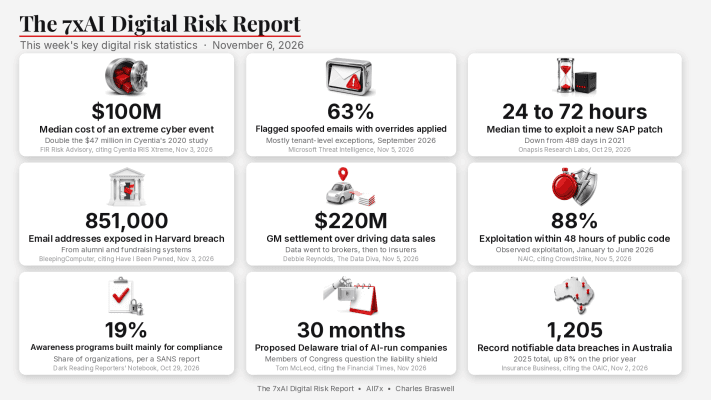
The same focus on what a system is allowed to do appears in Microsoft's latest email-threat data. In this case, the problem is not AI but security exceptions that organizations and users created over time to keep legitimate email flowing. Between July and September, Microsoft detected approximately 129 million malicious messages impersonating services such as DocuSign. In September, existing settings designed to allow certain email through overrode Microsoft's security detection on 63 percent of those messages for which an outcome was recorded. The security system flagged the messages as malicious, but previously approved exceptions still allowed many to reach users.
The Binance theft shows how an attacker can start with one employee and gradually work toward the systems that hold the real authority. According to Binance's incident report, the attack began with a fraudulent job interview that compromised the computer of an engineer working on the exchange's wallet systems. Binance detected that compromise, replaced the computer, and changed the affected credentials, but the attackers had already learned about the engineer's job and colleagues.
Months later, the attackers compromised two additional engineers. One of them had permission to deploy software to Binance's systems. The attackers then used stolen credentials and that existing deployment access to install the software used in the October 29 theft of approximately $6.3 billion in cryptocurrency.
The important part of the Binance incident is how the attack progressed. The attackers did not start with direct access to the systems that authorized cryptocurrency transactions. They worked through employees, developer tools, credentials, and permissions used for legitimate business purposes until they reached systems with enough authority to move the money.
That makes identity and access particularly important because permissions can accumulate long before anyone considers how they might be combined. Michigan State University required students and employees to reset their passwords after identifying a potential credential compromise. At the same time, a ransomware group claims to hold data on 1.3 million current and former students. AI agents introduce another version of the same problem. In SAP environments, an agent acting for an employee may inherit permissions the employee accumulated over years, including old roles or temporary access that should have been removed. NIST's recent guidance recommends giving agents their own identities and limiting their access to the work they need to perform rather than giving them permanent access inherited from a person.
Independent oversight becomes more important as organizations rely on these long-standing permissions and decisions. The SEC recently approved changes to PCAOB rules that remove a requirement for the largest audit firms to use an outside function to review how they assess their own quality-control systems. Delaware is considering the issue from a very different direction, with a proposed legal structure that could allow an AI agent to conduct much of a company's day-to-day business. Both developments raise questions about where independent review sits when the organization or system being evaluated is also responsible for assessing its own work.
The same problem becomes harder when responsibility extends outside the organization. Amadeus disclosed unauthorized access to a booking system that affected customer information at several major airlines, with Cathay Pacific reporting that the access continued from August 2023 until September 2026. Cyber insurers are absorbing more of these interconnected losses. The National Association of Insurance Commissioners reported that insurers' cyber losses and defense costs exceeded half of the premiums they collected in 2025 for the first time since the pandemic-era ransomware surge, even as cyber insurance prices continued to fall.
Long-lived access creates one form of exposure; keeping data and vulnerable systems longer than expected creates another. Harvard University's breach of alums and fundraising systems, discovered in November 2025, has now been linked to approximately 851,000 unique email addresses. Synology is dealing with an even older problem: ransomware operators are exploiting a vulnerability the company fixed in December 2024 on devices that were never updated. AI memory adds a new layer to the same concern because information from an earlier interaction can remain available and influence later responses or decisions.
The difficulty is that organizations increasingly have less time to discover that an old decision is no longer safe. Onapsis and Recorded Future report that the median time between an SAP security patch and the appearance of public attack code or active exploitation fell from 489 days in 2021 to as little as 24 to 72 hours. Access, vendor connections, stored data, software exceptions, and patch decisions may remain in place for years, while attackers can now exploit a weakness within days. That gap makes periodic review increasingly important because an approval or security decision does not remain valid simply because no one has revisited it.
For risk and audit leaders, the practical priority is to identify the access, exceptions, vendor connections, and sensitive data that remain in place because they were approved in the past, and determine whether the conditions that justified them still exist.
Deep Research
Change or stop
1. GRC (Governance, Risk & Compliance)
Governance programs often focus most on risks that occur frequently or on systems that appear technically complex. This week's two GRC sources argue for a different prioritization basis: consequence. Cyentia's research identifies the conditions behind the largest cyber losses, while the OCC applies similar thinking to how bank examiners should evaluate advanced AI.
Bruce Bird , founder of the risk advisory firm FIR Risk Advisory, reviewed Cyentia Institute's IRIS Xtreme 2026 study of the costliest 5 percent of publicly reported cyber incidents over five years. The analysis covers 136 confirmed events with $26.4 billion in documented losses and 205 incidents reported to the SEC. Cyentia classifies an event as extreme if losses reach at least $32 million. The median loss among those events is now $100 million, about twice the figure in Cyentia's 2020 research.
Those extreme incidents look quite different from the events that dominate general breach statistics. Across cyber incidents overall, approximately 91 percent primarily involve data exposure. Among the extreme events Cyentia studied, data exposure accounted for only 33 percent. Business disruption represented 43 percent, while fraud, primarily cryptocurrency theft, accounted for another 24 percent.
The gap widens when Cyentia examines how attackers gained access. Stolen credentials were involved in 58 percent of extreme events but accounted for 91 percent of documented losses. Vendor or partner access appeared in only 20 percent of incidents yet was associated with 65 percent of losses. Nearly half of the extreme incidents also affected organizations beyond the original victim through supply-chain relationships, and those events accounted for 55 percent of losses.
Those numbers challenge the way cyber risks are often prioritized. A control that affects the most incidents may not have the greatest financial exposure. Patching internet-facing systems can reduce how often attackers gain access. Controls over employee, remote-user, and vendor access can determine how far an attacker can go after gaining access and how expensive the resulting incident becomes.
Cyentia also questions several measures companies commonly use when discussing cyber incidents. Among 205 incidents reported through Form 8-K, the SEC filing used to disclose material corporate events, companies described only 6 percent as material or likely material. Only 22 filings included an estimate of financial impact. The number of records exposed also showed little correlation with the eventual loss.
Cyentia offers a simple reality check for risk assessments: a multi-billion-dollar company whose largest cyber scenario yields only a few million dollars in potential loss is likely substantially understating its exposure. Bird therefore recommends comparing risk-register scenarios with actual loss experience rather than relying primarily on technical severity or incident volume.
The OCC takes a similar approach to AI, in which technical sophistication does not necessarily determine business risk.
On November 4, the OCC issued Bulletin 2026-54, Super Intelligence: Supervisory Framework, to help bank examiners assess the use of advanced AI in routine banking activities. The framework does not create a new category of AI risk, and the OCC is not asking banks to establish a separate risk appetite for advanced AI. Examiners instead expect banks to integrate AI into existing reviews of governance, model risk, technology, compliance, and operational risk.
The more useful part of the framework is the guidance it provides on how closely to review an AI use case. The OCC identifies three considerations: what can happen if the system fails or is misused, how much decision-making authority it has been given, and how much human oversight remains.
That provides a more practical comparison than model sophistication alone. A highly capable AI system used to draft analysis for a person to review may create limited direct exposure because another person still makes the decision. A simpler agent authorized to transfer funds, approve a transaction, or modify customer records may warrant substantially greater scrutiny because the system can create the business outcome itself.
The comparison with Cyentia's research is useful because both approaches separate frequency and technical complexity from financial consequences. Cyentia shows that relatively uncommon access paths can account for a disproportionate share of losses. The OCC gives examiners a way to assess AI based on what the system can affect and how much authority remains with people.
Risk teams can apply the same approach to the largest scenarios on their risk register and to their most consequential AI deployments.
- What is a plausible worst-case loss for an organization our size?
- How much authority has been delegated to an employee, vendor, remote user, or AI agent?
- What human review remains before that authority results in a consequential business outcome?
The answers may produce a very different priority list from one based primarily on incident frequency, control counts, or how technically advanced a system appears.
Sources
2. Cyber Security
This week's security research shows how attackers can exploit the trusted paths organizations already rely on. Microsoft's quarterly email data shows security exceptions that override current threat information. The Binance theft shows attackers progressing from a recruiting interaction to developer systems and ultimately to transaction authority. Research on security awareness and small businesses shows why the people and organizations with trusted access increasingly need defenses designed around the work they actually perform.
Microsoft's threat-intelligence team detected approximately 7.3 billion phishing emails from July through September, including nearly 3 billion in September alone, a 41 percent increase from August. QR-code phishing declined 67 percent from the second quarter, while phishing sites hidden behind CAPTCHA tests began to rise again. Malicious SVG image attachments also increased sixfold in August.
Credential theft remained the primary objective. Between 94 and 96 percent of attacks involving malicious attachments ultimately directed recipients to phishing sites or fake sign-in pages designed to capture credentials.
The more consequential finding involved messages Microsoft's security systems had already recognized as malicious. Microsoft detected approximately 129 million messages impersonating familiar business services such as DocuSign, Adobe, and SurveyMonkey. Many still reached users because organization-wide or individual settings overrode the security verdict.
In September, those exceptions applied to 63 percent of the impersonating messages for which Microsoft recorded an outcome, and most were configured at the organization level. Microsoft's data does not show whether recipients opened the messages. It does show that a rule created to ensure legitimate business email gets through can later help an attacker impersonating the same service get through as well.
Microsoft's campaign data shows how attackers exploit initial access. An August campaign targeting law firms sent personalized salary-review documents with QR codes. Victims were directed to Microsoft's legitimate sign-in page and tricked into approving a session for the attacker. The attacker could obtain a valid session without learning the password or triggering another multifactor-authentication prompt.
A September campaign used Agent Tesla, malware commonly used to steal credentials, but it still passed standard email authentication checks because the attacker's sending domain satisfied those checks. Attackers using Microsoft Teams also became less obvious. Ordinary personal names accounted for 46 percent of the malicious calling sample in July and 88 percent by September, replacing conspicuous names such as "Help Desk."
The Binance theft shows how a compromise can escalate once an attacker reaches employees and systems with greater authority.
On October 29, attackers stole approximately $6.3 billion from Binance's internet-connected cryptocurrency wallets. Chainalysis, Elliptic, and TRM Labs attributed the attack to North Korea, and the FBI later attributed it to the North Korean group known as TraderTraitor.
According to The Block, the attackers prepared for at least 36 hours and tested malicious code before the theft. Coordinated transactions across several blockchains suggested the attackers accessed Binance's broader system to authorize transactions rather than compromising a single cryptocurrency wallet.
Binance's November 3 incident report describes an attack that began months earlier. In June, a fraudulent job interview targeted an engineer responsible for the exchange's wallet systems. While installing an AI coding tool, the engineer downloaded a tampered copy of Homebrew, a commonly used Mac utility for installing developer software.
Binance detected the compromise, replaced the employee's computer, and changed the affected credentials. However, the attackers had already learned information about the engineer's role and colleagues. On October 20, they used an internal AI tool to compromise two additional engineers. One of those employees had permission to deploy software containers to Binance systems.
Nine days later, they used the stolen credentials to deploy the software that initiated the theft.
The final code was not particularly complex. Simone Imbrescia, a vice president at Immunefi, which operates bug-bounty programs for cryptocurrency projects, said the blockchain program was about 130 lines long. The hard part was reaching the people, systems, and permissions that could authorize transactions.
Binance reported stopping 57 suspected North Korea-linked attacks in 2026, many involving fraudulent job interviews and malicious developer tools. That history makes the initial employee interaction important. The attacker didn't start with the transaction-signing system. The path began with a business process and accumulated authority as it progressed.
Security-awareness research helps explain why conventional employee training can miss attacks like these. During Dark Reading's Cybersecurity Awareness Month discussion, Sharon Shea of TechTarget Cybersecurity cited SANS Institute research finding that 19 percent of organizations design awareness training primarily to meet compliance or audit requirements.
The editors argued instead for training around the attacks employees are likely to encounter in their roles. Recruiters need to recognize fraudulent candidates. Developers need to recognize poisoned software packages and manipulated search results. Privileged administrators, executives, payroll employees, contractors, and customer-facing teams each present different opportunities to an attacker.
Binance provides a useful example. The initial compromise involved a developer installing an AI coding tool during a fraudulent recruiting process. A generic phishing course may teach an employee not to click a suspicious email link. It does little to prepare a developer for a compromised software installer discovered during what appears to be a legitimate job interview.
The smallest companies face a different limitation because many have no dedicated security staff. NIST addressed that group this month with Small Business Cybersecurity: Non-Employer Firms, written for more than 28 million U.S. businesses with no paid employees other than the owner.
The guide uses the NIST Cybersecurity Framework 2.0 but assumes no previous cybersecurity knowledge. Each recommendation explains why an action matters, how to begin, and how the practice can become more sophisticated later. Some recommendations are basic, such as replacing factory-default passwords on routers and other connected devices, but that is appropriate for organizations where one person may handle every technology decision.
The guidance also matters to larger companies. Independent consultants, freelancers, and very small suppliers often access corporate systems and information even though they lack the security teams their customers have. NIST now provides a reasonable baseline that larger organizations can give those suppliers rather than expecting them to interpret an enterprise security framework on their own.
Microsoft's data, the Binance incident, role-specific security training, and NIST's small-business guidance describe different points along the same access chain. Some organizations have accumulated email exceptions. Developers install specialized tools. Small vendors receive access to larger customers' systems. Each arrangement may have a legitimate business purpose.
The security problem begins when that trust remains in place after the original conditions change or when an attacker learns how to use the trusted path for a different purpose. Security teams should know which email exceptions, delegated permissions, software channels, and external relationships bypass normal restrictions, when those decisions were last reviewed, and whether the access still serves the purpose for which it was originally granted.
Sources
- Microsoft: Email Threat Landscape, Q3 2026 Trends and Insights
- The Block: How Attackers Breached Binance for $6.3 Billion
- The Block: Binance Says Hackers Used Fake Job Interview, Internal AI Tool
- Dark Reading: Rethinking Cybersecurity Awareness in the AI Era
- NIST: A Cybersecurity Guide for Solopreneurs
3. Internal Audit, IT Audit & Continuous Control Monitoring
Independent assurance depends on more than having controls and testing them. It depends on who performs the review, who receives the findings, and whether the reviewer can reach information the organization or system being examined cannot change. This week's audit developments test that independence from two very different directions: the SEC approved a reduction in outside review of the largest audit firms' quality systems. At the same time, a proposal in Delaware raises a much broader question about assurance inside a company whose daily management could eventually be run by AI.
On November 2, the SEC approved amendments to PCAOB standard QC 1000, which governs the quality-control systems of firms that audit public companies. The amendments take effect December 15.
The original standard required firms issuing more than 100 public-company audit reports during the prior year to establish an External QC Function. That outside group would independently assess how the audit firm evaluated its own quality controls. The SEC-approved amendments remove that requirement.
The amendments also eliminate a separate provision requiring firms without public-company audits to design a quality-control framework for that work even when they were not currently performing it. The Big Four accounting firms, KPMG, PwC, Deloitte, and EY, supported the changes in letters to the SEC.
PCAOB Chairman Demetrios Logothetis described the amendments as part of a modernization effort intended to align U.S. rules more closely with international quality-management frameworks and remove requirements the board considers unnecessarily burdensome.
Investor groups objected to removing the external review. The CFA Institute, the global professional association for investment professionals, ranked preserving that requirement as a very high priority. Sandra Peters, its senior head of corporate disclosure and information advocacy, argued that the outside assessment provided additional protection because the firms subject to it audit much of the U.S. public market. She proposed retaining it at least for firms auditing more than 500 public companies.
The change also fits a broader effort under SEC Chair Paul Atkins to reduce some compliance requirements. Atkins has proposed increasing the thresholds used to determine which companies qualify as large accelerated filers, the companies subject to the strictest public-company reporting requirements and an independent audit of internal control over financial reporting.
If those thresholds increase, fewer companies would need that external opinion on their financial controls. At the same time, removing the External QC Function from QC 1000 leaves large audit firms with one less independent layer reviewing how they assess the quality of their own audit practices.
That does not mean audit firms stop evaluating quality. It means audit committees may need to understand better how their external auditor challenges its own conclusions. Recent PCAOB inspection results, the firm's internal quality reviews, and the process used to investigate recurring deficiencies become more important when an external quality function is no longer part of the structure.
A proposal in Delaware takes the independence question much further by asking what assurance looks like when the subject being audited may itself be acting through AI.
Tom McLeod, an advisor focused on internal audit and assurance in AI-driven organizations, highlighted a Financial Times report on Delaware's proposed Artificial Intelligence Company. The new legal form could allow an AI agent to manage much of a company's daily business, including negotiating contracts, controlling assets, making decisions, and conducting transactions. A person or corporate owner would remain behind the company but could have relatively little involvement in day-to-day management.
Supporters have proposed testing the structure through a supervised 30-month experiment. Some members of Congress have raised objections about liability and how the proposal was developed.
McLeod uses the proposal to examine what internal audit would look like if management itself were substantially automated. In his model, internal audit would need to examine both the transactions agents produce and the decisions behind them. It would test whether agents stayed within their authority, whether their objectives changed over time, and whether one automated system influenced another in unintended ways.
That kind of audit cannot depend entirely on asking the AI system to explain what it did. The auditor would need separate records showing the instructions agents received, relevant system activity, transactions, and resulting decisions.
The harder questions are organizational rather than technical. Internal audit traditionally derives its independence from a mandate approved by the board or audit committee, unrestricted access to information, and the ability to report findings outside the management process being reviewed.
An AI-managed company complicates each of those assumptions. Someone still has to give internal audit its mandate, guarantee access to information, appoint or remove the auditor, and receive a finding serious enough to recommend stopping part of the business.
Those questions matter long before companies become fully autonomous. Organizations are already allowing agents and automated systems to make decisions that affect money, customers, security, and operations. As that authority expands, internal audit needs access to the information required to reconstruct those decisions without relying solely on the system's own account of what happened.
The PCAOB amendment and Delaware proposal involve very different forms of assurance, but both make independence easier to see by considering what happens when it is reduced. An audit firm assessing its own quality controls and an AI system explaining its own decisions both require some mechanism for independent challenge.
Audit committees should therefore understand where that challenge sits today: how the external auditor demonstrates that its quality controls work, whether internal audit can independently reconstruct consequential automated decisions, and who has the authority to respond when an audit concludes that an automated process should be changed or stopped.
A system reporting on itself can provide useful information. It cannot, by itself, provide independent assurance.
Sources
4. Identity Management / IAM
Identity and access management (IAM) determines who can access a system and what they can do once they get there. The problem is that access accumulates over time. Old passwords remain valid, temporary access outlives its purpose, and employees collect roles and permissions they may no longer need. This week's identity stories show how that accumulated access becomes useful to attackers and AI agents alike.
Michigan State University provides the more traditional example. University officials said claims by the BYOD ransomware group are connected to an October incident that led MSU to require password resets for every student and employee account. BYOD later added Michigan State to its leak site and claimed to hold personal information on 1.3 million current and former students.
In an October 1 campus email, the university required everyone with an MSU NetID, the account used to access university systems, to create a new password of at least 15 characters. An MSU spokesperson described the activity as a potential credential compromise but said current evidence did not show that the university's central Active Directory environment, the Microsoft system used to manage accounts and access, had been compromised. MSU also said it had no evidence that other data had been accessed, changed, or stolen.
BYOD itself is relatively new. The ransomware group appeared in September and gained attention after an attack on the University of New Mexico disrupted its hospital and forced ambulance diversions. The group later apologized and reportedly provided decryption keys without charge. BYOD also claimed an attack on Trump Mobile and published data involving 3,615 customers, drawing congressional attention.
Michigan State's decision to reset passwords is a standard response when an organization cannot determine which credentials may have been exposed. It also addresses only one part of the problem. Changing a password does not necessarily end active sessions, invalidate previously issued access tokens, or change service and application credentials outside the normal password-reset process. Establishing what the compromised credentials could reach becomes as important as replacing the passwords themselves.
The same accumulation of access takes on a different meaning when AI agents act on employees' behalf.
Vincent Doux , an SAP solution advisor specializing in GRC, cybersecurity, and data protection, examined SAP's approach known as principal propagation. In simple terms, an AI agent working for an employee operates with that employee's identity and permissions. The agent does not receive a separate set of unrestricted privileges. It works within the access SAP has already granted to the person.
That is a sensible design when the person's permissions are correct. The problem, Doux argues, is that employee access is rarely as clean as organizations assume.
People accumulate roles over years. Temporary access is not always removed. Emergency permissions remain after the emergency ends. Employees receive access "just in case" and may never use it. Historically, some of that dormant access created limited practical exposure because employees did not know every permission they had or had reason to use it.
An AI agent works differently. It can discover and use the permissions available to the identity it represents. A segregation-of-duties conflict that existed on paper but had never been exercised can suddenly become operational.
Segregation of duties is particularly important in systems such as SAP because it prevents one identity from controlling incompatible parts of a financial process. For example, the same person should not be able to change a supplier's banking information and then approve payment to that supplier.
Doux therefore recommends applying existing SAP access-management disciplines before employees begin delegating work to agents. Segregation-of-duties analysis, sensitive-access reviews, role management, and periodic access certifications need to cover the people whose identities agents will use as well as technical accounts assigned directly to autonomous agents. Once agents are operating, SAP Enterprise Threat Detection can monitor whether those permissions are being used in unusual ways.
The arrival of agents also changes how some longstanding SAP controls should be evaluated. A mitigating control that relies on someone reviewing a monthly report was designed around people performing transactions occasionally. An agent can operate continuously. A firefighter ID, SAP's term for emergency privileged access, is typically reviewed assuming a person used it. That assumption changes if an agent can operate under the same emergency role. A user-access review that approves excessive permissions in bulk can effectively approve those permissions for future agent activity.
Michigan State and SAP represent different identity problems, but the lesson between them is direct. Credentials and permissions both accumulate. Changing a password addresses a compromised credential. Removing unnecessary access addresses what that credential, or an agent acting for that identity, can actually do.
Before employees delegate work to agents, organizations should review the access those employees already hold. Old roles, unused permissions, emergency access, active sessions, and long-lived tokens deserve particular attention. An agent should not inherit years of accumulated access simply because nobody removed it.
Sources
5. Cyber Insurance
Third-party access becomes an insurance problem when a vendor incident causes a loss elsewhere. The Amadeus breach shows how exposure can spread through a shared technology provider without compromising the customers' own systems. The NAIC's latest market data adds a second concern: cyber losses are increasing while insurance prices have continued to fall.
Amadeus, headquartered in Madrid, provides booking technology used throughout the airline industry and says its platforms handled more than 2.2 billion passenger boardings in 2025. The company disclosed unauthorized access to one of its booking systems that exposed customer information belonging to passengers of Qantas, Cathay Pacific, Japan Airlines, Malaysia Airlines, and others. The airlines themselves were not breached.
The length of the intrusion makes the incident particularly important for insurance. Cathay Pacific said approximately 53,000 bookings were affected and that unauthorized access extended from August 2023 until September 2026. Japan Airlines reported that basic booking information for 90,000 customers was exposed and that passport and frequent-flyer information for about 2,000 customers was exposed. Malaysia Airlines confirmed that customer records were involved but said financial information was not accessed.
Amadeus said it contained the incident in September, reset passwords, and introduced additional monitoring and detection.
The incident raises insurance questions that are different from those created by an attack on a company's own systems. Insurance Business, a trade publication covering the insurance market, focused on whether a customer's cyber policy responds when the compromise begins inside a critical vendor, how much coverage is available if a vendor outage interrupts the customer's business, and how notification requirements work when months or years pass before a customer learns that an intrusion occurred.
The duration can matter as much as the source of the breach. Many cyber policies are written around when a claim is reported and include a date before which an incident is not covered. An intrusion beginning in 2023 and remaining undiscovered until 2026 creates a more complicated coverage question than an attack discovered immediately.
Amadeus is not an isolated example of increasing data incidents. Australia's privacy regulator recorded 1,205 reportable data breaches in 2025, its highest annual total since the reporting program began in 2018.
At the same time, the U.S. insurance market is absorbing more claims without charging substantially more for the coverage.
The National Association of Insurance Commissioners reported on November 5 that U.S. cyber insurers collected $9.46 billion in premiums in 2025, up 3.5 percent. The number of policies increased much faster, rising 33 percent to 5.84 million. Reported claims increased 20 percent to 56,323, more than six times the number reported in 2017.
The relationship between premiums and losses also deteriorated. Insurers' claims and legal-defense costs increased from 48.7 percent of premiums to 53 percent, the first time the figure exceeded 50 percent since the ransomware surge during the pandemic.
Prices nevertheless continued to decline. Citing market data from AM Best and the Council of Insurance Agents & Brokers, the NAIC identified eight consecutive quarters of U.S. cyber insurance price reductions through the first quarter of 2026, with some of the largest reductions occurring toward the end of that period.
The composition of claims is also changing. NetDiligence data cited by the NAIC shows that large companies account for only 3 percent of cyber claims but 56 percent of incident costs. Supply-chain disruptions are becoming more expensive, with third-party-caused business interruption increasing from 6 percent to 15 percent of the value of large claims in one year.
Not every emerging claim requires a breach. Privacy litigation involving website-tracking technologies, biometrics, and AI profiling is increasing and can touch cyber insurance, directors and officers coverage, and employment practices insurance at the same time.
The NAIC also acknowledges that regulators do not yet have a complete picture of the market. Current insurer filings provide limited state-level financial information, no quarterly view, and little visibility into how claims change as cases develop. Some forms of insurance, including captive insurers owned by companies, are also outside NAIC data. The 2026 report therefore relies on commercial insurance studies in addition to regulatory filings.
Amadeus shows why those gaps matter. A technology provider can expose several customers simultaneously, an intrusion can continue across multiple policy years, and the resulting costs can fall on organizations whose own systems were never compromised.
Before renewal, companies should compare their most important technology providers with the coverage their policies actually provide. The review should include how long an incident could plausibly remain undiscovered, what happens when the loss originates at a vendor, how much coverage exists for business interruption caused by that vendor, and how far back the policy will recognize an incident that is discovered today.
A useful question for the broker is straightforward: If a critical supplier told us tomorrow that an intrusion began three years ago, how would our current policy respond?
Sources
6. Data Protection
The Amadeus incident shows what happens when personal data remains exposed through a vendor for years. Data can create the same problem without an attacker remaining inside a system. Personal information accumulates in databases, AI memory, backups, and storage devices long after anyone has considered whether it still needs to be there.
Harvard University's alums and fundraising systems provide one example. Have I Been Pwned, the breach-notification service, confirmed that data stolen during Harvard's November 2025 breach was linked to about 851,000 unique email addresses.
The affected systems contained information on students, alums, donors, faculty, and staff, including email addresses, telephone numbers, home and business addresses, event attendance, donation information, and biographical details used for alum relations and fundraising. Harvard said the systems did not contain Social Security numbers, passwords, payment card information, or financial data.
The absence of those traditional high-risk identifiers does not make the information harmless. Fundraising databases can contain detailed information about relationships, interests, event participation, giving history, and biographical characteristics. Combined with an email address or telephone number, that information can support highly convincing fraud and impersonation.
The timing also highlights a basic data-management problem. Harvard discovered the incident on November 18, 2025, but the public estimate of approximately 851,000 unique email addresses came later from analysis of the leaked data. When BleepingComputer asked Harvard about the breach at the time, a university spokesperson could not provide the number of people affected.
That leaves an uncomfortable situation in which an outside party may be able to quantify the organization's exposed information before the organization can.
Privacy advisor Debbie Reynolds examines a less obvious form of stored information: AI memory and personalization.
AI products increasingly remember preferences, previous conversations, summaries, or profiles so future interactions can begin with more context. That improves the experience, but it also changes the privacy question. Information collected for one interaction may later be used for another purpose, combined with other information, or influence a decision after the original context has changed.
Reynolds argues that consent at collection is therefore only the beginning. Organizations also need to consider whether the information remains accurate and appropriate for later use, who else receives it, and what decisions it eventually informs.
Recent enforcement cases show why those later uses matter. On October 29, a coalition of state attorneys general announced a $220 million settlement with General Motors over allegations involving its Smart Driver program. Regulators alleged that driving information, including trip duration, hard braking, acceleration, and speeding, was shared with data brokers that later sold it to insurers. An FTC complaint described consumers facing increased premiums or being denied insurance.
A separate FTC case involved RentGrow, a tenant-screening company accused of displaying the same criminal or eviction case multiple times in consumer reports, making applicants' records appear worse than they were. The resulting court order included a $2.25 million penalty.
Job applicants have also sued Eightfold AI, alleging that its recruiting software used online and third-party information to assess and rank candidates without adequate notice or a meaningful opportunity to correct errors. Those claims remain allegations.
The examples reinforce Reynolds' larger point: personal information becomes more consequential when it is reused, combined with other information, or turned into a profile that determines what happens next.
Her recommendation is to define why personalization data is collected before collecting more, reassess the information when new sources are added, control how third parties can reuse it, and ensure corrections and deletions reach the profiles, summaries, and downstream systems built from the original information.
A useful test is to look at the process from the person's perspective. Could someone discover that a profile exists? If the information is wrong, would correcting it actually change the next decision?
The third example sits outside cloud applications entirely.
Synology warned customers after a surge in C3RB3R ransomware attacks targeting network-attached storage devices running outdated versions of its DiskStation Manager software. NAS devices are small file servers commonly used by offices and departments for shared files, archives, and backups.
The exploited vulnerability is not new. Synology patched it in December 2024.
The attackers are finding devices that were never updated. Victims have reported files encrypted with a .L0CK3D extension and demands to purchase a decryption tool. Synology urged customers to enable automatic updates and prevent its management interface from being exposed directly to the internet.
Shadowserver tracks more than 380,000 Synology NAS devices accessible from the internet, although it cannot determine how many are vulnerable.
These devices matter for data protection because they often contain exactly the information that formal programs lose sight of: old file shares, backup copies, departmental archives, and records created outside centrally managed platforms. A department-owned NAS device may sit outside enterprise patch management. If nobody knows the device exists, the data stored on it can also disappear from the organization's data inventory.
Harvard's donor records, AI memory, and Synology storage systems represent very different technologies, but they create exposure for the same basic reason: information remains long after attention has moved elsewhere.
Data protection teams should look beyond their primary databases and identify three categories in particular: relationship and profile systems such as fundraising, CRM, and marketing platforms; information created and retained by AI memory or personalization features; and backups or storage devices outside central technology management.
For each one, the organization should know who owns it, why the information is still needed, how it is protected, and whether a correction or deletion request actually reaches every copy and profile derived from it.
Sources
7x. Enterprise Digital Risk Products
The time available to secure SAP systems has compressed dramatically. Onapsis and Recorded Future report that vulnerabilities that once took months to become actively exploitable can now attract working attack code within days. At the same time, SAP is introducing new infrastructure for governing AI agents that can operate inside the same finance, procurement, supply-chain, and operational systems attackers are targeting.
The joint Days to Zero: 2026 SAP Threat Report from Onapsis and Recorded Future quantifies how quickly the environment has changed.
In 2021, the median time between publication of an SAP Security Note, SAP's term for its security patches, and verified public exploitation or proof-of-concept attack code was 489 days. By 2025 and 2026, that period had fallen to approximately 24 to 72 hours.
For every SAP vulnerability where the researchers could verify initial exploitation since April 2025, attacks began between 0.3 and 24 days after disclosure. SAP-related threat activity also increased 211 percent between 2023 and 2025, from 791 to 2,458 human-authored threat documents.
Ransomware groups are increasingly targeting SAP because compromising an ERP system can disrupt far more than a single server.
The number of ransomware and extortion groups appearing in SAP-related threat intelligence increased from eight in 2023 to 26 in 2025. Thirty distinct groups appeared between 2023 and the first half of 2026, including Qilin, Scattered Spider, LAPSUS$, and ShinyHunters.
Qilin has gone further by modifying its ransomware to stop SAP background services before encrypting files. During one 40-day period in early 2026, 11 organizations listed on Qilin's leak site had stolen files labeled as SAP. Underground markets also advertise access to SAP systems for prices ranging from approximately $500 to $30,000, compared with around $1,300 for ordinary administrator access to an enterprise network.
That difference reflects what an SAP system can represent. An attacker reaching ERP may gain access to finance, supplier information, customer records, manufacturing, purchasing, or other company processes that directly affect operations.
AI is reducing the time required on both sides. Onapsis uses AI-assisted research to find vulnerabilities faster and expects SAP to publish about 220 Security Notes in 2026. Attackers can use similar tools to analyze patches, develop exploits, and scan internet-facing systems.
That makes traditional patch schedules increasingly difficult to defend.
Many SAP customers patch around quarterly maintenance windows because updates require testing and critical business systems cannot be interrupted casually. A vulnerability that becomes exploitable within 24 to 72 hours does not fit that schedule.
Onapsis therefore recommends handling SAP's most serious HotNews and High Priority patches through an emergency process. When an immediate production patch is impossible, temporary protections need to reduce exposure until the update can be deployed. Continuous monitoring inside SAP can also help detect exploitation attempts and unauthorized transports, the packages used to move code and configuration among SAP systems.
The ransomware findings connect directly to the GRC research earlier in this issue. Cyentia found that business disruption accounts for a much larger share of extreme cyber losses than general breach statistics suggest. An attacker who disables SAP can interrupt order-to-cash, supplier payments, manufacturing, and supply-chain operations even when data theft is not the primary objective.
SAP's TechEd announcements address a different challenge developing inside those same systems: AI agents increasingly need access to business applications and data while they work.
SAP Enterprise AI Gateway, built on SAP Integration Suite, is intended to provide a central point for controlling connections between agents, models, tools, and enterprise systems. Rather than managing each connection separately, organizations can apply policies, monitor usage, and record activity as agents interact with other services.
The gateway covers Model Context Protocol connections, which agents increasingly use to reach tools and information, along with traditional application interfaces, agent-to-agent communications, and large language models.
SAP also expanded the governance surrounding the information agents use. New features in SAP LeanIX allow enterprise architects to manage the system and architecture information available to Joule agents. A knowledge-intake agent can extract information from security and architecture documents and propose additions to the LeanIX knowledge graph. Still, a person approves the information before agents can access it.
The same pattern appears in SAP AI Agent Hub, which maintains an inventory of agents across platforms. A new AI Governance Assistant can help organizations assess systems under the EU AI Act by identifying incomplete documentation, pre-filling information, flagging systems that may require a higher-risk classification, and initiating another assessment when an agent changes materially. The output remains a draft for legal and compliance review.
These are SAP product announcements, and their value will ultimately depend on how customers implement them. They do, however, show how SAP expects agent management to operate: know which agents exist, control the services they can reach, manage the business information they rely on, and revisit assessments as agents change.
That architecture has to work alongside existing SAP identity and access controls.
The Enterprise AI Gateway can determine whether an agent is permitted to connect to a service. SAP Access Control and Identity Access Governance determine what the identity behind that agent can do after the connection succeeds. As the IAM section of this issue describes, an agent operating through an employee's identity can still inherit excessive roles and old permissions even when the gateway works correctly.
The timing makes these systems increasingly connected. Attackers can begin exploiting newly disclosed SAP vulnerabilities within days. Agents can perform business actions within seconds. Many patching, access-review, and GRC processes still operate monthly or quarterly.
SAP security and GRC teams therefore need to know how quickly they can respond at each layer. How long does a HotNews patch take to reach production, or to receive temporary protection? Can the organization detect exploitation and unauthorized transports inside SAP? And before agents are allowed to act, does the organization know which agents exist, what systems they can reach, which identities they operate through, and what those identities are permitted to do?
The time available to secure SAP systems has compressed dramatically. Onapsis and Recorded Future report that vulnerabilities that once took months to become actively exploitable can now attract working attack code within days. At the same time, SAP is introducing new infrastructure for governing AI agents that can operate inside the same finance, procurement, supply-chain, and operational systems attackers are targeting.
The joint Days to Zero: 2026 SAP Threat Report from Onapsis and Recorded Future quantifies how quickly the environment has changed.
In 2021, the median time between publication of an SAP Security Note, SAP's term for its security patches, and verified public exploitation or proof-of-concept attack code was 489 days. By 2025 and 2026, that period had fallen to approximately 24 to 72 hours.
For every SAP vulnerability where the researchers could verify initial exploitation since April 2025, attacks began between 0.3 and 24 days after disclosure. SAP-related threat activity also increased 211 percent between 2023 and 2025, from 791 to 2,458 human-authored threat documents.
Ransomware groups are increasingly targeting SAP because compromising an ERP system can disrupt far more than a single server.
The number of ransomware and extortion groups appearing in SAP-related threat intelligence increased from eight in 2023 to 26 in 2025. Thirty distinct groups appeared between 2023 and the first half of 2026, including Qilin, Scattered Spider, LAPSUS$, and ShinyHunters.
Qilin has gone further by modifying its ransomware to stop SAP background services before encrypting files. During one 40-day period in early 2026, 11 organizations listed on Qilin's leak site had stolen files labeled as SAP. Underground markets also advertise access to SAP systems for prices ranging from approximately $500 to $30,000, compared with around $1,300 for ordinary administrator access to an enterprise network.
That difference reflects what an SAP system can represent. An attacker reaching ERP may gain access to finance, supplier information, customer records, manufacturing, purchasing, or other company processes that directly affect operations.
AI is reducing the time required on both sides. Onapsis uses AI-assisted research to find vulnerabilities faster and expects SAP to publish about 220 Security Notes in 2026. Attackers can use similar tools to analyze patches, develop exploits, and scan internet-facing systems.
That makes traditional patch schedules increasingly difficult to defend.
Many SAP customers patch around quarterly maintenance windows because updates require testing and critical business systems cannot be interrupted casually. A vulnerability that becomes exploitable within 24 to 72 hours does not fit that schedule.
Onapsis therefore recommends handling SAP's most serious HotNews and High Priority patches through an emergency process. When an immediate production patch is impossible, temporary protections need to reduce exposure until the update can be deployed. Continuous monitoring inside SAP can also help detect exploitation attempts and unauthorized transports, the packages used to move code and configuration among SAP systems.
The ransomware findings connect directly to the GRC research earlier in this issue. Cyentia found that business disruption accounts for a much larger share of extreme cyber losses than general breach statistics suggest. An attacker who disables SAP can interrupt order-to-cash, supplier payments, manufacturing, and supply-chain operations even when data theft is not the primary objective.
SAP's TechEd announcements address a different challenge developing inside those same systems: AI agents increasingly need access to business applications and data while they work.
SAP Enterprise AI Gateway, built on SAP Integration Suite, is intended to provide a central point for controlling connections between agents, models, tools, and enterprise systems. Rather than managing each connection separately, organizations can apply policies, monitor usage, and record activity as agents interact with other services.
The gateway covers Model Context Protocol connections, which agents increasingly use to reach tools and information, along with traditional application interfaces, agent-to-agent communications, and large language models.
SAP also expanded the governance surrounding the information agents use. New features in SAP LeanIX allow enterprise architects to manage the system and architecture information available to Joule agents. A knowledge-intake agent can extract information from security and architecture documents and propose additions to the LeanIX knowledge graph. Still, a person approves the information before agents can access it.
The same pattern appears in SAP AI Agent Hub, which maintains an inventory of agents across platforms. A new AI Governance Assistant can help organizations assess systems under the EU AI Act by identifying incomplete documentation, pre-filling information, flagging systems that may require a higher-risk classification, and initiating another assessment when an agent changes materially. The output remains a draft for legal and compliance review.
These are SAP product announcements, and their value will ultimately depend on how customers implement them. They do, however, show how SAP expects agent management to operate: know which agents exist, control the services they can reach, manage the business information they rely on, and revisit assessments as agents change.
That architecture has to work alongside existing SAP identity and access controls.
The Enterprise AI Gateway can determine whether an agent is permitted to connect to a service. SAP Access Control and Identity Access Governance determine what the identity behind that agent can do after the connection succeeds. As the IAM section of this issue describes, an agent operating through an employee's identity can still inherit excessive roles and old permissions even when the gateway works correctly.
The timing makes these systems increasingly connected. Attackers can begin exploiting newly disclosed SAP vulnerabilities within days. Agents can perform business actions within seconds. Many patching, access-review, and GRC processes still operate monthly or quarterly.
- SAP security and GRC teams therefore need to know how quickly they can respond at each layer.
- How long does a HotNews patch take to reach production, or to receive temporary protection?
- Can the organization detect exploitation and unauthorized transports inside SAP?
- Before agents can act, does the organization know which agents exist, what systems they can reach, which identities they operate through, and what those identities are permitted to do?
Sources
Weekly Digital Risk Topics Trending on X
1. GRC (Governance, Risk & Compliance)
The pressure to show that controls actually work carries into this week's governance discussion on X. Two posts take different angles: whether third-party risk programs measure their own effectiveness, and whether existing business continuity controls can absorb new AI regulation.
Diligent, which sells GRC software, highlighted research conducted with Compliance Week, a publication for compliance professionals, showing that only 18% of organizations set improvement goals and measure the effectiveness of their third-party risk programs. The finding comes from The State of Third-Party Risk & Integrity, a benchmark based on research with 124 ethics, compliance, and risk practitioners, which Asha J. Palmer and Daniel Zmak discussed at the Third-Party Risk Management & Supply Chain Summit in Chicago.
Effectiveness measures are most needed where the largest losses originate. The Cyentia data in this week's GRC research found that access through vendors and partners drove 65% of extreme-event losses, and a program that cannot measure its own effectiveness cannot show whether it reduces that exposure. Useful measures include how long due diligence takes for critical vendors, the share of critical vendors with current assessments, how many identified issues were fixed, and how many incidents trace back to third parties.
Source: @diligentHQ
Continuity programs face a similar test as AI regulation arrives. The Business Continuity Institute (BCI), the professional body for business continuity practitioners, shared an article by Daniel Strelczuk, an IT service delivery manager and BCI member, arguing that the EU AI Act, NIS2, DORA, and NIST's AI Risk Management Framework all ask questions continuity professionals already know: what is critical, what it depends on, how it recovers, who can change it, and what gets reported when it fails. NIS2 is the EU's cybersecurity directive for essential and important sectors, and DORA, the Digital Operational Resilience Act, sets technology resilience rules for EU financial firms. Rather than building a separate resilience structure for AI, Strelczuk recommends extending the controls organizations already trust.
In practice, that means asking which critical services now depend on AI, since an AI capability may sit several layers below the service the business cares about. It means extending the business impact analysis, the assessment of how an outage would hurt the business, to cover a model becoming unavailable or unreliable; re-examining recovery time objectives, the target time to restore a service, that now depend on an outside model provider; routing material AI changes through existing change management; and defining when AI degradation becomes an incident. The BCI's Operational Resilience Report 2026 found that 72.5% of organizations already run a resilience program, usually led by the business continuity manager. Strelczuk calls extending that program the fastest, lowest-cost route to defensible AI governance.
Source: @TheBCEye
2. Cyber Security
Extending existing controls to new technology is also the lesson of this week's security posts, which found old weaknesses in new places. Flaws in the connectors AI agents use turned out to be classic web vulnerabilities, a prediction from the research and advisory firm Gartner challenged patching by severity score, and attackers again reached supermarket refrigeration through management screens exposed to the internet.
Karl Mehta, a former venture capitalist at Menlo Ventures who founded TrustModel, which offers behavioral trust scoring and adversarial testing for AI, reported that the official MCP code repositories published 31 security advisories in 28 days in October. A catalog of 44 MCP advisories found that 18, or 41%, follow one pattern: untrusted text, such as a web address, a configuration field, or an input to a tool, becomes a command. Only two began with prompt injection, the technique of hiding instructions in content an AI reads. The rest were familiar web flaws, including missing authentication, missing checks on who owns a resource, path traversal, which exposes files outside the intended folder, and command injection, which lets an attacker run commands. The most serious involved OAuth, the standard many applications use to grant access without sharing passwords. The flaw appeared in the Python and TypeScript software development kits and in the FastMCP framework, and it let a malicious server redirect refresh tokens, the long-lived credentials that keep an application signed in, to an attacker's authorization server, because clients did not confirm which server had issued their credentials. Upgrading alone does not fix it; teams must also specify which server can issue credentials and re-link the credentials they have already stored.
Mehta recommends that boards ask management for an inventory of every MCP server the company's agents connect to, minimum safe versions locked in place, and a named approver for new servers. Agent tool connections are part of the software supply chain and belong in application security and patch management, as well as AI governance.
Source: @karlmehta
Deciding which flaws to fix first is the subject of the Gartner prediction, highlighted by the cybersecurity news site The Hacker News. Gartner predicts that organizations that prioritize exposures using threat intelligence, business context about each asset, models of how likely a flaw is to be exploited, and testing of whether existing controls would stop an attack will see at least 70% lower breach likelihood by 2028 than peers relying on the Common Vulnerability Scoring System (CVSS), the industry's 0-to-10 severity scale. In a vendor-contributed article, Picus Security, which sells tools that test security controls, cited Gartner's finding that fewer than 10% of vulnerabilities are ever exploited. Yet, most are treated as urgent, and control testing is described as the element most programs lack.
The prediction argues for a different metric. Vulnerability-closed measures activity, while exploitable exposures reduce outcome. With SAP exploitation windows now measured in days, programs need to know which exposures attackers can actually use in their environment, given the controls already in place.
Source: @TheHackersNews
Exposures that attackers can actually use showed up in grocery stores this week. SecurityWeek, a cybersecurity news site, reported that more than 100 stores in Belgium, Estonia, Ireland, Luxembourg, the Netherlands, and Sweden saw fridges and freezers heat up overnight from November 1 to 2, some to as high as 50°C (122°F), with problems also reported in Finland, Italy, and Portugal. The incidents resemble an October wave in France that forced refrigeration units at about 700 supermarkets into defrost mode. French authorities linked those compromises to controllers made by Danfoss, the Danish refrigeration and climate controls maker, and later expanded the alert to systems from Copeland and Dixell, other refrigeration control brands; Danfoss said most of the hacked units were older products it no longer updated.
Danfoss told customers on October 13 to disconnect their systems from the internet; most did, but some did not. Security researcher Kevin Beaumont said every freezer hit in the second wave had a management screen reachable from the internet, and Lupovis, a security firm that runs decoy systems to catch attackers, saw login attempts against its decoy Danfoss controllers that mostly used factory-default passwords the manufacturer documents publicly. No one has claimed responsibility, and the EU's agriculture commissioner called the attacks a deliberate attempt to disrupt the food supply chain. Operational technology, the equipment that runs physical processes, is often owned by facilities teams or refrigeration contractors and sits outside IT inventories, and outdated devices with default passwords and internet exposure can turn a cyber incident into physical loss.
Source: @SecurityWeek
3. Internal Audit, IT Audit & Continuous Control Monitoring
Equipment outside IT's view is one blind spot, and AI-driven decisions are another. Three posts from the audit profession asked where audit fits as AI takes on more judgment: in the audit committee's charter, in the criteria auditors use to assess AI, and at the line between management's monitoring and audit's assurance.
The Institute of Internal Auditors (IIA), the global professional body for internal auditors, promoted "When Machines Make Judgments," an article in its Internal Auditor magazine by Dominique Vincenti, a former chief audit executive at Uber and an audit committee chair at the satellite company Loft Orbital. Vincenti argues that audit committees were built on the premise that accountability rests with people, and that agentic AI is quickly dismantling that premise. Boards, the IIA said, need to rethink the charter now, before a crisis exposes the gaps.
Boards can start by reading the current audit committee charter and asking whether it addresses the decisions, estimates, and controls that AI now influences. Does the committee oversee how AI affects financial reporting and disclosures? Does internal audit's plan cover the traceability of AI decisions and the data used to train models? Does the committee have access to independent AI expertise when it needs it?
Source: @TheIIA
Criteria for auditing AI itself arrived from India. Sharat Chandra, founder of the Bengaluru startup advisory firm EmpowerEdge Ventures, reported that the Indian Computer Emergency Response Team (CERT-In), India's national cybersecurity agency, released AI Security Auditing Guidelines, a framework for secure, ethical, and auditable AI systems. The guidelines set out nine core audit domains, from governance and accountability to data lifecycle and privacy, model risk management, bias and fairness, explainability, security and resistance to attack, continuous monitoring and model drift, human oversight, and assurance over third parties and the AI supply chain. The requirements are risk-based, cover a system's full lifecycle, and scale with each system's nature, scale, autonomy, and potential impact.
The guidelines recognize that ethical principles and conventional cybersecurity controls are not enough on their own. Their emphasis on autonomy and impact echoes the OCC's classification factors in this week's GRC research. For audit teams outside India, the nine domains offer a ready outline for an AI audit program.
Source: @DLTevangelist
Using AI inside the audit function raises a different concern for Norman Marks, a retired chief audit executive and long-time commentator on governance and risk, who warned that auditors are being tempted to take on management's work, such as continuous monitoring. In his blog post, Marks argues that testing every transaction for errors and identifying new risks are management's responsibilities. Internal audit should instead assess whether management's controls prevent errors and whether management has effective processes for identifying risk. He criticizes vendor and consultant messaging, including a KPMG webcast, an eBook from the audit automation company DataSnipper that the IIA promoted, and parts of PwC's AI material, while praising language about continuously testing controls. His summary is pointed: "We should be auditing their controls, not their data."
Marks's line between monitoring controls and monitoring transactions is also an independence question. If internal audit operates the control that catches errors, someone else has to audit it. Continuous monitoring of controls can strengthen assurance, while continuous monitoring of transactions can quietly turn audit into an extension of management.
Source: @normanmarks
4. Identity Management / IAM
Monitoring what an agent does depends first on knowing which agent did it. Two identity posts this week addressed how AI agents get their identities and how long their access lasts after the people behind them leave.
Chris Hughes, founder of the Resilient Cyber newsletter and podcast, highlighted NIST's Design Tenets for Agent Identity Management Systems, an initial set of ten principles drawn from public comments on an agent identity project at NIST's National Cybersecurity Center of Excellence (NCCoE). Among the points he found most significant: agents should have their own identities, verifiable through cryptography and separate from human users and service accounts; there should be a clear chain of trust when agents act for users or organizations; agents should operate with the least privilege needed and no standing, always-on access; and digitally signed mandate statements should define what an agent is meant to achieve and the limits on its actions. NIST also calls for agents to avoid long-lived bearer tokens, credentials that work for whoever holds them, and fixed, reusable keys, and to acquire short-lived access only when a task begins. It also calls for the logic that decides what an agent attempts to be kept separate from the systems that decide what it is allowed to do.
Hughes expects least privilege and no standing access to be the hardest tenets to achieve, because organizations will keep trading security for the usefulness agents provide; it was hard enough for human users and cloud workloads. The tenets also sharpen a design choice raised in this week's identity research. SAP's principal propagation has the agent act with the user's identity, while NIST calls for a distinct agent identity linked to the user by a chain of trust. Either way, every action needs to trace back to both the agent and the person or organization that authorized it.
Source: @ResilientCyber
How long that authorization lasts is the subject of the second post. Martin Szerment, who writes about practical AI on X, flagged a detail in a new update from Anthropic, the AI company that makes Claude, that many administrators may miss. Since June, Claude Team and Enterprise customers could connect MCP plugins automatically at login through Enterprise Managed Auth. Still, the company's identity provider, the system employees sign in through, had to sign the statement confirming the user's identity. In practice, that meant Okta, the identity management company, through its Cross App Access feature. In a new beta, Claude can sign that statement itself under a web address unique to each organization. The plugin's server exchanges it for an access token in a single server-to-server call, with no redirect and no consent screen.
Szerment notes that Anthropic's documentation is direct about the tradeoff. A statement signed by Claude proves only that the user belongs to the Claude organization through a verified email; the company's single sign-on (SSO) and multifactor authentication play no part. Removing a user stops Claude from signing new statements, but tokens already issued remain valid until they expire. For MCP server operators, he concludes, "your access token lifetime is now your offboarding policy." Identity teams should decide which issuer each MCP server should trust, keep token lifetimes short, and confirm that removing an employee also ends the tokens issued to them.
Source: @MartinSzerment
5. Cyber Insurance
This week's insurance posts examined the gap between cyber risk and cyber insurance, including small-business take-up, losses that spread across lines of business, and whether current rates are adequate.
Cyber Insurance News, a trade publication, reported on a roundtable at the Zywave Cyber Risk Conference in New York; Zywave sells software to insurers and brokers. Helga Munger, a senior cyber consultant at the reinsurer Munich Re, put small-business take-up in the UK and Europe at around 8% to 10%, and John Keebler, national cyber development leader at the specialist insurer CFC, estimated adoption among US small and medium-sized enterprises (SMEs) at 20% to 30%. Keebler said about half of small businesses rank cyber as their top threat, yet roughly 75% do not understand that cover would respond to social engineering or ransomware. About half say no one has ever offered them cyber insurance.
A simpler policy is on the way. The Lloyd's Market Association (LMA), which represents the businesses that underwrite at Lloyd's of London, is close to publishing its first model cyber policy wording, built for small businesses. Chris Mather, a senior executive in technical underwriting at the LMA, described it as modular and written in plain English, with a required core covering incident support services, cybersecurity awareness, system restoration, and extortion and ransomware. Business interruption, data liability, theft of funds, cybercrime, and downtime at a key customer would be optional add-ons. A UK version comes first, followed by US and European versions, and the wording will be free to use. Panelists also noted that more contracts now require suppliers to carry cyber cover. Organizations that impose that requirement should specify what the coverage must include, and a standard wording would make that easier to verify.
Source: @CyberInsureNews
Losses that spread across lines of business were the focus at ReWiRe, the Women in Reinsurance conference in Bermuda, where reinsurance executives discussed how AI is turning cyber incidents into physical and supply-chain crises. According to The Royal Gazette, a Bermuda newspaper, Lara Mowery of the reinsurance broker Gallagher Re said her firm combined its cyber team with its data center and AI liability teams into one digital risk team, and she questioned whether the industry understands how losses could accumulate across the hundreds of older data centers already on balance sheets. Kathleen Reardon, chief executive of Hiscox Re, the reinsurance arm of the insurer Hiscox, pointed to the French supermarket refrigeration hacks, which caused business and supply chain interruption, food spoilage, equipment damage, and fires, as an example of how one cyber event can trigger losses across lines of business, and said AI makes such events travel further and faster.
The fridge attacks discussed in this week's security posts are already becoming a reinsurance scenario. Organizations should consider how a single cyber event could trigger property damage, business interruption, product liability, and cyber claims at the same time, and whether their own insurance programs would respond consistently.
Source: @TheRoyalGazette
Whether the market is charging enough for that risk was the question behind a post from Intelligent Insurer, an insurance industry publication, promoting its Cyber Insurance Week in Chicago. It reported that US cyber losses rose 26% to nearly $21 billion in 2025 while market rates continued to soften, and that 49% of underwriters in its 2026 survey cited rate adequacy as their top operational threat.
That signal matches the NAIC data in this week's research: losses are rising, prices are falling, and underwriters are concerned. Buyers may want to use current conditions to improve terms, such as sublimits, the caps on specific types of loss within a policy, dependent business interruption, and retroactive dates, rather than focusing on price alone.
Source: @intelligentins
6. Data Protection
Two European developments this week tested how far privacy law reaches when personal data is collected or published outside traditional institutions: people-search services built on public records, and smart glasses that record everyday life.
Ezra Hatt, writing on X about Swedish privacy law, reported that the Swedish Authority for Privacy Protection (IMY) decided that four people-search services must comply with the General Data Protection Regulation (GDPR), the EU's main privacy law. Much of what the Swedish state knows about individuals, including addresses, income, and court judgments, is public, and companies compile it into searchable databases. They had relied on voluntary publishing certificates that give them the same constitutional protection as newspapers, which meant the GDPR did not apply. That protection weakened after Sweden's Supreme Court found in February 2025 that making criminal judgments available in bulk and searchable, with defamation law as practically the only protection, was incompatible with EU law. In July, the Court of Justice of the European Union, the EU's highest court, ruled in Legal Newsdesk Sweden (C-199/24) that such processing is exempt only if it serves journalistic, academic, artistic, or literary purposes, which, for paid publication of judgments, requires editorial control, press ethics, and fact-checking.
Applying both rulings, IMY concluded that the Swedish exemptions go further than EU law allows and that none of the four sites operates for journalistic purposes. It reprimanded two services for processing data about criminal offenses without a legal basis. It ordered them to ensure users cannot see that information when searching by name, personal identity number, or address. The others were reprimanded for failing to honor requests to erase data. IMY has received about 3,800 complaints against the four companies. For organizations that use people-search or background data in hiring, fraud screening, or customer due diligence, the decision reminds them that public availability alone does not provide a lawful basis.
Source: @ezrahatt
Data captured by wearable devices raises the same question: who is responsible? The X account ArpokratLeg summarized a statement on smart glasses adopted on October 13 by the European Data Protection Board (EDPB), which brings together the EU's national privacy regulators to apply the GDPR consistently; the Board calls the statement preliminary reflections rather than final guidelines. The GDPR does not apply to a wearer whose use is purely personal, such as sharing video only with family and friends, but that exemption is read narrowly. It does not cover footage shared with an unlimited audience on a public social media account, or use in professional or other non-personal activities. In those cases, the wearer is responsible for the data and must comply with the GDPR, including telling people they are being recorded.
Responsibility does not stop with the wearer. Manufacturers and the providers of apps and AI features remain subject to the GDPR and should not rely on users to handle transparency toward bystanders. The Board also found that current indicators leave many bystanders unaware they are being recorded, and it suggested combining lights, sounds, and design cues that are hard to switch off. For employers, camera-equipped glasses worn for work fall outside the personal-use exemption, so organizations should decide whether to permit them and set clear terms for recording and for AI features that upload captured content.
Source: @ArpoLegDep
7x. Enterprise Digital Risk Products
AI features on personal devices are one place new data risk appears, and the AI agents now running inside companies are another. Two posts this week showed security and identity vendors following those agents to where they run, with customers paying for it.
CrowdStrike, the cybersecurity company, announced at its Fal. Con Europe conference that it is building Falcon Guardian AI Detection and Response (AIDR), its product for protecting AI agents while they run, directly into Anthropic's Claude agent workspace. The integration extends Falcon protection to AI agents from creation through execution and brings that environment under the Falcon platform's enterprise security controls. Anthropic enabled Falcon deployment within the environment, while CrowdStrike engineered and tested the integration across installation, real-time protection, and ongoing updates.
With integrations like this, agents become another surface security teams must inventory, monitor, and govern, much like laptops and cloud workloads. The practical question is whether the organization can see which agents are running, who created them, and what they are doing, using the same detection and response processes it already operates.
Source: @CrowdStrike
Customers are paying for the identity side of the same problem. Biometric Update, a digital identity news site, reported that 1Password, the password and identity security company, has passed $500 million in annual recurring revenue (ARR), with net new ARR up about 90% year over year in the third quarter. Demand for tools that secure AI agents is part of the growth: monthly active non-human identities, accounts used by software rather than people, using its developer and AI security tools grew 500% year over year, while monthly active human users of those tools grew 200%. The company says the tools are now used in 16% of its business accounts, and it lists partnerships with technology and AI companies including Anthropic, OpenAI, Meta, NVIDIA, Snowflake, Perplexity, and Ramp.
One detail from the announcement addresses this week's identity debate directly. The chief security and trust officer of Snowflake, the cloud data company, described a "compound identity" that ties each agent action to both the agent and the person it acts for, which gives security teams a full audit trail and allows tighter policies on agent sessions without limiting the user's own access. That approach answers the attribution question raised by both principal propagation and NIST's agent identity tenets.
Source: @BiometricUpdate
Closing Thoughts
Tracing each action back to an accountable person, the problem that compound identities address, is one form of the pattern behind this week's news. Across disciplines, most exposure came from earlier decisions.
Stolen logins and trusted vendor access drove most of the losses in the costliest cyber events on record. Exceptions created to protect legitimate email workflows let malicious messages through. A developer compromise that began in June led to a $6.3 billion theft in October. Dormant SAP permissions can become an agent's working space. A vendor's booking system stayed open to an intruder for three years. A NAS vulnerability patched in December 2024 is still being used to encrypt data. Donor records and AI memory outlast the purposes that justified them. Governance structures carry assumptions forward too: audit committee charters written for human decision-makers, outside oversight of audit firms' quality control that has just been relaxed, and insurance pricing that has moved in the opposite direction from losses.
These exposures persist because attackers and agents both enumerate what is available and use it, while governance processes tend to revisit access, exceptions, and data on a calendar. When exploitation takes days and agents act in seconds, anything waiting for the next scheduled review stays available to them in the meantime.
Before the next governance, risk, or audit review, pick the organization's most sensitive access paths, exceptions, and data stores and ask three questions of each. Any item without a clear answer to all three is a candidate for removal:
- What does this exist to do today?
- Who would notice if it were used?
- How quickly could we revoke it?
How this report is made
AI is used for research and drafting. Charles Braswell reviews and makes edits.