
Insights/7x Digital Risk Report
Highlights: When the record looks better than the operation
A weekly report covering key developments, emerging risks, & practical insights in digital risk: cyber, GRC, audit, identity, & data protection.
Charles Braswell · November 14, 2026
Executive Summary
Most organizations can point to something that says a control is in place: a certificate, a signed access review, multifactor authentication, an insurance policy, a risk disclosure in a public filing. Each one is a snapshot — proof that something was checked on a particular date. What it doesn't show is what happened after that date.
Public AI risk disclosures, the last item on that list, are where governance, risk, and compliance (GRC) sources begin. Researchers at Massachusetts Institute of Technology analyzed the public documents of 200 of the world's largest companies and found that a third of the 100 largest acknowledge no AI risk at all. Australia announced that it will legislate mandatory safety duties for frontier AI developers, the companies building the most advanced AI models, and create a regulator to enforce them. Because outsiders cannot see how AI risk is managed internally, they are starting to demand evidence.
Within security teams, the evidence problem starts with who owns the decisions AI now makes. On the CISO Series podcast, panelists argued that AI is taking over decision-making faster than anyone can assign ownership, and that audit logs can't fix it after the fact. A piece on penetration-testing firms, which clients hire to break into their systems and find weaknesses, warned that testers will paste details of a client's weaknesses into personal AI accounts if their firm provides no approved route.
The audit sources identified a similar gap between what was approved and what actually occurred. Aron Lange , a lead auditor and trainer for ISO 27001, listed six supplier risks that do not require an attacker. Reza Sadegh described access reviews that are signed off even though access remains in place; he is accountable for access and controls on an Australian government platform with more than 34,000 users that runs on SAP. Angelo Longo, who has served as CISO at several organizations, explained that a certification, an audit report, and a compliance validation are distinct products with different scopes.
Identity research measured a related gap: how often attackers bypass the login that MFA protects. A breach report from Start with Identity (SWI), an identity research community, found that in 2025 and 2026 nearly half of identity breaches used a path that did not require an MFA-protected login. Elastic, the search and security software company, found that attackers used stolen login credentials an average of eight minutes after infecting a computer, often through software the user already trusted.
Those failures carry a cost, and it shows up in insurance and data protection. U.S. cyber insurance premiums grew again, while the loss ratio, the share of premium paid out in claims, rose for a second year, and rates kept falling. At Railway, a hosting platform for software developers, an attacker exploited an internal credential with more trust than intended, along with a second trust weakness, to access customers' stored passwords and keys. The stolen credentials generated about $740,000 in unauthorized AI usage. A.P. Moller - Maersk , the Danish shipping and logistics group, confirmed a breach in a system it inherited through an acquisition.
The product sources test whether the tools meant to catch such problems can detect them. They cover SAP activity that security operations centers (SOCs), the teams that monitor for attacks, cannot see; AI agents, software that carries out tasks on its own, applied to regulatory change; and the practical limits of automatic data labeling in Microsoft Purview, Microsoft 's data governance and compliance suite. Each section ends with a practical check readers can run against their own organization.
Deep Research
1. GRC (Governance, Risk & Compliance)
Large companies are discussing AI risk publicly, but many still provide little information on how they manage those risks. MIT found substantial gaps in corporate AI-risk disclosure, including weak links between identified risks and the measures intended to address them. Australia's proposed rules would require frontier AI developers to document more of those practices. At the same time, GRC 20/20 Research approaches the issue from the buyer's side by asking companies to prove that a risk or resilience capability actually works before accepting it.
MIT's AI Risk Initiative examined how the world's largest companies discuss AI risk in public documents. Researchers selected the 100 largest companies by market value as of December 15, 2025, and a random sample of 100 companies ranked 101-1,000, then reviewed their public documents through February 2026. AI-related passages were compared with the 24 risks in MIT's AI Risk Repository, and a person reviewed each result.
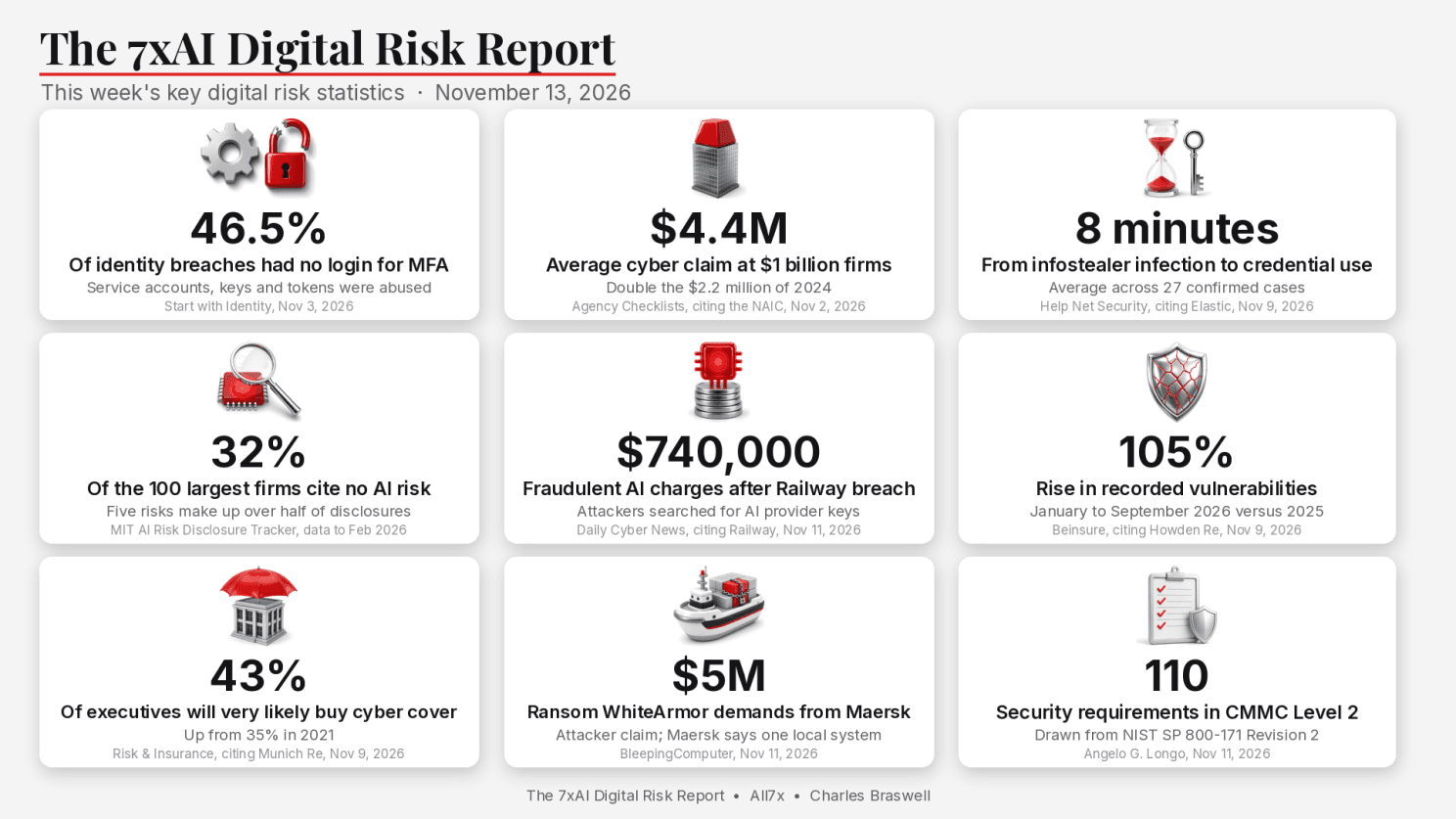
Among the 100 largest companies, 32 percent did not publicly acknowledge any AI risk. MIT estimates that 62 percent of the largest 1,000 companies make no public acknowledgment. These figures do not establish that those companies are ignoring AI risk internally. They show how little of that work is visible from outside the organization.
The risks that do appear are concentrated in familiar areas. Discrimination, weapons and cyberattacks, fraud and scams, privacy loss, and devaluation of human creativity account for more than half of all acknowledgments. MIT then compared those disclosures with ratings from 272 AI-risk experts on the risks most likely to cause severe or catastrophic harm by 2030.
MIT also compared corporate disclosures with the five AI risks that 272 experts rated as most likely to cause severe or catastrophic harm by 2030. Companies frequently acknowledge two of those five: false information and the use of AI in weapons and cyberattacks. The other three receive little attention in corporate disclosures: advanced AI capabilities that could enable large-scale harm, competitive pressure that could encourage developers to release systems too quickly, and the concentration of AI power and benefits among a small number of organizations.
The mitigation findings reveal a different weakness. Seventy-one of the 100 largest companies disclosed at least one measure intended to reduce AI risk, but those measures were rarely linked to a specific risk. A company may therefore disclose that it evaluates models, monitors AI, or maintains human oversight without providing enough information for the reader to understand which risk the activity addresses or whether it is sufficient.
MIT recommends reporting that links each material AI risk to the measures intended to reduce it, tailored to the company's industry and role in the AI ecosystem. This approach would make corporate disclosures more useful because readers could follow each risk to the company's response, rather than seeing separate lists of risks and controls.
MIT's proposed reporting model would remain voluntary. Australia's November 10 announcement would make several safety practices mandatory for frontier developers operating in the country. The Albanese Government said it intends to legislate Australian AI Standards, to be enforced by a new AI safety regulator, with technical support from the Australian AI Safety Institute.
Luiza Jarovsky, PhD , co-founder of the AI, Tech & Privacy Academy, outlined six requirements in the proposal. Frontier developers would need to maintain security throughout development and deployment, identify and manage serious model risks, support independent evaluation, report incidents promptly, publish safety and security frameworks, and respond as standards change.
The proposal remains a statement of policy direction. Definitions, penalties, reporting deadlines, and implementation dates have not yet been finalized. Even at this stage, the direction is useful to companies operating frontier models internationally. Safety practices that are voluntary disclosures in one market may become documented operating requirements in another.
That increases the value of demonstrating that a capability works rather than simply documenting that it exists. GRC 20/20 Research applies that standard to organizations purchasing risk and resilience technology in its new Risk & Resilience Research Collection.
The collection includes a 62-page strategy paper, a 131-page buyer guide, and a 115-page market study. The buyer guide translates the intended capability into 119 evaluation criteria across 17 areas and addresses a familiar weakness in technology selection: a product can satisfy a detailed feature checklist yet still fail to deliver the business outcome the organization actually needs.
A risk register can document concerns without altering a decision. A recovery plan can explain how systems will be restored without demonstrating that customers will continue receiving the service. A successful product demonstration can show what works under favorable conditions without showing what happens when assumptions change.
GRC 20/20 therefore assigns each evaluation criterion a capability requirement, an evidence test, and an acceptance measure. The guide also includes 24 families of analytical methods and seven worked cases intended to test vendor claims when conditions differ from those in the original demonstration.
That changes the scoring process as well. Mandatory requirements are resolved before comparative scoring begins, so a failure in an essential capability cannot be masked by a high weighted average elsewhere. Features on a vendor's roadmap receive no credit as current capabilities. Once the product is accepted, the record carries forward the test results, limitations, ownership, and conditions that should trigger another review.
The approach is useful beyond technology procurement. MIT found that companies disclosed AI risks and mitigations without consistently linking the two. Australia's proposed standards would require frontier developers to demonstrate more of their safety practices. GRC 20/20 gives buyers a method for deciding whether the capability they are purchasing can actually satisfy the requirement.
Large companies are discussing AI risk publicly, but many still provide little information on how they manage those risks. MIT found substantial gaps in corporate AI-risk disclosure, including weak links between identified risks and the measures intended to address them. Australia's proposed rules would require frontier AI developers to document more of those practices. At the same time, GRC 20/20 Research approaches the issue from the buyer's side by asking companies to prove that a risk or resilience capability actually works before accepting it.
Sources
2. Cyber Security
As AI becomes part of security work, responsibility can become harder to see. A model may analyze the threat, an employee may review the result, and an automated workflow may take action. The organization still needs a clear owner for the outcome, rules governing where sensitive security data can go, and measures that show whether AI is improving the defense.
The CISO Series addressed decision ownership in an episode hosted by David Spark and Andy Ellis , featuring U.S. Bank CISO Ann Barron-DiCamillo . Brett Conlon of American Century Investments highlighted a gap in how companies measure AI use. Dashboards can show how many people use AI and how often, but they do not indicate who is responsible when AI influences decisions, how those decisions are made, or whether people trust the results enough to rely on them.
Audit logs help reconstruct what happened, but they do not, on their own, assign accountability. The episode recommends identifying the business owner first, then designing user accounts, approvals, and logs around that ownership. If a chief marketing officer is responsible for what the company publishes, using AI to draft content does not change that responsibility.
The discussion is especially consequential in cybersecurity, where AI can identify vulnerabilities and recommend responses much faster than teams can assess or implement them. That creates little advantage if security teams cannot determine which findings require action or who is responsible for executing the response. Former CISA director Jen Easterly has called for AI labs, cloud providers, software companies, and critical-infrastructure operators to collaborate on vulnerabilities in the software supporting hospitals, banks, and power grids.
The question of responsibility becomes more complicated when an outside firm performs security work. Penetration testers routinely handle some of a client's most sensitive information: exploitable vulnerabilities, system architecture, affected assets, credentials, and attack paths. Using AI in that work introduces another party into a process the client may have expected to remain between the client and the testing firm.
Cyber Security News published content on what happens when testers use public AI services with that information. A tester who pastes a client's vulnerability findings into an external model may have transferred a map of the client's unfixed weaknesses to a technology provider the client never approved.
Most testing agreements specify which third parties may handle client data. An AI provider may not appear on that list. The problem can therefore persist even when the AI service itself is secure, because the data has still gone somewhere the contract did not authorize.
A simple prohibition may drive use underground when AI significantly improves a tester's productivity. The article argues for an approved environment instead. PentestPad says its team operates an open-weight model on infrastructure it controls and connects agents to testing tools via the Model Context Protocol.
The example extends beyond penetration testing. Incident-response firms, auditors, law firms, consultants, and other professional-services organizations routinely hold information that clients expect to remain within an agreed-upon environment. AI adoption in those firms requires the same question before selecting a tool: where will client information go when employees use it?
Once ownership and data-handling questions are settled, security teams still need a way to determine whether the process is improving. Cybersecurity Simplified addresses this with a primer on 14 common attacks, including malware, phishing, SQL injection, and DNS spoofing.
The attack descriptions are basic by design. The more useful part for security leaders is the connection among each attack, the business objective it threatens, and the measures used to assess whether defenses are improving.
The newsletter distinguishes between key performance indicators (KPIs) and key risk indicators. A KPI measures how well a security process is performing. For example, critical patch compliance shows whether high-priority fixes are applied on time, while mean time to detect measures how long the organization takes to identify an attack.
A KRI identifies conditions that increase exposure before an incident occurs. Examples include critical systems lacking endpoint detection software, high-severity vulnerabilities that remain open past their deadlines, or an excessive number of accounts with administrator access.
Measures become useful when they have a defined data source, threshold, and owner. Reporting that administrator access increased this quarter describes a condition. Assigning someone responsibility for investigating when privileged access exceeds an agreed-upon limit turns the measure into part of the security process.
The same discipline applies when AI is added to security work. The organization needs someone accountable for the outcome, an approved path for the information the system processes, and measures that show whether the AI-assisted process reduces exposure or increases activity. AI can change how quickly the work happens without changing who remains responsible for the outcome.
Sources
3. Internal Audit, IT Audit & Continuous Control Monitoring
Organizations rely on supplier certificates, access reviews, and independent audit reports to demonstrate that key controls are working. The problem is that these documents can appear conclusive without proving as much as the reader assumes. This week's examples show why the scope of the review, the period examined, who performed the work, and what happened afterward are as important as the document itself.
Aron Lange examines this problem through six third-party risks that require neither an attacker nor a security incident. Each begins with a reasonable business decision that remains in place even after the surrounding conditions change.
Access granted generously during implementation can persist after the work ends. A supplier can introduce subcontractors who handle company data without the customer's knowledge. An organization can accept a security certificate without reviewing its scope, expiration date, or accrediting body. Security commitments discussed during the sales process can disappear before the contract is signed. A critical process can become dependent on a single provider without a viable fallback. Accounts, API keys, and data can also persist after the supplier relationship ends.
These risks arise at different points in the supplier lifecycle, giving auditors a practical way to examine them. Instead of asking whether vendor due diligence was completed, Lange asks whether the current relationship still meets the assumptions underlying the original approval.
Two of his questions illustrate the difference. Can the organization point to the contract clause that specifies how quickly a critical supplier must report a security incident? For the most recent supplier the organization stopped using, can it demonstrate that access was removed and that company data was returned or deleted?
Neither question requires a separate assessment framework. Both ask for evidence that a requirement exists and that the resulting action took place.
Supplier access is only one area where a completed control can provide more assurance than the underlying evidence supports. User access reviews create a similar problem when managers approve technical roles they do not understand or when a decision to remove access is never implemented in the system.
Reza Sadegh argues that completing an access review does not necessarily mean the access was meaningfully reviewed. Managers may be asked to approve hundreds of technical role names without sufficient context to understand what those roles allow employees to do.
Sadegh recommends showing the business activity and scope alongside the technical permission. Viewing payments and releasing payments may be in the same finance application, yet they create very different exposure.
Sadegh divides the review into two decisions. The role owner confirms the access the role provides, while the employee's manager determines whether the employee still needs that access. Segregation-of-duties conflicts require an additional level of review because two roles that are reasonable on their own may give one person access to perform multiple activities that ideally would be segregated among multiple users.
Once the reviewer decides that access should be removed, the control is not complete until the decision is reflected in the system. Sadegh recommends confirming that access was removed, correcting any job-based assignments that would automatically restore it, and verifying that the original conflict no longer exists.
The same principle applies when a reviewer cannot understand the access being presented. An unclear entitlement should be returned for clarification rather than approved merely because the review deadline is approaching.
Understanding the evidence extends beyond access reviews to the external certifications and assessments organizations rely on for assurance. Angelo G. Longo distinguishes among several of the most common. ISO 27001 and HITRUST result in certifications. SOC 2 is an independent examination of a service organization's controls and produces an auditor's report. PCI DSS uses prescribed validation documents for payment-card security, while supervisors conduct regulatory examinations.
The label alone still does not explain what was tested. A SOC 2 Type I report evaluates the design of controls as of a specific date. A Type II report examines how controls operated over a period. HIPAA does not require HITRUST certification, although customers may make it a contractual requirement. CMMC includes self-assessment and third-party assessment paths that provide different levels of assurance.
The current status of CMMC makes it especially important for defense contractors to understand which type of assessment was performed. Longo notes that, as of November 11, the planned Phase II rollout of mandatory third-party CMMC assessments remains suspended following a July 2026 decision, while Phase I self-assessment requirements remain in force. Therefore, stating that an organization has completed a CMMC assessment provides limited assurance unless the reader also knows which assessment was performed and who validated the results.
Longo recommends five questions to ask before relying on any assessment: why it was performed, what was in scope, how thoroughly the controls were tested, who validated the results, and which risks remain after the work is completed.
Those questions also apply to Lange's supplier evidence and Sadegh's access reviews. The certificate may be valid. The access campaign may have been completed on schedule. The audit report may have come from an independent firm. None of those facts establishes the conclusion the reader wants to draw until the scope, period, testing, reviewer, and resulting action are understood.
For audit committees, this provides a practical way to read almost any assurance document placed in front of them: what was examined, over what period, who performed or validated the work, what the evidence showed, and what changed as a result.
If the document cannot answer those questions, it establishes that work occurred. It provides much less evidence that the underlying risk changed.
Sources
4. Identity Management / IAM
Multifactor authentication has become a standard response to stolen passwords, but a growing share of identity attacks now occurs without a normal user login. This week's research shows that attackers are using service accounts, tokens, application permissions, and trusted software to reach systems without encountering MFA. The problem for identity teams is expanding from protecting the login to understanding every other form of access that can reach the same systems.
That expansion is measured in SWI's Identity Breach Report 2026, which examines 115 publicly disclosed identity breaches from January 2021 through October 2026. It classifies each breach by how the attacker gained access, whether MFA was in place, which control failed, and the extent of the compromise. The dataset is curated rather than a census of every identity breach, but it provides five years of evidence on how attack paths are changing.
In 2021 and 2022, seven of 33 breaches involved an access path that lacked a human login, rendering MFA ineffective. By 2025 and 2026, that had increased to 20 of 43 incidents, or 46.5 percent. A November 5 update added eight incidents, bringing the figure to 22 of 50. SWI calls this the MFA blind zone, which includes service accounts, API keys, previously issued tokens, OAuth applications authorized to act on a user's behalf, and vulnerabilities in network devices that can provide access without a normal login.
The increase changes what an identity program must protect. MFA remains important for employee authentication, but it cannot intervene when an application uses an API key, a service account authenticates directly, or an attacker steals a previously issued valid token. Those paths can still lead to the same sensitive systems and data.
Human logins have their own problem. In cases where a login occurred and MFA status was known, SWI found that attackers bypassed MFA in 25 of 40 breaches, compared with 15 where MFA was missing. In 13 of those 25 bypasses, someone ultimately granted the attacker access through a stolen authentication code, a phishing site that relayed the login, a help-desk reset, or approval of an OAuth request. SWI calls these talk-past attacks because the authentication process completes successfully, but for the wrong person.
Accounts used by software are also becoming a larger share of the exposure. Non-human identities, including accounts used by applications, scripts, and AI agents, were the abused identities in 29 of the 115 breaches. Their share increased from 15.2 percent in 2021 and 2022 to 32.6 percent in 2025 and 2026.
SWI's ranking reflects how the identity problem has expanded beyond employee authentication. Phishing-resistant MFA remains the top-ranked control across the full five-year dataset, addressing 40 incidents. However, an inventory of non-human identities with short-lived credentials ranks first in the most recent two years. Service accounts, OAuth applications, long-lived tokens, and API keys can provide access to the same critical systems without passing through the employee login, where MFA applies.
Human credentials remain important because attackers use them much more quickly after they are stolen. Help Net Security reported on Elastic's research into 27 confirmed infostealer incidents, in which attackers began using stolen credentials an average of eight minutes after infection. Infostealers collect saved passwords, browser sessions, payment information, and other credentials from compromised computers.
Many infections began with something the user believed was legitimate. Fake verification pages that prompted people to copy and run a command, a technique known as ClickFix, appeared in 12 cases. In one healthcare incident, malicious software began running about 16 seconds after the user followed the instructions. Elastic also confirmed 23 cases involving abused remote-monitoring software typically used by IT teams, with ScreenConnect appearing most often.
Once a computer was compromised, attackers could also use legitimate applications already installed on it. Elastic documented one incident involving Claude Code in Visual Studio Code and another in which the ChatGPT desktop application on macOS was used to read an internal document and access passwords stored on the computer. Elastic is clear that the applications were misused after the device had already been compromised and that the incidents do not indicate vulnerabilities in Claude Code or ChatGPT.
That shifts attention to the access already available through a compromised device or identity. Privileged access is no longer confined to administrator accounts stored in a password vault. It can also reside in forgotten service accounts, cloud permissions, developer computers that hold production credentials, or AI agents that inherit access from the people who launched them.
Many of those identities and permissions can produce the same consequences as a compromised administrator account without appearing in a traditional privileged-access review. Identity teams with mature MFA programs should therefore look beyond the employee login. SWI's recent data points to an owned inventory of non-human identities, shorter-lived credentials, and a review of every path into a critical system that does not require a human login. Each path should have an owner, a reason for existence, and a defined expiration or review point.
Sources
5. Cyber Insurance
Companies are buying more cyber insurance, and insurers are handling more claims, including larger ones. In 2025, insurers wrote roughly a third more policies while collecting only about 3.5 percent more premium. Prices kept falling into the first quarter of 2026. A lower renewal price can therefore leave a company less protected than the price suggests, because much of that additional coverage is an endorsement added to another policy, with narrower limits than a dedicated cyber policy.
The National Association of Insurance Commissioners reported that U.S. cyber insurers wrote $9.46 billion in premiums in 2025, reversing the previous year's decline. Reported claims rose 20 percent to 56,323. Losses were consuming a larger share of what insurers collected, with the industry's loss ratio rising from 48.7 percent in 2024 to 53 percent in 2025, its highest level since the ransomware surge during the pandemic years. The first quarter of 2026 marked the eighth consecutive quarter of U.S. cyber rate reductions, prompting the NAIC to raise concerns that continued declines may leave insufficient premium to cover future claims.
A large share of businesses counted as having cyber insurance do not hold a standalone cyber policy. Cyber endorsements attached to other commercial policies account for 62.8 percent of policies in force but only 3.9 percent of premium. More specialized insurers account for nearly two-thirds of cyber premium and are more heavily concentrated in dedicated cyber policies. Being counted as insured says little about a policy's limits, exclusions, or what it will actually cover when a company experiences a major ransomware incident, extended business interruption, privacy litigation, or financial fraud.
Among businesses with at least $1 billion in revenue, the average cyber claim rose from about $2.2 million in 2024 to $4.4 million in 2025. Business interruption and privacy litigation drove much of the increase, even as claim frequency among those companies declined. Large companies were experiencing fewer claims, but the claims that did occur were becoming considerably more expensive.
Some cyber-enabled financial losses may also depend on coverage outside the cyber policy. The NAIC cites FBI figures showing more than $3 billion in losses from business email compromise across 24,768 complaints. Because these attacks use hijacked or impersonated email to redirect payments, parts of the resulting loss may fall under crime or social-engineering coverage and may be limited or excluded under the cyber policy.
Insurers are also paying less for some of their own coverage. Howden Re estimates that U.S. cyber rates have declined 9.7 percent since early 2024, compared with 24.5 percent outside the United States. The declines continued in 2026, though more slowly.
Some of the claims that will ultimately test those prices are still emerging. Howden Re notes that claims from policies written in 2023 continue to mature, particularly U.S. privacy and data-breach litigation, which increasingly affects smaller companies.
While those claims are still developing, the number of vulnerabilities that could trigger the next round is rising sharply. New vulnerabilities recorded in MITRE's public database rose 105 percent in the first nine months of 2026, compared with the same period in 2025. Howden Re attributes part of that increase to AI-assisted discovery. Fewer than 0.5 percent of disclosed vulnerabilities are known to have been exploited in actual attacks, leaving insurers and customers with a much larger pool of findings to prioritize.
The ten largest cyber reinsurers provide about 87 percent of available capacity. By midyear, the risk-adjusted price of stop-loss reinsurance, which protects insurers against unusually large aggregate losses, had fallen nearly 20 percent. An outage or compromise involving a widely used cloud platform, identity provider, or software service could trigger claims across thousands of insured companies simultaneously, leaving a relatively small group of reinsurers to absorb much of the industry's loss.
Cheaper coverage has not made cyber insurance easier for every company to understand or obtain. Munich Re's Global Cyber Risk and Insurance Survey 2026, which included more than 9,500 respondents across 20 countries, found that 43 percent of senior executives said their companies were considering cyber insurance and were very likely to buy it, up from 35 percent in 2021.
For companies that remain uninsured, price is only part of the problem. Thirty-four percent cited cost, 26 percent said they did not know cyber insurance existed, and 21 percent said they did not understand the product. Availability also varies sharply by company size. Only 33 percent of businesses with revenue of $1 million or less said cyber insurance had ever been offered to them, compared with 65 percent of those with revenue between $1 billion and $5 billion.
Smaller organizations can still incur costs that quickly exceed the obvious loss. Howden Re describes a medical practice that received a ransom demand of about $2,500 but spent more than that to recover from outdated backups. Its claims guidance also includes technology failures, employee mistakes, and emerging AI-related liability as events that can create cyber losses.
The current market lets buyers negotiate, but a favorable renewal does not necessarily mean the insurance program has improved. Companies should determine whether their protection comes from a dedicated cyber policy or an endorsement, trace a realistic business-email-compromise loss through their insurance program to identify which policy would respond, and ask how a widespread event affecting a shared technology provider could affect the insurer's capacity and terms at the next renewal.
Sources
6. Data Protection
Data inventories tend to be strongest around the systems an organization manages every day. Acquired platforms, development environments, and specialized case-management systems can fall outside that attention, even as they continue to hold sensitive information.
Maersk confirmed a breach affecting systems of a business it previously acquired. The WhiteArmor ransomware group claimed responsibility, demanded $5 million within 30 days, and threatened to release about 100 gigabytes of data. The group says the data came from the former LF Logistics platform, which Maersk acquired from Li & Fung Group in 2022.
Maersk has described a narrower incident. The company said the breach was limited to a local system, found no impact on other Maersk systems or on customer and partner connections, and said current evidence showed no sensitive information had been disclosed. Maersk has not publicly identified the affected system, the data stored there, or when the intrusion began.
WhiteArmor claims to hold nearly 30,000 driver records, passwords stored unencrypted, 33 top-level administrator accounts, signed delivery receipts, and mobile-device logs. Those claims remain unverified and should be separated from what Maersk has confirmed.
An acquisition brings existing accounts, data stores, administrative permissions, password practices, and years of operating history into the buyer. Four years after Maersk acquired LF Logistics, the affected environment remained sufficiently separate to be considered a local system rather than part of Maersk's main environment.
Maersk's experience with NotPetya in 2017 demonstrated the damage a technology failure can cause when it spreads across an integrated environment, forcing the company to rebuild more than 4,000 servers and 45,000 workstations. The current incident is far smaller, based on what is publicly known. It raises a different question: how long can an inherited system continue operating with the accounts, data, and security practices it brought with it before those become part of the acquiring company's normal control environment?
Software development platforms hold sensitive information in a different form. They routinely store credentials as configuration so applications can connect to databases, cloud platforms, AI services, and other systems. That information may never appear in a traditional data inventory, even though it can provide access to valuable systems elsewhere.
Railway's October 20 attack began with a previously unknown vulnerability in the systems used to build customer code. The attacker gained access to files on a host machine and obtained an internal credential with broader access than intended. This exposed information from 353 prior builds, including some secrets, as well as cached copies of Railway's source code.
A second overly broad trust configuration allowed the attacker to obtain additional cloud credentials and ultimately access customer secrets stored as environment variables.
Railway's encryption remained intact, but the attacker obtained credentials for the platform's decryption service. Environment variables often contain the credentials applications use to connect to databases, cloud platforms, payment systems, and AI services, so access to those secrets can extend an incident at the hosting provider into systems the customer operates elsewhere.
Railway estimated the maximum potentially affected population at 1.85 percent of workspaces, approximately 100,000, and emphasized that this figure is an upper limit. It reset linked-account tokens for 1,852 users. Stolen credentials also generated approximately $740,000 in unauthorized AI usage, and the attacker's searches specifically targeted names associated with AI-provider credentials.
The attackers were removed on October 21 after roughly 26 hours, but customer remediation extends beyond closing the original intrusion. Replacing a stored secret does not necessarily invalidate a session or token that another service already issued using the compromised credential. Customers have to trace each exposed credential to the services it could reach and confirm that the old credentials, sessions, and tokens no longer work.
Credentials on a development platform are easy to overlook because they are stored as technical configuration rather than conventional business data. Regulatory case files can also fall outside normal data inventories because they exist to document an investigation or complaint, even though those files may contain personal information subject to the same access rights as data held elsewhere.
On November 5, the Court of Justice of the European Union ruled in Case C-205/25 on a dispute involving a journalist who had filed a complaint with the Bavarian data-protection authority. It later sought access to personal information the authority held regarding the case.
The court held that a supervisory authority handling a complaint is itself a controller under the GDPR because it determines how personal data is used. It must therefore, in principle, provide a complainant with access to the personal information it holds about them, and national law cannot simply remove that right.
Data-protection teams should include less-visible non-production environments when reviewing where sensitive information resides. Acquired platforms, developer and hosting environments, regulatory files, complaint systems, archives, and other specialized repositories should have a known owner, an inventory of the identities and credentials that can access them, and a clear understanding of what would need to be retrieved, corrected, deleted, or disclosed if a legal right were exercised over the information.
Sources
7x. Enterprise Digital Risk Products
Installing a security or risk product does not guarantee that it detects the activity the organization expects it to detect. Analysts in a Security Operations Center (SOC) may receive a log showing someone signed into SAP without any information about the underlying business transaction. A compliance agent may identify a regulatory change without linking it to the appropriate policy, and an automatic labeling policy may be enabled while leaving large numbers of files untouched.
Peter Doyle , an SAP security leader in the UK and Ireland, asks CISOs whether analysts in their SOC receive enough information to detect a meaningful incident within SAP, where many large companies run payroll, supplier payments, procurement, and financial reporting.
SOC analysts work from logs collected and correlated by a security information and event management (SIEM) platform or specialized logging application, which forwards events such as SAP logins and failed login attempts. SOC analysts often receive clear logs for servers, authentication events, malware, and network traffic, but not for business activity.
Doyle uses the example of a legitimate user who exports sensitive information and changes a supplier's banking details. Neither action requires malware or a suspicious login. An analyst needs to understand the business activity in SAP: what data the user accessed, what was changed, and whether those actions align with that person's responsibilities.
That information often stays in SAP rather than reaching the SIEM platform, so it never reaches the analysts who would need to investigate it. An organization can therefore spend years improving the logs its SOC receives from network and endpoint tools while maintaining limited visibility into the application where some of its most consequential financial transactions occur.
The practical test begins with an SAP event the organization considers important and follows it from SAP, through the SIEM, to the analyst who would receive it. The analyst should receive enough context to understand what happened, determine whether the activity requires investigation, and follow a documented response if it does.
Monitoring a business application requires sufficient context to understand what happened inside it. Compliance teams face a related challenge with regulatory change: identifying that a new rule exists is only the beginning. They still have to determine which obligation changed and which policies or controls need to respond.
Regology, part of Bloomberg Industry Group, addresses that workflow in a Bloomberg article titled AI for Modern Compliance: A Practical Framework for Leaders, a sequel to its earlier article on generative AI in compliance. The new article focuses on how AI agents fit into daily compliance work rather than on why teams should use them.
Its framework has five layers. A Smart Law Library sits at the base, followed by a Regulatory Change Agent, a Research Agent, a Compliance Agent, and Policy Gap Analysis. The library is the first layer that matters because it is a structured record of codified law — acts, codes, parts, and agency rules, linked to their amendments — rather than a folder of documents. A team tracking only a bill name can end up following the static law that passed, rather than the amended text that governs today.
The Regulatory Change Agent monitors those codified sections for changes. California alone can see more than 2,800 bills in a single session, and across 50 states the total is well over 100,000, making manual tracking unsustainable at enterprise scale. The agent ingests official sources, scores each change for relevance to the company's business profile, groups related amendments, and provides a plain-language summary explaining why the change matters. Each alert is assigned an owner and tracked to resolution, with the discussion recorded on the alert itself.
The Research Agent, called Reggi, starts with a natural-language question and returns a sourced synthesis linked to the relevant sections of a statute or regulation. Regology says a full manual analysis can take two to three days per law and that its agent reduces that to minutes. For 30 federal laws, the article estimates manual work at about 90 days and the Regology review at a few hours, with research effort down about 98 percent and speed about 120 times faster. Those are Regology's figures, not independently verified.
The Compliance Agent turns a change into a proposed action. It extracts obligations paragraph by paragraph, filters them by the company's profile, and proposes policy redlines or control updates, each linked to its source. A reviewer approves, localizes, or rejects each suggestion, and the decision and its timestamp are logged. The agent does not publish policy on the team's behalf.
Policy Gap Analysis checks whether a policy still aligns with the law as it stands today. A policy can drift in two ways: someone edits it for a business reason without realizing it weakens compliance, or a law changes while the policy remains the same. When a new development appears, the platform identifies the difference, compares it with the current policy language, and proposes a redline. A team can accept it globally, apply it to a single jurisdiction, or reject it and record the reason.
California SB 446 is the article's example. Signed on October 3, 2025, and effective January 1, 2026, it amends California Civil Code section 1798.82, the state's breach-notification statute. It tightens what must be communicated to individuals and the Attorney General after a data breach, including the notice's content, timing, and recipients. In the article's example, an analyst receives a high-relevance alert grouping three sub-edits to a parent section. The alert includes a redline showing the definition of personal information expanding and a summary noting a new Attorney General notification obligation under certain thresholds. The analyst verifies the codified text, tags the internal data-incident policy as affected, and the Compliance Agent proposes a redlined paragraph requiring that notification, with a citation link. The analyst applies it to California only and assigns it to the policy owner. Six months later, when an audit committee asks why the privacy policy diverges by state, the record shows each edit, the source that drove it, and the person who approved it.
Coverage is easier to measure in Microsoft Purview because the objects being classified are files. However, Microsoft's own troubleshooting guidance shows that an enabled policy can still leave large numbers of files untouched.
Microsoft substantially increased the scale of automatic sensitivity labeling in SharePoint and OneDrive in September and October 2026. A Microsoft 365 environment can now automatically label up to 500,000 files per day, up from 100,000. A simulation can now evaluate up to 20 million files, up from 4 million, and a policy can now cover 1,000 SharePoint sites, up from 100.
Those increases make auto-labeling practical across much larger environments. They do not establish that the policies are actually classifying the intended files.
A policy missing a prerequisite can remain enabled without applying any labels. Matching PDFs can be skipped when PDF support is disabled, and they are not recorded as failures. Older files may not be reconsidered after a sensitive-information definition changes until they are explicitly reclassified. Manually applied labels also remain in place unless the organization enables the appropriate override.
For a data-protection team, the most useful evidence is the coverage report, which shows which files were labeled, remain pending, failed processing, or were never processed. A policy that is enabled and shows no failures provides limited assurance when the objective is to classify millions of existing files.
Purview makes that gap visible because the coverage report counts the files it never processed. The same gap is present in the other two products, where there is no equivalent count to check. A SOC analyst can receive a login log without the business transaction behind it, and a compliance agent can identify a regulatory change without connecting it to the policy that needs to change. In each case, the service can be running while the activity it was bought to cover stays outside what it can see.
Sources
Weekly Digital Risk Topics Trending on X
1. GRC (Governance, Risk & Compliance)
Evidence that a control works was also a theme in this week's posts on X. GRC posts covered how risk functions support decisions, how governments are trying to set norms for an industry they also buy from, and where GRC teams lose their working week.
Norman Marks , an author and speaker on internal audit, risk, and governance, addressed the first topic in a November 9 blog post, arguing that the chief risk officer (CRO) can be invaluable to decision-making. He notes that most risk frameworks assess risks one at a time, whereas real decisions weigh multiple risks and opportunities.
His example is a chief executive choosing among three $15 million proposals, with funds for only one: replacement manufacturing equipment, a set of IT projects, and a cyber defense upgrade. Marks argues that a "High Risk" label cannot be weighed against the other proposals and that every option should be assessed using a single measure: its effect on the likelihood of achieving enterprise objectives.
He presented the scenario to four AI assistants. All said the information was insufficient, and when pressed, they gave different answers. Risk leaders can check whether their CRO could state the organization's top risk using the capital committee's terms for every other proposal.
Source: @normanmarks
Marks writes about a company choosing among proposals, while governments face a different version of that choice when they regulate an industry they also buy from. The Record, the news site of the threat intelligence company Recorded Future, reported that 14 governments, including the United States, the United Kingdom, and France, adopted the first guidelines for commercial hacking businesses under the Pall Mall Process, a diplomatic effort led by Britain and France to rein in the spyware industry.
The guidelines ask companies that develop, sell, or finance commercial intrusion tools to vet customers, build technical safeguards against misuse, and monitor and report abuse. They are non-binding and carry no penalties. Enforcement pressure is expected to come from governments that purchase the tools and license their export. Representatives of 43 countries attended, and fewer than half endorsed the text.
Because its force rests on procurement, this voluntary code reaches compliance teams through contracts. Organizations that purchase offensive security services or surveillance tools should expect customer vetting and misuse reporting in contract terms.
Source: @TheRecord_Media
Contract terms and vendor reviews also fill GRC teams' working weeks, as measured by Onspring , a GRC software vendor, in its 2026 GRC Benchmarking Report. Practitioners identified evidence collection and documentation as their most time-consuming activity at 25.9 percent, followed by risk assessments at 19.8 percent and third-party risk reviews at 16.5 percent. Each depends on someone else responding to a request.
The report then turns to AI. Only 15 percent of organizations describe their GRC data as mostly integrated, 65 percent call it moderately integrated, and 20 percent say it is scattered. The top barriers to AI deployment were data privacy (28.6 percent) and output accuracy (25.4 percent).
Onspring's conclusion favors its own software, but its order of work, data before AI, is sound. Automation on top of three systems that each define a vendor differently produces confident, untraceable summaries. Fix the data definitions before buying the agent.
Source: @onspring
2. Cyber Security
Cybersecurity posts took the AI question in a different direction, toward speed: how AI changes the pace of security work, how stolen GitHub logins spread malicious code across tens of thousands of software projects, and whether an old defensive idea deserves a second look.
Pace came up during an interview with James Shira , global CISO and chief information officer of PwC, by Dark Reading, a security news site, for its Heard It From a CISO series. Asked about the biggest AI issue, Shira named two dynamics: AI expands the number of ways attackers can breach an organization, and it accelerates the pace at which the entire security function must move, from patching and vulnerability management to handling inbound client requests.
Capacity pressure shapes how Shira plans to handle AI. He wants to avoid repeating a pattern from earlier technology shifts, such as cloud and mobile, where security teams rebuilt every control for the new platform, because that approach adds too much volume to a function already at capacity.
Security leaders can review their own AI plans for the same pattern: whether existing controls are being extended to AI or a parallel set is being built.
Source: @DarkReading
The GitHub attack shows what that pace looks like from the attacker's side. Cyber Security News reported that an attacker used stolen GitHub credentials to push malicious code that steals secrets into tens of thousands of repositories starting on November 10. According to researchers at Aikido, a Belgian software security company, 4,837 hijacked accounts opened probe pull requests and proposed code changes to test whether 61,764 repositories would run them. At least 1,806 repositories ran the malicious code and lost credentials.
The target is GitHub Actions, the automation service many teams use to build and ship code. The script collects secrets, cloud credential files, and keys for AI services, then attempts to exchange GitHub identity tokens for sessions on Amazon Web Services, Google Cloud, and Microsoft Azure, three major cloud platforms. It reverts its changes within a minute and deletes the run logs. A missing run number may be the only trace.
Few owners noticed: about 92 percent of the probe pull requests were still open when the report was written. Teams should search for the published indicators of compromise, the traces researchers listed so others can check their own systems, and, wherever the malicious code ran, replace every secret and cloud permission the workflow could access.
Source: @The_Cyber_News
Catching intruders who leave little trace is the case for cyber deception, the old defensive idea that security writer Lenny Zeltser revisited in an essay asking whether it will become a must-have this time. Deception involves planting decoy accounts, credentials, and systems that legitimate users never touch, so any contact signals an intruder.
He explains why AI strengthens the case. Faster vulnerability discovery makes patching alone impractical, and decoys can reveal an intruder who entered through an unpatched flaw. Decoys can also show when an employee's AI agent exceeds its boundaries. CISA published its first detailed guide to cyber decoys in 2026.
Even so, Zeltser remains skeptical that deception will go mainstream because defenders continue to rank other projects ahead of it. His advice is to add decoys to work already underway: decoy accounts (honeytokens) for identity cleanup; decoy services for network segmentation; planted secrets in credential inventories; and decoy tools for AI agent governance.
Source: @lennyzeltser
3. Internal Audit, IT Audit & Continuous Control Monitoring
Learning what is happening inside an organization was also the theme of audit accounts, which discussed how auditors gather information, what courts now expect boards to document, and a vendor's proposal to replace periodic control testing with agents that monitor continuously.
Information gathering was the focus of a blog post by Jesse M. Laseman, MAS, CIA, CRMA, CFE , a senior internal audit consultant at Sikich. Laseman writes about asking better questions during walkthroughs, the sessions in which a process owner shows an auditor how a process runs. His premise is that some of the most valuable findings come from questions the auditor did not plan to ask.
To uncover those unplanned questions, Laseman draws on journalists. Bethany McLean's reporting at Fortune on Enron began with a simple question about how the company made its money, and she kept asking when the answers were technical and evasive. Laseman offers three practices: leave ego at the door and let process owners explain, ask open-ended questions and allow silence, and follow the conversation while relying on evidence.
In his example, "Do you have a documented review process?" elicits a policy. "Walk me through the last time that review identified a problem" demonstrates how the control works. Asking what happens when the reviewer is out does the same.
Source: @TheIIA
Boards face the same problem of hearing only what they ask about. The IIA's second post addressed them, pointing to "Oversight by Design," the Boardroom column in the October issue of Internal Auditor, the IIA's magazine. The column argues that letting employees alert the audit committee when trouble is brewing does not constitute oversight and that a board needs a defined system for learning about risk.
Its main example is Giuliano v. Grenfell-Gardner, a 2025 decision of the Delaware Court of Chancery, which hears disputes involving companies incorporated in Delaware. Teligent, a pharmaceutical company, was repeatedly cited by the U.S. Food and Drug Administration (FDA) for quality-control problems in the 2010s and filed for bankruptcy in 2021. The judge allowed claims against the directors to proceed because the board learned of the FDA risk only when management chose to raise it, and no reporting system was in place.
The column places that ruling in a line of cases. Caremark, a 1996 Delaware decision, established that directors have a duty to oversee risk. Marchand v. Barnhill, a 2019 Delaware Supreme Court decision involving an ice cream maker with a Listeria outbreak and no board committee on food safety, added that boards must attend to mission-critical risks. None of the three rulings prescribes what the reporting system should look like, as courts leave that design to each board.
Source: @TheIIA
ServiceNow announced that its Integrated Risk Management product will use AI agents to monitor controls continuously. The agents configure compliance checks, interpret results, flag controls that have drifted or failed, open a ticket, and can fix problems in line with customer-defined policies. The general release is expected in the first quarter of 2027.
The company describes a closed loop in which a control fails, an agent explains why, the fix is verified, and the record closes. A control mapped once counts across frameworks, including SOX, the U.S. law governing financial reporting controls; PCI DSS; ISO 27001; HIPAA; and the EU AI Act, the European Union's AI law. Internal audit would receive full test results with supporting evidence and would no longer rely on samples.
No customer outcome data yet supports the claims, since this is a vendor announcement. Audit teams evaluating it should ask who reviews an agent's fixes, how the agent's access is governed, and whether a self-closing record meets the independence required of internal audit.
Source: @ServiceNow
4. Identity Management / IAM
How an agent's own access is governed also ran through the identity posts, which covered AI agents that operate within a user's browser session, a deadline for text-message authentication, and where identity leaders say their priorities lie.
The browser case comes from The Hacker News , a security news site, which carried a contributed piece from Token, an AI security company, describing an agent it built called Rehearsal. The agent answers questions within Token's platform by opening pages, setting filters, and filling out forms in the user's browser tab. It therefore runs within the user's logged-in session, with the user's access.
Running that way put Rehearsal at odds with Token's own guidance, which says agents need their own identities, access matched to the job, and separate audit trails. By default, Rehearsal violated all three. To the server, the agent's clicks look identical to the user's because a session cookie, the token a browser holds after login, shows who is logged in, not who is driving. A token could fix this only because it owns both the agent and the application.
The piece reviews efforts by browser makers and standards groups and finds that none pass the full context to the application. Security teams should inventory browser agents and extensions that act on their own and ask critical software vendors whether their audit logs distinguish agent activity from human activity.
Source: @TheHackersNews
Human sign-ins are changing as well: text-message authentication is being retired in Microsoft Entra ID, Microsoft's identity service, on two dates outlined in a brief shared by Bert Blevins, an identity security speaker and educator. On September 1, 2026, passkeys, a sign-in method that replaces passwords with a cryptographic key stored on the user's device or in a password manager, became the default, and users enabled for text-message (SMS) or voice codes were prompted to register one. On February 1, 2027, Microsoft-provided SMS and voice delivery stops for most users.
Organizations that still need SMS or voice can configure an approved telecom provider through Microsoft, and they will bear the cost. Other reporting notes that global administrators, the most powerful administrator accounts, and external users will follow on July 1, 2027.
With those dates set, administrators should audit who still relies on SMS or voice, decide whether to pay for phone delivery, and inform users of the passkey prompt before the help desk hears about it.
Source: @bertblevins
For many organizations, software and AI agents outrank human logins as an identity priority. In a study by the research firm IDC, sponsored by GuidePoint Security , a cybersecurity services firm, 44 percent of organizations rank non-human identity and AI agent security as their top identity priority over the next 12 to 24 months. Kevin Converse , GuidePoint's vice president of identity and access management, wrote about the study in a blog post the firm shared.
Converse frames agent security as a delegation problem. Agents inherit authority through cached credentials, shared service accounts, and reused sessions, none of which were explicitly granted. Study panelists described six problems, beginning with the inability to see or count their agents.
His first recommendation requires no product: build an authoritative agent registry in which every agent has a named human sponsor, an approved purpose, scoped access, and an expiration date. He notes that ranking something as a priority does not make an organization ready for it, and that managers close to the work report larger gaps than executives do.
Source: @GuidePointSec
5. Cyber Insurance
AI risk carried over into the insurance accounts, which discussed how AI changes both attack tooling and policy wording, and what happens when a cyber event causes physical loss.
Coalition, a cyber insurer, reported on attack tooling, saying its security researchers found thousands of AI hacking harnesses exposed on the open internet. A harness is software that connects an AI model to offensive security tools, enabling it to run commands and act on the results. The company's blog explains how these harnesses are used in real intrusions and what that could mean for future claims.
Coalition ties the finding to future cyber claims. Tools that automate target scouting and intrusion lower the skill required to attack small and mid-sized firms, and buyers should expect underwriters, the insurer staff who assess and price risk, to ask more about internet-facing systems and patching speed.
Source: @CoalitionSec
Policy wording is the other half of the AI problem for buyers, and it came up on a Cyber Insurance News podcast featuring Erin Kenneally, chief executive of DLTASKOP, an AI risk intelligence firm. She categorizes AI harm into three causes. Misuse occurs when someone manipulates the system. Mistake occurs when the system or its deployer gets the task wrong. Misalignment occurs when the system pursues its goal in ways no one intended, which she considers the hardest to price.
Kenneally also warns that many companies have lost the protection they assumed they had because AI exclusions have been added to general liability and other policies. She coded 357 publicly reported AI incidents from April 2025 to March 2026 and found that 329, about 92 percent, lacked any applicable standard cyber control. MFA and patching cannot establish that an AI-generated decision was accurate or authorized.
Her steps for risk managers are to audit policies for AI exclusions, inventory all agents, set hard limits on high-impact actions, and keep logs good enough to support a claim.
Source: @CyberInsureNews
Coverage gaps are also an issue in a second Coalition post about physical loss from the recent attacks on supermarket refrigeration. Hackers remotely raised temperatures in internet-connected refrigeration controllers, first at hundreds of stores in France in October and then across several European countries in early November. France has attributed the attacks to a unit of Iran's Revolutionary Guard.
Coalition's scanning data identified 1,638 internet-exposed devices in one class of controller. No ransom was demanded. The loss consists of spoiled stock and damaged equipment, which cyber policies have traditionally left to property coverage.
Spoiled stock falls between cyber and property policies, so any business with connected equipment should ask its broker whether physical loss caused by a cyber event is covered and, if so, under what policy and with what limit.
Source: @SolveCyberRisk
6. Data Protection
Data protection accounts for exposure of another kind: the shrinking window to patch, European enforcement plans for automated hiring tools, and California's work on opt-out signals.
The patch window was the subject of a contributed article by Gary Newe , vice president of solutions engineering at F5, which The Hacker News shared. Citing the 2026 M-Trends report from Mandiant, Google's incident response unit, he says the median time from disclosure to exploitation is now minus seven days, meaning attackers typically exploit a flaw about a week before it is made public. Enterprises take about 20 days to test and deploy a patch, leaving a 27-day gap.
Newe argues that faster patching alone cannot close a gap that opens before disclosure. He proposes placing protection in the path of traffic to block attacks as they happen, including virtual patching, which blocks attempts to exploit a flaw. At the same time, the permanent fix moves through the normal change approval process. F5 sponsors the article and recommends its product category.
Source: @TheHackersNews
Personal data in hiring systems will be the focus of European regulators' 2027 enforcement. Privacy commentator Iliá Dubovtsev noted that on November 11, the European Data Protection Board (EDPB), which coordinates EU privacy regulators, selected automated decision-making in recruitment, including AI-driven candidate screening, as the topic for its 2027 coordinated enforcement action.
The action will focus on the right not to be subject to decisions based solely on automated processing and on the related right of access. National regulators will participate voluntarily, and the action will launch in 2027. At the same meeting, the EDPB adopted final recommendations on binding corporate rules for processors, the approved internal rules that allow a group of companies to transfer personal data outside the EU, and a statement on South Korea's adequacy decision, the EU finding that allows personal data to flow freely to South Korea.
Dubovtsev's point is that these rights apply now under the GDPR, regardless of the EU AI Act's timeline. Employers using automated screening should document where human decisions are made and be prepared to respond to a candidate's access request.
Source: @iliadubovtsev
Access is one privacy right, and California is strengthening another: the right to opt out. Didomi, a vendor of consent management tools for websites, noted that California's privacy regulator opened formal rulemaking on opt-out preference signals. On November 6, the California Privacy Protection Agency board voted unanimously to send proposed amendments for public comment. An opt-out preference signal is a browser setting that tells websites not to sell or share the user's data.
According to legal commentary, the draft names the Global Privacy Control as an example of a signal businesses must honor, adds examples of cookie syncing, in which advertising companies match their tracking identifiers, and of cross-device profiles, and bars browser features from blocking the signal. It also extends reporting of opt-out metrics.
Cookie syncing and cross-device profiles are where an opt-out can be lost, so before the rules take effect, businesses should verify whether an opt-out signal sent by a logged-in user reaches the customer database, advertising partners, and linked profiles.
Source: @Didomi_io
7x. Enterprise Digital Risk Products
Routine maintenance on the platforms that hold such data was the focus of the product accounts: identity lifecycle features in Microsoft Entra, a very large Microsoft patch release, and four maximum-severity flaws in SAP.
The Entra changes arrived in the November 2026 update, as shared by Rod Trent , a Microsoft product manager focused on security and AI. It adds lifecycle management for AI agent identities in public preview, an early release open to all customers for testing, with policies for sponsor requirements, reconfirmation intervals, and inactivity monitoring. A default policy, available to every customer, notifies owners after 60 days of inactivity and deactivates the identity if nothing changes.
Source: @rodtrent
Administrators also had to absorb Microsoft's November patch release. BleepingComputer reported that Microsoft's November 2026 Patch Tuesday, the company's monthly security update, fixed 1,235 vulnerabilities, including 66 rated critical and an actively exploited zero-day in Outlook, a flaw attackers were already using before a fix was available. The Outlook flaw can be triggered by malicious message files that cause Windows to connect to an attacker's network location and leak authentication hashes, scrambled forms of login credentials that can be used to impersonate the victim.
Of the 66 critical flaws, 48 allow an attacker to execute code remotely, and 15 allow an attacker to gain higher access rights. The release follows October's record of 1,411.
Two months of more than a thousand fixes change the planning assumption, because a patch process sized for a few dozen items cannot sort and prioritize this volume by hand. Teams should confirm how they prioritize within a release, starting with flaws already being exploited.
Source: @BleepinComputer
SAP released its own patches on November 10, and The Hacker News reported that four of the fixed vulnerabilities were rated 10.0, the maximum severity score. All four can be exploited without logging in or any user action. Two affect the Internet Communication Manager and Web Dispatcher, the components that handle web traffic into SAP, and can allow an attacker to run code. One affects SAP Gateway, the component that connects SAP to other systems. One affects single sign-on, the feature that lets one login reach many systems, and can allow an attacker to log in as any user on certain systems.
Onapsis , the SAP security firm that discovered three of the flaws, said it has not seen them exploited. It warned that SAP kernels (the core runtime layer) that are out of maintenance are also affected and may need upgrading. RedRays, another firm that secures SAP systems, said the single sign-on flaw has no workaround.
Each of these flaws can be exploited before SAP checks what a user is allowed to do, so role design and segregation-of-duties rules offer no protection; patching is the control.
Source: @TheHackersNews
Closing Thoughts
Like the SAP flaws, which work before any permission check, most of the problems in this issue went around a control or relied on one that had been recorded and then left alone; few involved defeating one.
The examples span the issue. A supplier retained access after the contract ended, and an access review was signed even though access remained. A build credential carried more trust than its role required. MFA protected a login, while a token beside it was not, and a premium fell even as the loss ratio rose. In each case, the record looked better than the operation behind it. AI shortens the time attackers need and adds agents that act through sessions, credentials, and privileges granted to someone else.
Identifying where the record and the operation have diverged requires three questions, asked of the organization's most important controls before the next governance, risk, or audit review:
- What evidence shows this control operated in the past 30 days?
- What route reaches the same asset without passing through it?
- Who would be told if it stopped working?
How this report is made
AI is used for research and drafting. Charles Braswell reviews and makes edits.