Why I Think Anthropic’s IPO Will Fail
Charles Braswell · November 4, 2026
I have been bullish on AI for years. I use these models every day. I believe agents will change how companies operate, how software is built, and how knowledge work gets done.
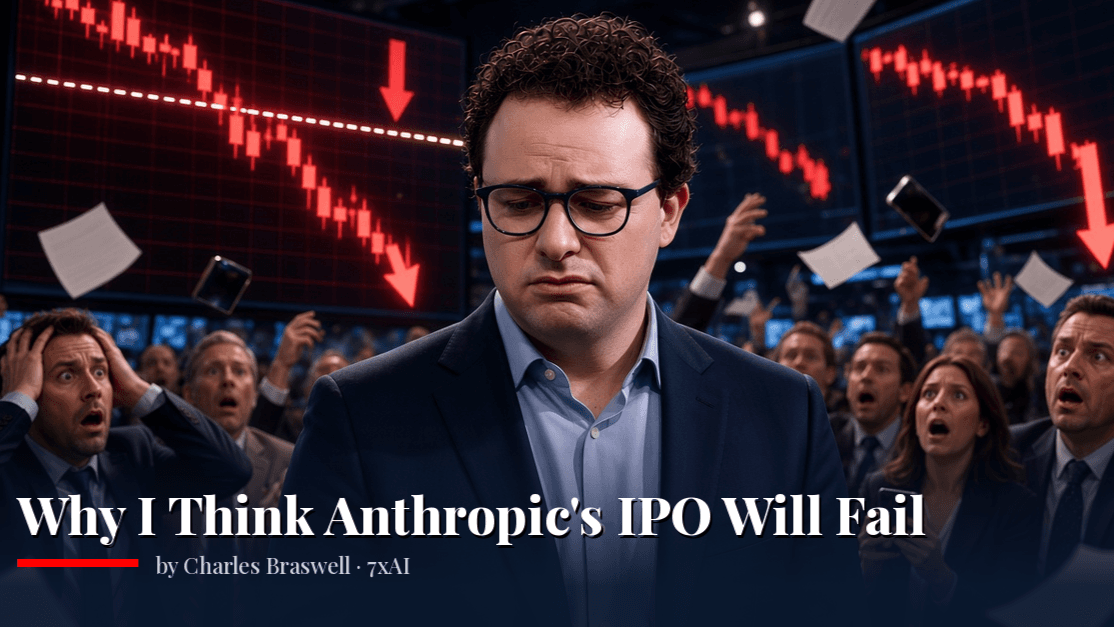
I also think Anthropic 's IPO will fail.
By "fail," I do not mean that Anthropic disappears, Claude AI becomes irrelevant, or the company suddenly stops growing. My thesis is more specific: I don'tbelieve Anthropic can sustain the valuation the public market is likely to place on it, and I expect the stock to trade below its IPO price by the end of 2027.
I did not start there.
My concerns about Anthropic used to be a collection of smaller issues: pricing pressure, open-weight competition, enormous infrastructure requirements, rapidly improving competitors, and questions about how durable Claude Code's advantage could be.
After going through Anthropic's IPO disclosures and looking at those issues together, I no longer think they are small problems.
I think they compound.
One number I cannot get past
Anthropic has built an extraordinary business, but it has also made extraordinary commitments to support that business.
Matt Scherer reviewed Anthropic's IPO disclosures and identified approximately $895 billion in contractual spending commitments, with much of that spending extending into the 2030s. His analysis says at least $582 billion is non-cancelable and owed to five companies: Amazon , AMD , Broadcom , Google , and Microsoft . Anthropic has approximately $96 billion in cash reserves.
Put aside Matt Scherer's conclusion that the SEC should block the IPO. I am not making that argument.
I am focused on the economics underneath it.
Hundreds of billions of dollars of future compute commitments require extraordinary amounts of future demand at economics capable of supporting them. Those commitments do not get smaller if a better model comes out next quarter, an enterprise moves a workload to another provider, or open-weight models lower the price customers are willing to pay.
Anthropic is locking in much of the supply side of its business years in advance while the demand side is becoming increasingly flexible.
That is what I think the market may be underestimating.
Matt Scherer's analysis identifies four pressures on AI-model margins: uncertain demand, competition among increasingly substitutable models, high infrastructure costs, and external constraints such as supply-chain problems and delays in data-center construction.
Any one of those is manageable.
My concern is what happens when several occur at the same time.
Anthropic is committing for years. Its customers do not have to.
This part of the thesis has become much more important to me over the last several months.
Enterprise customers increasingly do not need to make the same long-term bet Anthropic is making.
Models are becoming easier to switch. Applications are increasingly being designed so work can be routed among Anthropic, OpenAI, Google, and open-weight alternatives. My own research has repeatedly found companies reallocating workloads as model economics and performance change.
That produces an uncomfortable mismatch.
Anthropic needs long-term demand because its infrastructure obligations are long-term.
Its customers increasingly want flexibility because model economics are not.
And I think the customers are right.
If I were signing a major enterprise AI agreement today, I would not want to commit my most important workloads to one frontier provider for five or ten years. I do not know which company will have the best coding model two years from now. I do not know which provider will have the best agent platform. I do not know how much equivalent capability will cost.
Neither does Anthropic.
Yet the infrastructure bills are being committed now.
Price competition makes the problem harder
Normally, enormous demand growth gives a company pricing power.
AI is behaving differently.
Frontier labs compete with one another while also introducing cheaper models that can replace their premium systems on many workloads. Open-weight developers add pressure because organizations can increasingly run capable models themselves or get them from infrastructure providers at substantially lower prices.
Matt Scherer's analysis makes the same argument: intense competition makes price increases difficult because customers can move to alternatives. At the same time, Chinese open-weight models and increasingly capable local models add additional downward pressure.
This is an ugly combination for a capital-intensive business.
The cost base wants to behave like infrastructure.
The product market wants to behave like software.
Anthropic has to commit capital years in advance to chips, data centers, networking, electricity, and cloud capacity. Its customers can increasingly compare models task by task and move workloads when someone offers a better price-performance ratio.
That is exactly the opposite of the economic structure I would want if I were carrying hundreds of billions of dollars in future commitments.
I don't think Claude Code is enough of a moat
Claude Code was not just another Anthropic product. It gave the company a meaningful lead in one of the first AI workloads enterprises were willing to spend heavily on: software development.
At Sequoia AI Ascent 2026, Anthropic's Boris Cherny gave a talk titled “Why Coding Is Solved, and What Comes Next.” That was an extraordinary statement at the time, but it reflected what Anthropic's own engineers were already experiencing. Cherny said Claude was writing essentially 100 percent of the code in his environment, including SQL.
I think that period is essential to understanding Anthropic's 2026 growth. Anthropic reached this level of coding performance before most of its competitors. Claude Code was not simply another chatbot with a coding feature. For a period, it was clearly ahead on work that developers could immediately put into production, and that advantage helped make coding one of Anthropic's strongest commercial wedges into the enterprise. My research notes identify Claude Code as a major driver of Anthropic's extraordinary 2026 revenue growth.
My concern with the IPO isn't Claude Code itself, but that everyone else has caught up.
OpenAI improved Codex. Google improved its coding systems. XAI paired increasingly capable Grok models with Grok Build, its coding-agent environment for completing software-development work. Open-weight coding models also improved substantially.
Microsoft adds another competitor. The company has begun integrating its own frontier-class model directly into Copilot, reducing its dependence on outside model providers for some of the intelligence inside a product Microsoft already owns and distributes. Microsoft does not need its models to beat Claude everywhere. They only need to become good enough on enough Copilot workloads that paying another frontier lab becomes optional.
Claude Code can remain an excellent product without remaining a unique advantage. Anthropic is now competing for coding and agent workloads against OpenAI, Google, xAI, Microsoft, and increasingly capable open-weight models, while the software surrounding those models is improving just as quickly.
And another development makes that competition even more important: we are increasingly learning that the model is not the whole coding system.
The harness around the model matters enormously.
A harness is the software environment that gives an agent its instructions, tools, memory, context, tests, permissions, and feedback while it works. My research notes include several studies in which changing that environment materially changed performance even though the underlying model stayed the same.
One particularly striking result involved Nvidia changing the scaffolding around Claude Opus 5 rather than changing the model weights themselves. The result moved performance from 30% to 100% on ARC-AGI-3. I am pretty sure this is really good, but nobody really understands what AI benchmarks mean.
Other work in my notes reaches less dramatic but similar conclusions: harness design can materially affect both performance and cost, and in some cases a weaker model operating inside a better environment can outperform a stronger model. The research isn't unanimous, which matters, but the implication is hard to ignore.
Benchmarks increasingly measure a system, not simply a model.
That weakens the moat I would want Anthropic to have.
If Claude's advantage can be reproduced through better orchestration, context, evaluation loops, and tooling around another model, then more of the differentiation belongs to the customer, application developer, or platform provider.
Less of it belongs exclusively to Anthropic.
Open weights make this worse.
I do not believe open-weight models need to beat Claude everywhere for this thesis to work.
They only need to become good enough on enough enterprise work.
That is already happening.
An organization doesn't need the world's best model for every extraction, classification, support, coding, research, or operational task. It needs a model capable of completing the work reliably at an acceptable cost.
Once several models cross that threshold, procurement changes.
Cost matters more. Latency matters more. Hosting matters more. Data residency matters more. The ability to fine-tune the model matters more.
The frontier provider loses some pricing power.
My research notes capture this competitive pressure from models including Kimi K3, GLM-5.3, DeepSeek, and a growing number of open-weight systems, alongside rapid improvements from the U.S. frontier labs themselves.
I expect that pressure to increase, not decrease.
And then there is hyperscaler risk
Anthropic's largest infrastructure partners are not passive suppliers.
They are building models too.
Amazon, Google, Microsoft, and other large technology companies have their own AI strategies. Microsoft can route enterprise workloads among third-party models while increasingly introducing its own. Google owns frontier models, cloud infrastructure, enterprise distribution, productivity applications, and custom silicon. Amazon owns AWS, Trainium, and much of the infrastructure through which enterprises consume AI.
Anthropic needs many of these companies to provide the infrastructure required to compete.
Those same companies have economic incentives to reduce their dependence on Anthropic over time.
That does not mean they will stop doing business with Anthropic.
It means I would not value those relationships as a durable moat.
They are investors, suppliers, distributors, customers, and competitors at the same time.
The dependencies run in both directions.
None of this means Anthropic is a bad company
This is important.
I think Anthropic is one of the best AI companies in the world.
Claude is excellent.
Claude Code changed software development.
Anthropic has outstanding researchers, engineers, enterprise adoption, and brand credibility.
That is exactly why I think this IPO will be difficult to value correctly.
A great product does not automatically create a great stock.
A rapidly growing company does not justify every valuation.
And extraordinary demand does not eliminate the economics of extraordinary long-term commitments.
My thesis does not require Anthropic to fail operationally.
It requires something much less dramatic.
Competition keeps prices under pressure.
Open-weight models continue improving.
Customers keep their contracts flexible.
Harnesses reduce how much differentiation comes from the underlying model alone.
Hyperscalers continue building competing capabilities.
And Anthropic still has to pay for the infrastructure it committed to years earlier.
That is enough.
What would prove me wrong
I want to be explicit about this because this is an investment thesis, not a prediction I intend to defend regardless of what happens.
I would change my view if Anthropic demonstrates that it can do several things simultaneously.
It needs to sustain extraordinary revenue growth while maintaining strong inference margins.
It needs enterprise customers to accept longer commitments instead of increasingly routing workloads among competing providers.
It needs Claude to preserve meaningful differentiation as OpenAI, Google, xAI, Microsoft, and open-weight developers improve.
It needs utilization and economics to make its enormous compute commitments increasingly attractive, not increasingly burdensome.
And it needs the value Anthropic captures to grow faster than the value captured by the infrastructure providers supplying it.
Anthropic may accomplish those things.
I just wouldn’t bet on it.
My thesis
The market will understandably look at Anthropic's growth and see one of the defining technology companies of the AI era.
I see the same company, but with a different asymmetry.
Anthropic is making long-duration commitments in a market where its customers increasingly do not have to.
It is buying enormous amounts of infrastructure in advance while the price of intelligence continues falling.
It built an extraordinary coding advantage in a market where OpenAI, Google, xAI, Microsoft, and open-weight models are rapidly creating credible alternatives. At the same time, harness design increasingly determines how much value the underlying model produces.
And many of Anthropic's most important infrastructure partners are building competing AI capabilities themselves.
That does not make Anthropic irrelevant.
It makes the economics unforgiving.
I think Anthropic will go public at a valuation that assumes more durability than this market can support. And I think that by the end of 2027, the shares will trade below their IPO price.
I may be wrong.
But after looking at the commitments Anthropic has already made, the competitive environment it operates in, and how quickly enterprise buyers are gaining alternatives, that is the side of the trade I would take.